Kingdom of Night Review
“I’m Going to Miami, Bienvenido a Miami”
Welcome to Miami! Not the sunny paradise full of palm trees, posh high-rises, and neon-lit dance clubs. No, in the desert town of Miami, Arizona, one is far more likely to see tumbleweeds, trailer parks, and a two-bit bar in the center of town. Oh, and instead of hosting the hottest A-list celebrities, this Miami is currently undergoing a rather unfortunate demonic invasion summoned forth by the local satanic cult looking to bring about the end of the world. This apocalyptic vacation destination is the setting of developer Friends of Safety’s action RPG Kingdom of Night, a game that manages to feel both intriguing and grindy in turns, with a sweeping scope and ambitious storytelling that are undercut by copy-and-paste combat and vague sign-posting.
Players take on the role of John, an average high schooler whose biggest problems in life are the after-school detention he has to serve and balancing his social life obligations of attending parties and tabletop gaming sessions. At least, that is, until the night the game opens, when nightmarish beasts descend upon Miami for unknown reasons, decimating its population and kidnapping John’s classmate Ophelia (whom he’s too intimidated to ask out). It is up to John to become the hero from his make-believe gaming sessions, seek out and slay the four elder demons that have made their lairs in different parts of Miami, and save Ophelia and his town (and, perhaps, the world) in the process.

When there’s a damsel in distress, a hero will need to step up to the plate!
Before all hell literally breaks loose, players will spend the game’s first ten or twenty minutes in a brief prelude. Here, some supporting characters are introduced, like Jimmy, big man on campus and all-round jock who makes John’s life unpleasant. More critically, players are given tutorials on how the game’s two combat classes work and asked to make a choice. There’s a distinct contrast in how the up-close melee classes play as opposed to ranged magic users. Melee enjoys a far simpler combat system consisting of swinging a weapon and dodging out of the way of incoming attacks, as long as stamina holds out. Magic users, on the other hand, are less nimble and have a far more complex system to come to grips with, losing the dodge ability but gaining immediate access to their full spellbook. Casting spells requires unique three-button inputs, so a bit of combo memorization will be required to become an effective spell slinger. Additionally, both classes have distinct archetypes to choose between, with a linear skill tree until much later, when drilling down into even more specialized paths becomes possible. Choosing a class does, however, completely lock out the others.
Regardless of chosen combat style, the game is fairly grindy, with enemy variety in short supply. Whether in the street, sewer, grocery store, or shopping mall, to name but a few, players will spend large chunks of time fighting the same zombies, wraiths, frogmen, and hell bats, with higher-level variants added to the mix depending on the location. The trailer park, meanwhile, is experiencing an infestation of giant mutated insects, so those make up the enemy hordes there. And it is literally hordes, as the developers focused more on quantity over variety, throwing armies of foes at John (and his friend in the optional two-player mode). Whenever a new enemy type is introduced, like the poison-spewing acid slimes, one can be sure to meet many, many more of them nearby. The town of Miami is pretty sizeable, and making one’s way through its fairly large maps is a grindy proposition, particularly when taking into account the many homes, double-wide trailers, and stores, most of which are explorable for loot.
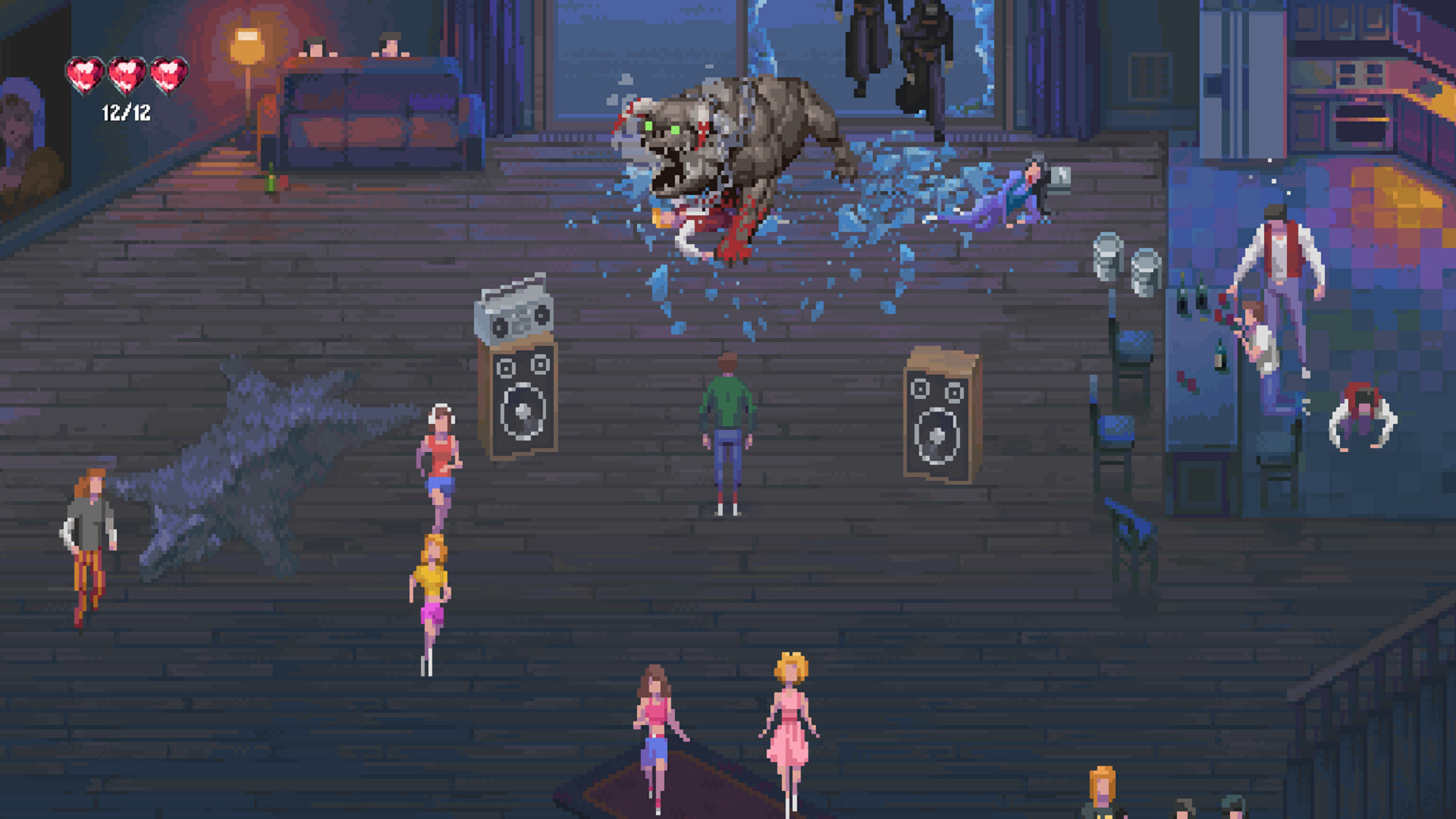
It’s nice when a more memorable enemy encounter occurs, like this bloodthirsty hellhound crashing (and devouring) a house party.
Regardless of which combat style one chooses, the game has a hard time sustaining interesting combat encounters over its fifteen-or-so hours. There is little required in terms of strategy or skill, and enemy attack patterns prioritize brute damage-dealing over elegant dodging, with foes that don’t fit a fleet-footed gameplay style very well. Bosses, too, feel more like wars of attrition, as there is often no surefire way to read attack tells or step out of the way of incoming danger. Instead, players must burn through the myriad healing items they’ve collected during the quest. It’s worth noting that the game seems to be a better fit for its built-in controller support than keyboard, as scrolling through items mid-battle is too hectic and the chance of wasting a valuable item too great since item, movement, and combat keys are placed right next to each other on the keyboard. Extended gaming sessions also led to some mild hand-cramp discomfort during the review playthrough.
Seeking out the four demon generals who have taken residence in Miami should, on paper at least, be a rather intriguing task. A mysterious old man who has appeared to give John counsel and set him on his quest is able to provide him with a vague hint for each one, pointing John to specific parts of Miami to conduct his search. But beyond that, the game’s sign-posting feels a bit vague, and though the town map is marked with points of interest and quest locations, it is a bit clunky to interpret. Players may immediately have an idea of where the next boss may be holed up, but it’s another thing entirely to actually find where in Miami it is. Other times, the location of the demon lair is easy enough to suss out, but the map is so large that it can take quite a while to get there and force a confrontation. Running into impossibly strong enemies can steer one in the right direction, but it is entirely possible to go too far off the intended path and spend large chunks of time grinding without any appreciable narrative progress being made. In the plus column, plenty of available sidequests provide at least some momentum even when one is otherwise lost. A fast-travel system does become available before too long, though it’s limited to previously visited locations and only connects predetermined spots, with plenty of footwork still required to reach one’s destination.

Having the ferryman of Styx as your personal chauffeur is a neat way to implement a fast-travel system.
The game is presented in a top-down isometric view and delves into a pixel-art style that somewhat straddles the line between a low-poly look and something a step above that. The trouble is that it doesn’t often do much with its pixel art. Town traversal and combat environments look to be somewhat pedestrian, uncluttered but without much to catch the eye. Sewers, streets, homes — they all look unremarkable from start to finish. Narrative and other one-off locations, like Stinky’s bar, John’s bedroom, or the treehouse used by a group of local kids who’ve formed an adventuring guild amid all the chaos surrounding them, feature more detailed, bespoke designs. The music is similarly serviceable, consisting of moody and atmospheric synthesizer tracks that don’t get in the way, with the occasional more memorable track punching up the game’s score. There are recognizable elements that rise up from time to time, like a song that conjured up reminiscences of old-school Final Fantasy or perhaps inspired by the many Tim Burton/Danny Elfman collaborations. One song, in particular, evoked heavy vibes of ’80s film classic The Neverending Story. Sometimes creepy, sometimes funky, it’s a decent enough accompaniment for John’s quest to save Miami.
Kingdom of Night showcases a lot of passion, with many creative ideas at work. The combat system, in particular, has a good amount of flexibility to provide entry for players of differing tastes. It puts its best foot forward when it tells its story, with interesting vignettes breaking up the action to deliver its narrative. There are even entire sections of the game that feature unique, self-contained stories within them, such as when John tracks down one of the demon generals in the local shopping mall, only to find a group of survivors trapped within, unwittingly forced into a devious game of deceit and survival. But the game isn’t an all-out slam dunk either, with a heavy emphasis on grinding through oversized maps stuffed with armies of mobs, while contending with some wonky sign-posting and more than a handful of repetitive visuals. But with a low bar of entry provided by an approachable difficulty, those who don’t mind a bit of a grindfest will still find a good old-fashioned end-of-the-world, demonic invasion story worth experiencing here.
Disclosure: This review is based on a free copy of the game provided by the publisher.


Ambitious story adds a good bit of interest to the proceedings
Combat system allows tailoring to varying complexities
Occasional visual and aural standouts punch up presentation values a bit
Low enemy variety and overwhelming numbers translate to grinding galore
Nebulous sign-posting, despite a map and fast-travel system






Recent Comments