Village in the Shade Review
Shining a Torch
The team behind Nippon Ichi Software’s Yomawari series has turned its hand to an interesting take on the ever burgeoning farming sim genre with Village in the Shade. Offering a fascinating blend of coziness and horror, the game combines pleasantly deep farming sim gameplay with some great supernatural atmospheric spookiness to form a fantastic cohesive experience. It’s a ready recommendation to all those who have an even just a passing interesting in either genre, and maybe even wider.
Players control a customisable young child, who awakens in the small Japanese mountain village of Kagatsu. Although evidently cozy, they quickly learn that all is not as it initially seems, and there is a list of strict rules the villagers are required to follow, the first of which is not to go outside at night, which are designed to protect them from numerous supernatural threats that appear to afflict the area alongside regular sacrifices. These rules — chiefly one about not interacting with strangers — see the player treated coldly at first, but this changes when they persuade the village head to allow them to be part of the village and to contribute to it by running the initially dilapidated farm on its outskirts.
Village in the Shade does a superb job of combining farming sim coziness with Japanese supernatural horror and folklore, and the development team has crafted an ideal setting for it. Kagatsu is equally cozy and spooky depending on the time, providing a great dichotomy where one part is never too far away; while incredibly charming and peaceful during the day, it is frequently hostile at night as supernatural dangers lurk around most corners. Secrets are an important theme, and the game does a great examination of how trying to keep a secret can easily cause opposite outcomes to what was intended.

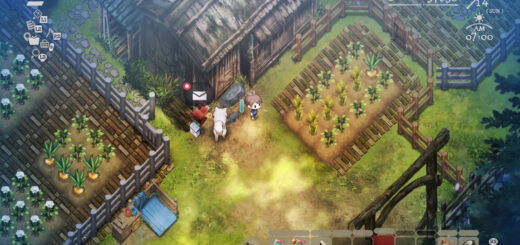
In order to become part of the village, players are tasked with running its old farm.
The village’s eight rules are a major driving part of the game’s story, which can be divided into eight chapters, each relating to a particular rule that gets broken in one manner or another by the player and the villagers. All of it revolves around the Kagatsu’s supernatural connections and the secrets it has held across many generations, and Village in the Shade is excellent at slowly doling out new reveals and hints to keep the story ticking along, with a few crucial points along the way that help turn things on their head. There isn’t any romance, but the game simply doesn’t need it, and there is still plenty of platonic and familial love that emerges in the story as the characters’ pasts are fully revealed and their bonds strengthen as a result. It makes for an excellent story, aided by a strong cast, great writing, and a superbly realised overall atmosphere. Each of the characters plays an important role, and uncovering all of its secrets while helping them overcome past traumas and other pressures makes for an incredibly satisfying time.
It certainly helps that Village in the Shade both looks and sounds beautiful. The locations are fabulous to behold, with its brilliant art style aided by tons of little touches in lighting and effects that really bring Kagatsu to life, with all of the seasonal changes bringing further delightful alterations and adding small but crucial extra flavours to the surroundings. The style works great with the chibi-esque character sprites brought over from the Yomawari games and the more detailed character art. All of the character designs are distinct and memorable, and the various folklore sprite designs are likewise readily identifiable, with plenty of character to them. Though there is some blood, the horror very much skews towards spooky rather than gruesome.
While the game doesn’t include any voice acting, the music does more than enough to evoke the appropriate atmosphere of situations. The daytime tracks are a pleasure to listen to as players go about their business for the day and never get tiring, while the music and sound effects are equally great at enhancing the spookier moments at night. The audiovisual experience is a huge part of what makes the blending of coziness and horror, and it’s a joy to take in throughout the sixty-plus hours that players are likely to spend with it.

The visuals and music are both exemplary and really help blend the sense of coziness and horror.
Village in the Shade has a very strong farming system with all of the traditional elements and the regular gameplay flow. Players will need to plant and water their crops before harvesting them. They can be sold directly or processed with various tools or apparatuses such as smokers, brewing casks, or beehives to create goods that can be sold for more money. Vegetables and flowers can be planted in soil, either tilled or furrowed, with fruits able to be grown on bushes and trees. In addition, there are multiple fishing spots, an especially useful money-making activity in the early game, as well as livestock to look after, a mining quarry, gathering opportunities, and hunting grounds. The amount of time players will need to devote to each system varies — hunting is mostly optional, but quarrying is necessary to get the tool upgrades needed to bypass a particular roadblock — but all of it comes with an appreciable level of depth, and it’s very easy to get sucked into the tried-and-tested progressive gameplay loop that the genre offers.
The more that the player grows a crop, the better the ingredients and resulting processed goods, which encourages players to focus their attention. Seeds can be purchased from the village’s two stores, alongside numerous pieces of furniture with which the player can decorate their house, and various other items and unlocks. Many of the items players can grow or otherwise obtain are also used in requests for villagers. There are a ton of little touches that really help solidify the farming gameplay, such as letting livestock use pastures or using fencing and paths to help prevent wild grass encroachment, as well as some deeper systems such as those involving cursed seeds and plants that will give completionists plenty of challenges to come back to. All of the systems fit together nicely, ensuring that even when the player is not focusing on the story, there is still plenty for them to do to fully build up their farm and home. Quarrying also has its own progression challenge, with the quarry made up of over a hundred floors and fast travel between them unlocked every ten floors.

The night offers many dangers.
Players will frequently find themselves woken up at night by knocking at their door and invited to venture around the village and its surroundings. In addition to main story events, the nighttime also includes an array of supernatural encounters in the village itself. The game also includes a small selection of boss encounters, which act as solid and appropriate climaxes to their particular story chapters. The game’s encounters are not combat in the true sense of the word; players instead need to avoid the enemy’s attacks and other dangers, potentially using tools to remove them, until they go into a clearly vulnerable state. There is a small bit of puzzle solving, but the hints in the main story encounters always make the solutions or actions needed fairly obvious. The same cannot necessarily be said for the general night events, and some are a lot more obtuse than others, but the game is largely friendly to players. Failing a story event simply allows them to retry it or return to the start of the day, while getting knocked out during any other encounter sees them wake up the next day as normal, just with less stamina and health.
There’s always some benefit to be found from venturing out at night, as these times are usually the best way to obtain magatamas, which are used at the shrine near the player’s farm to unlock new path and fence options as well as additional passive upgrades. Other character progression is tied to stamina and health, which also makes use of nighttime encounters. The limited amount of early stamina quickly runs out on farming and other activities, being restored by eating food, so early on players will want to find and follow the fox that takes them to a shrine where they can offer goods to increase their stamina. Similar to the farming sim gameplay, there are plenty of optional challenges and tasks to be found that will keep completionists satisfied for many days after the story is completed.
Village in the Shade brings to mind some thematic comparisons to Square Enix’s Harvestella. Both games have taken a strong, established base gameplay template, but used some impressive ambition to build upon it and take it in a new direction. In this case, Nippon Ichi Software has crafted an incredibly successful experience where both its cozy and horror elements help enhance the other and blend into an excellent experience thoroughly worth the time spent with it.
Disclosure: This review is based on a free copy of the game provided by the publisher.


Looks and sounds beautiful
Great blending of cozy farming sim with supernatural Japanese horror
Thoroughly engaging cast and story
A bit of unnecessary waiting between story beats
Certain night-time encounters are obtuse






Recent Comments