Stupid Never Dies Review
Stupid Fun
When I was growing up in the 2000s, pop-punk was everywhere. Avril Lavigne, Blink-182, and My Chemical Romance dominated the airwaves and infected the culture; skateboarding and associated fashion experienced a prominent surge in popularity, and shopping malls experienced their last moment of cultural prominence before going into their death throes. Stupid Never Dies cultivates that aesthetic perfectly, crossing it over with an apocalyptic plot full of monsters and wackiness, and incorporating some outrageously fun roguelike mechanics for good measure. Rocking it out with eccentric presentation, the gameplay is an engaging, well-paced blast, even if it could use some balance tweaks in the latter third of the game. Further boosted by its endearing cast and entertaining plot, Stupid Never Dies is a brilliant roguelike experience.
The game’s premise surrounds the aftermath of an apocalyptic war between humans and monsters. Originally, humans dominated monsters, captured them, and publicly ridiculed them, eventually torturing and executing them. This led the monsters to rebel, sparking the “Great War,” wherein the monsters, using Overtechnology (OT), exterminated nearly all of humanity and solidified their rule over the planet under their leader, KOM, King of Monsters. In the aftermath, dim-witted zombie Davy wanders into a seemingly abandoned shopping mall. In an ice cream store freezer, he finds a frozen human girl, Julia, and immediately falls in love with her. By a twist of fate, Davy gains the ability to “Style Eat” after consuming a phoenix egg, allowing him to absorb enemies’ powers by eating them. With a wacky cast around him, he sets out to revive the girl he loves and, along the way, maybe even defeat KOM.

Don’t judge. He was hungry!
What makes Stupid Never Dies’ plot so amusing is its bizarre, oddball humor, which is largely due to its tight, snappy, and charming writing. This is best represented in its diverse, varied cast of characters: Acelino, a chihuahua man – not a werewolf – who is technologically adept and fancies himself as a ladies’ man; Bessie, a tough, no-nonsense zombie biker who runs a burger joint; Goyle, a gargoyle in a shopping cart whose analytical support brilliance is often plagued by forgetfulness; and Dr. Frank Steiner, a genius cyborg human whose intelligence and eccentricity push Davy forward. As a combined team, they have a hilarious dynamic and plenty of memorable lines and comical moments.
While well-written humor keeps Stupid Never Dies hilarious, its deeper lore and plot are no slouches either, and the game keeps its ridiculous plot surprisingly coherent even in its more serious, dramatic moments. While it’s played for laughs, Davy’s love for Julia is handled with unexpected nuance and maturity in certain moments. Further, the war itself, Davy’s refusal to participate, and the other characters’ involvement are fascinating and believable. It’s not perfect by any means; there are a few hiccups in the pacing or delivery of the writing, and it sometimes feels like the game offers substance about a character but then doesn’t fully deliver their story to a satisfying conclusion. Nevertheless, the story sticks out as an overall positive, and a wacky pleasure to the end.
On his journey to defeat KOM, Davy enters a roguelike dungeon through a toilet, flushing himself into the abyss to fight monsters. Dungeons are separated into layers, each home to dangerous enemies that grow increasingly strong the deeper Davy goes. Layers are further divided into one or more floors, separated by a Landing Area where players can rest and prepare for the next floors. Players are on a timer, and when it runs out, their health quickly depletes, adding tension and urgency to each dive. Defeating monsters increases Davy’s Growth Rate, boosting his experience gain even if he collapses mid-dive and letting him level up faster each run.
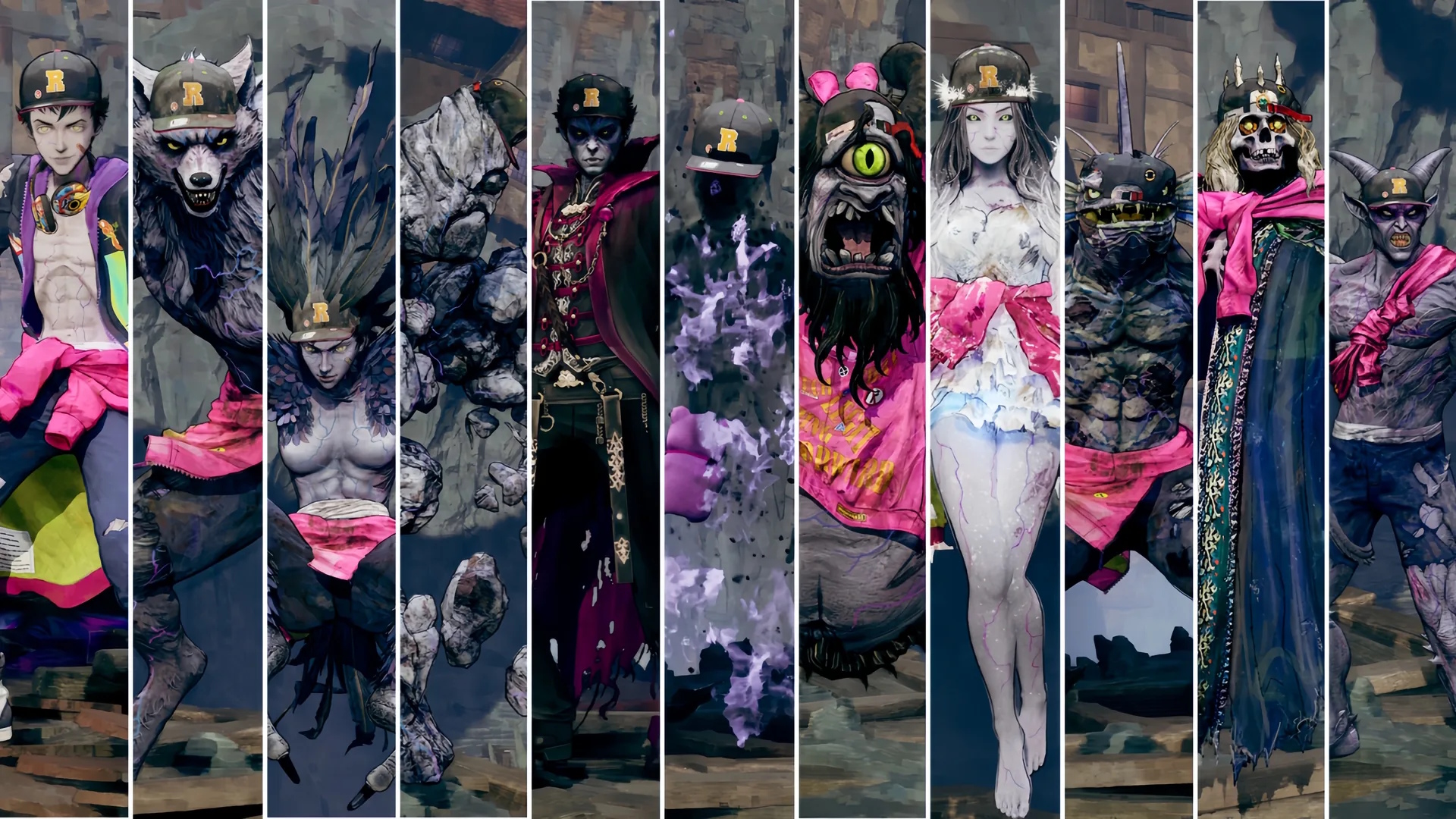
Davy can adopt eleven Styles: Zombie, Werewolf, Harpy, Golem, Vampire, Will-O’-The-Wisp, Cyclops, Snow Fairy, Merman, Lich, and Demon.
Combat centers on Style Eat, which lets Davy use Bite to eat enemies’ cores and transform into them. Enemies are separated into Weak Enemies, Elite Enemies, and bosses. Biting Weak Enemies can grant one-time-use Instant Skills, while Elite Enemies occasionally drop their cores, letting Davy transform into a different Style with unique abilities, including Style Skills and other Style-specific tangibles. Styles only last for a maximum of three floors. With each level-up, Davy can choose from various Level-Up receipts that grant a wide range of abilities, including stat boosts and Zombie Style skills.
Together, the combat is a straight-up delight, largely thanks to the different Styles and the approaches players can adopt. A floor limit on how long a player can use a Style means players must carefully consider which new ones to adopt or keep, and it forces them to contend with all eleven. Luckily, all the Styles are fluid and exciting to use and, for the most part, remarkably well-balanced. Further, the exponential increase in experience gain across runs, even failed ones, keeps the game’s pacing fast and furious and prevents it from becoming a repetitive slog, doing wonders for keeping the experience engaging throughout. Combat offers an adequate level of challenge, and the randomization feels deftly incorporated, with just the right balance of luck and player skill. However, in the late game, experience gains do somewhat outpace the game’s generally fair challenge, though this is a minor issue.
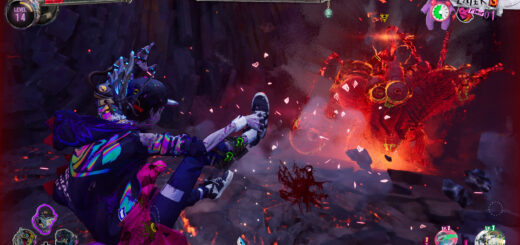
In combat, biting doesn’t just grant Davy skills; it also heals the player and does heavy damage. The game generally limits Davy to two bites at once, with the bite gauge charged through attacks or, more quickly, through Stupid Parries. Parrying allows Davy to turn permanent damage into temporary, recoverable damage, which can be gained back through a bite. This baseline mechanic is the glue that holds the entire experience together, giving players just the right amount of agency and room for error in combat without trivializing the roguelike structure. Combat has a few issues in practice, though, namely a few highly mobile bosses. Sometimes, Davy can’t keep up with these bosses on the ground, and the lack of a lock-on mechanic makes these fights frustrating exercises in keeping the camera focused on the action while desperately trying to get in range. This isn’t too much of an issue, especially since the game has helpful indicators that show when off-screen attacks are happening, but it keeps the combat from reaching its full ceiling and is worth mentioning nonetheless.
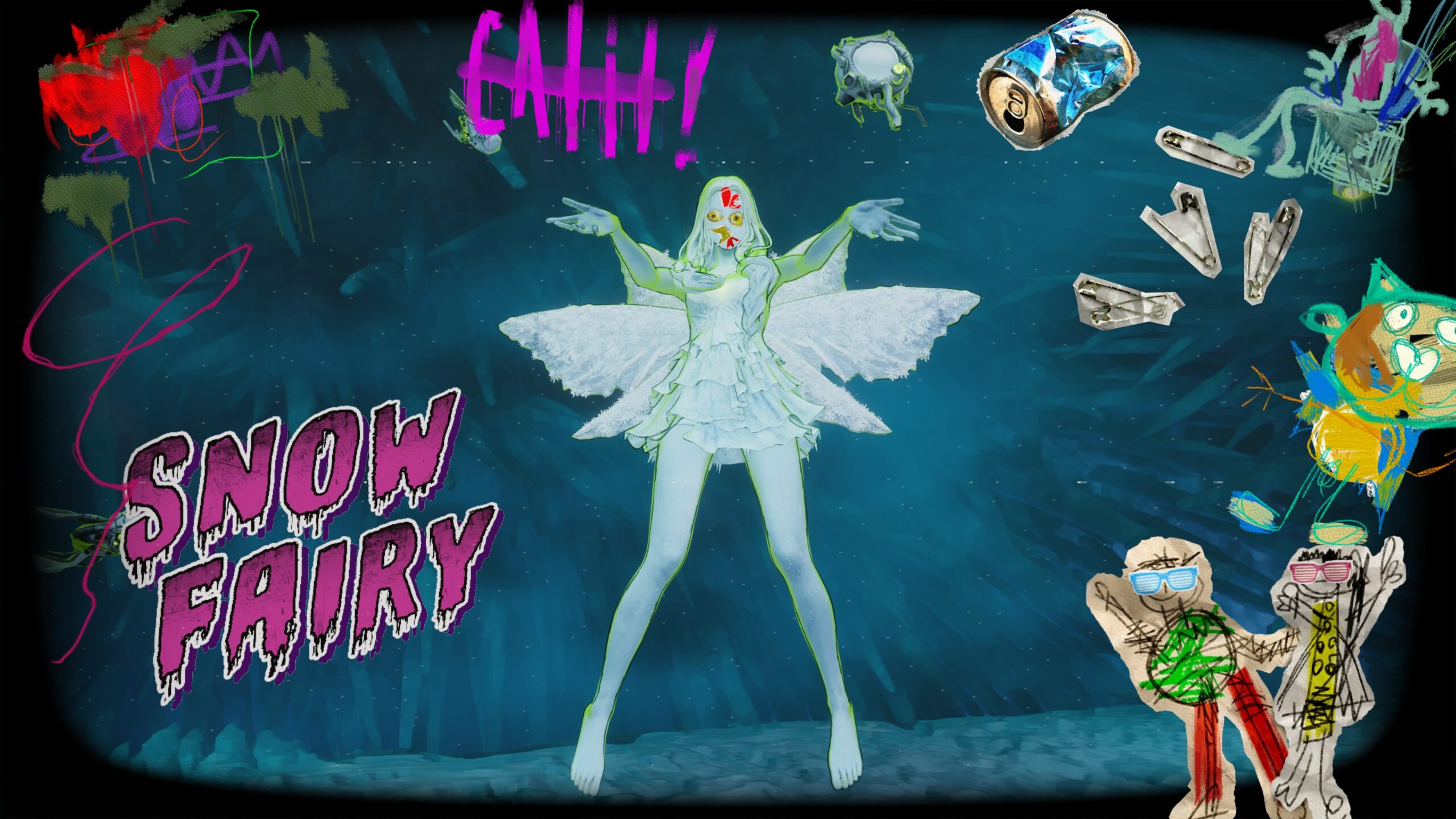
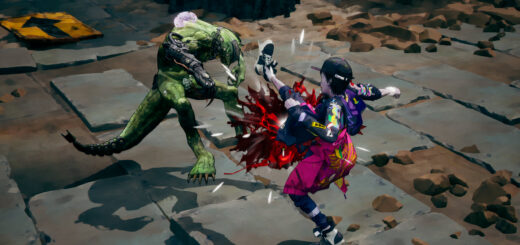
Enemies are always introduced in style.
Beyond the temporary dive-specific power increases, Stupid Never Dies offers players a handful of ways to permanently increase Davy’s power through various mall shops run by his team members. Bessie’s Burgers lets players use OT Energy, the game’s currency, to purchase new Level-Up Receipts, giving Davy access to a wider variety of skills. Acelino’s tattoo-shop-turned-tech-workstation develops OT armaments Davy can equip to his head, arms, and legs, essentially functioning like armor and weapons, whereas Mino’s Ice Cream lets Davy turn boss spoils into permanent stat increases or alter random dungeon elements. Generally, these are well incorporated and give the game satisfying interactive mechanics that aid progression, although Acelino’s Body Hack mechanic suffers from gear modification becoming available way too late in the game. This makes it harder to engage with than it should be, and it makes scrapping old gear useless for far too long.
Stupid Never Dies’ presentation is where it really stands out, both sonically and visually. The game oozes style throughout, with plenty of odd newspaper cutouts and juvenile drawings splattered in every corner, plus an abundance of color and flair, especially in the game’s characters and various level designs. Art Director Genseki Tanaka deserves heavy praise; the overall style screams pop-punk in the best way without feeling derivative, and fans of Suda51’s Lollipop Chainsaw will feel right at home. The music marvelously fleshes out the game’s identity, with nasally, angsty lyrics and loud, in-your-face guitars present throughout. Bosses, levels, and characters also get appropriately well-composed, memorable tracks: imposing organs pipe heavily in the medieval gothic level, while Acelino’s shop has groovy Spanish flamenco guitars. To round it out, the voice performances are fantastic, with Paul Castro Jr. delivering a wonderful performance as Davy and Sky Soleil acing the role of Dr. Frank Steiner.
While pop punk has certainly waned from its heyday, Stupid Never Dies refreshingly carries the torch and reminds us how fun the aesthetic is. Its well-written humor stands out, balancing well against the game’s overarching lore and more serious elements, and its breakneck progression and razzle-dazzle combat are too enjoyable to miss. Could it segue a few plotlines together better? Sure. Is it a tad too easy to juice up Davy to be a bit too powerful late in the game? Absolutely. But when it comes to fun, Stupid Never Dies simply doesn’t miss, and like Davy, it has wholly chomped at the core of my heart and won me over.
Disclosure: This review is based on a free copy of the game provided by the publisher.

Outlandish, colorful, and super appealing presentation
Fast-paced, well-balanced progression
Enjoyable, well-designed combat
Superbly balances randomness and player skill
Endearing cast of characters and funny plot
Late-game balance is a bit off
Some interactive elements feel superfluous or underutilized, especially Body Hack
A few hiccups in writing and character development




Recent Comments