Pool of Radiance: Ruins of Myth Drannor Deep Look
SNEG is doing amazing and admirable work when it comes to game preservation; unfortunately, the game preserved this time just isn’t very good.
When Pool of Radiance: Ruins of Myth Drannor first arrived in 2001, it had the monumental task of following BioWare’s masterpiece, Baldur’s Gate II: Shadows of Amn. Standing in the shadow of one of the greatest computer role-playing games (cRPGs) ever made is a tough spot for any title. However, Ruins of Myth Drannor didn’t need any help ruining its own legacy; it managed that all on its own thanks to one of the most infamous bugs in gaming history. Upon launch, if a player attempted to uninstall the unpatched game, it wouldn’t just remove the game files; it would completely wipe the user’s primary hard drive. It was the ultimate digital wipeout, handing players an instant game over before they even got past the title screen. Now, publisher SNEG, following up on its recent rerelease of The Temple of Elemental Evil, has brought Ruins of Myth Drannor back to life on modern PCs. But does this updated classic deserve a spot in players’ cRPG libraries, or should it remain buried in the ruins?
Beyond the notorious uninstaller bug of its initial release, Ruins of Myth Drannor offers a pure, tactical, turn-based dungeon crawl set in Dungeons & Dragons’ iconic Forgotten Realms. Sent by the archmage Elminster himself, the player’s party of adventurers (either premade or custom-built) descends into the ruined city of Myth Drannor to destroy a revived Pool of Radiance that is corrupting the surrounding land. That is essentially the extent of the narrative. If someone goes in expecting the rich party banter, moral complexity, or sweeping character arcs of Baldur’s Gate II, or even Neverwinter Nights, which arrived a year later, they will be severely disappointed. There is no narrative nuance here. Outside of quest givers handing out lore drops or the occasional dialogue (which is, surprisingly for the era it released in, voice-acted, even extending to ambient chatter between roaming orcs), the party’s sole purpose is to hack, slash, and spell-cast their way through hordes of monsters. Visually, the game looks good. It features beautifully hand-painted isometric backgrounds that fit right alongside Baldur’s Gate and Icewind Dale, grounding the dungeon exploration in an atmospheric, detailed environment.
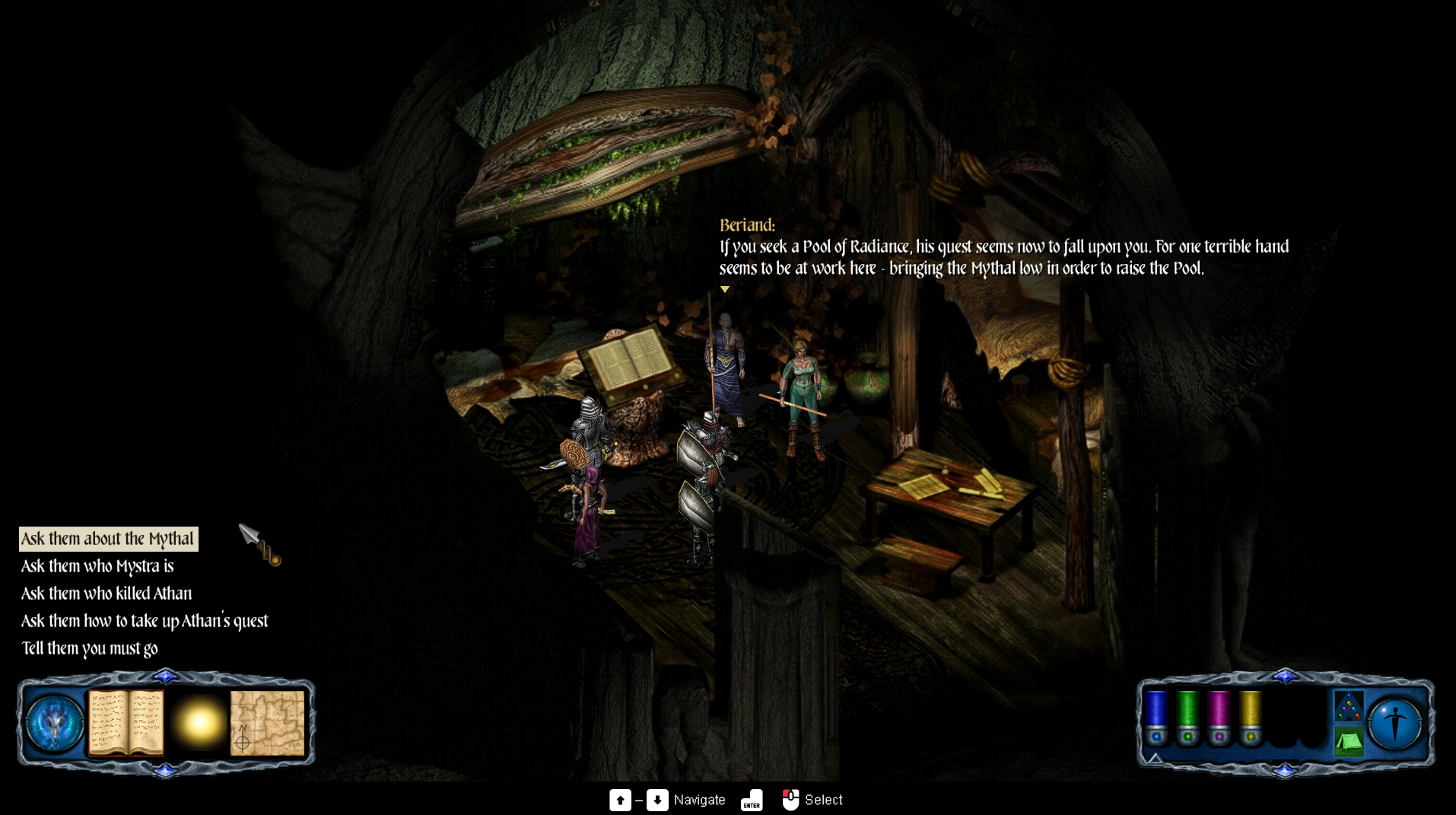
Quest givers deliver lore drops and campaign objectives through straightforward dialogue trees.
Where Ruins of Myth Drannor stumbles most as a D&D adaptation is in its execution of the 3rd Edition ruleset. The 3rd and 3.5 Editions of Dungeons & Dragons are celebrated by tabletop enthusiasts for their unparalleled depth, character customization, and mechanical freedom. Yet, Myth Drannor takes that intricate rulebook and strips away almost every choice. Presumably designed to streamline the experience and onboarding of new players without overwhelming them, the game ends up gutting the soul of the RPG experience. Building a unique character that genuinely feels the player’s own is the lifeblood of any cRPG. Here, level-up choices like selecting specific feats, skill points, or custom spell progression are taken out of players’ hands. Progression is automated and predetermined by class. While multiclassing is present, offering the lone island of character-build flexibility, the overarching sense of roleplaying is virtually nonexistent. There are no meaningful dialogue choices, no alignment shifts, and no roleplaying mechanics outside of naming custom party members at the start of the campaign. There isn’t even dual wielding, a staple feature in character customization. Ironically, the first video game to use Dungeons & Dragons’ deepest ruleset turns out to be very shallow.
Unlike BioWare’s Infinity Engine games, which utilized real-time with pause, Ruins of Myth Drannor relies on strict, turn-based combat. Because the game is almost entirely combat-focused without narrative breaks, the original release could feel painfully sluggish, and for the most part, this new release still feels like a chore to get through. The initial dungeon is massive, with terrible navigation, no interesting loot, too many enemies that spam spells like Hold Person or will drain Constitution without any possible means of fighting back, and too much required backtracking due to the inability to revive downed party members consistently trekking back to visit one specific NPC. Unless players randomly stumble upon a resurrection scroll their characters can use, they are forced to reload a previous save.
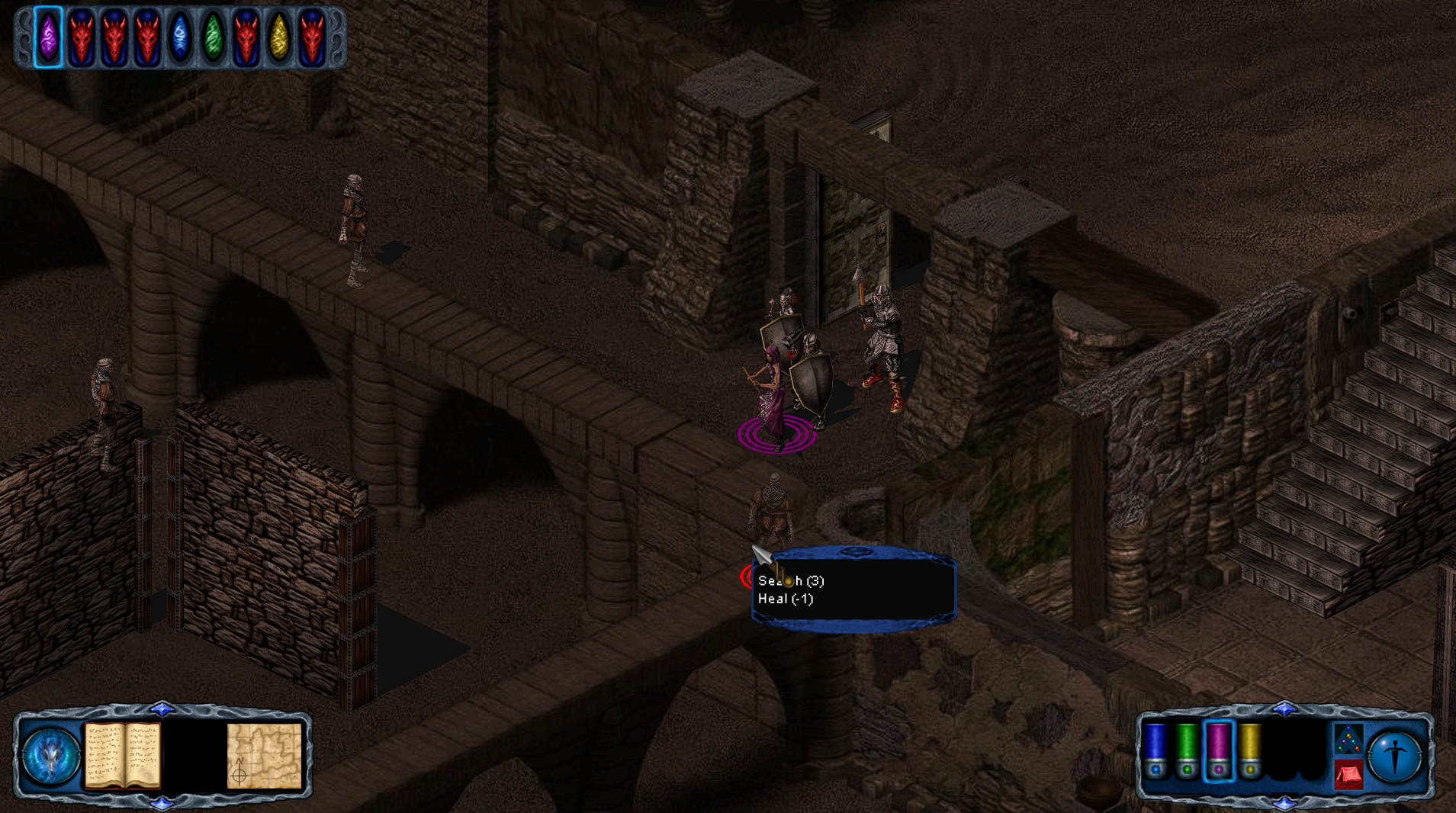
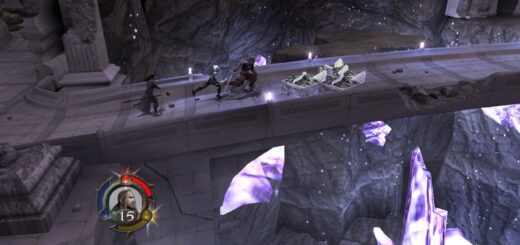
Tactical turn-based combat takes center stage as your party maneuvers through the dungeon’s claustrophobic stone corridors.
Thankfully, SNEG’s new release introduces several vital quality-of-life features that transform the pacing. First and foremost, independent speed sliders are included for both enemy turn resolution (up to 4x normal speed) and party animations/walking speed. Cranking these sliders all the way up eliminates the tedious lag of turn-based encounters and makes exploring large maps far less agonizing. Additionally, a newly added action bar makes tracking and triggering abilities significantly easier. The new version features full widescreen and 4K support, sharpening character models while letting those hand-painted background environments shine. Full controller support is also baked into the package for players who prefer to play on modern handhelds or couch setups, while purists wanting the original, untouched experience can switch on a togglable “Legacy Mode” to restore classic visuals and mechanics. Best of all, rest assured that the hard-drive wiping bug is 100% gone!
Despite these fantastic updates, one other major frustration remains: camera control and navigation. The camera remains rigid and slow. Players cannot pan fast in cardinal directions, nor can they click on a previously revealed area of the map to auto-pan the view or pathfind over long distances. Because players can’t click the map to travel, long backtracks require manual clicking just ahead of the party every few steps while constantly toggling the full map open and closed. It’s an unfortunate oversight in an otherwise stellar QoL package.
Pool of Radiance: Ruins of Myth Drannor is not a game for narrative-driven RPG fans seeking deep character arcs, complex dialogue, or intricate build crafting. However, this release is for the cRPG historians: players who have exhausted Baldur’s Gate, Icewind Dale, and Planescape: Torment, and want to experience another piece of Forgotten Realms history. It also serves as a second chance for nostalgia seekers wanting to revisit 2001 without risking their hard drives. SNEG is doing amazing and admirable work when it comes to game preservation; unfortunately, the game preserved this time just isn’t very good.
Disclosure: This article is based on a free copy of the game provided by the publisher.



Recent Comments