Crymelight Review
Uppers and Downers
“One pill makes you larger, and one pill makes you small,” sang Grace Slick of Jefferson Airplane, an American psychedelic rock band from the 1960s, in the song “White Rabbit.” Alice in Wonderland and its nonsensical imagery and themes have long inspired many expressive mediums, and just as Slick’s lyric vividly elucidates contrast, so too is Crymelight a clash of opposing elements. Using Alice in Wonderland as the backdrop for its lovely, cute aesthetic and atmosphere, Crymelight tries to balance dark, emotional storytelling with bishoujo elements, but its execution doesn’t pull off an intriguing premise. Luckily, the roguelike action gameplay and progression systems are fundamentally sound, if overly simple, and make for decent fun, even if the rest of the package finds itself tumbling through highs and lows.
At the beginning of Crymelight, a lone azure butterfly flutters around Wonderland, only to be accosted by an aggressive Card Soldier. Met by the White Rabbit, the butterfly manifests itself as a girl in a blue dress, whom the White Rabbit dubs Alice. The White Rabbit tells Alice she is a sinner who has died and that Wonderland is the afterlife. Here, using the power of her newfound weapon, a “Wonder Cryme,” Alice must fight through Wonderland as penance for her sins and, ultimately, kill the Queen of Hearts to earn her “freedom.” What freedom entails is part of the journey, as Alice suffers from amnesia about the very nature of her sin. To this end, the White Rabbit whisks Alice away to the Tea Party, where she meets a host of other cute girls, all aptly themed after Alice in Wonderland characters. In one final lecture, she explains that the girls are participants in a “killing game,” and only one girl may earn her freedom. If Alice or the other girls are defeated, they resurrect back to the Tea Party to repeat until one emerges as the victor.
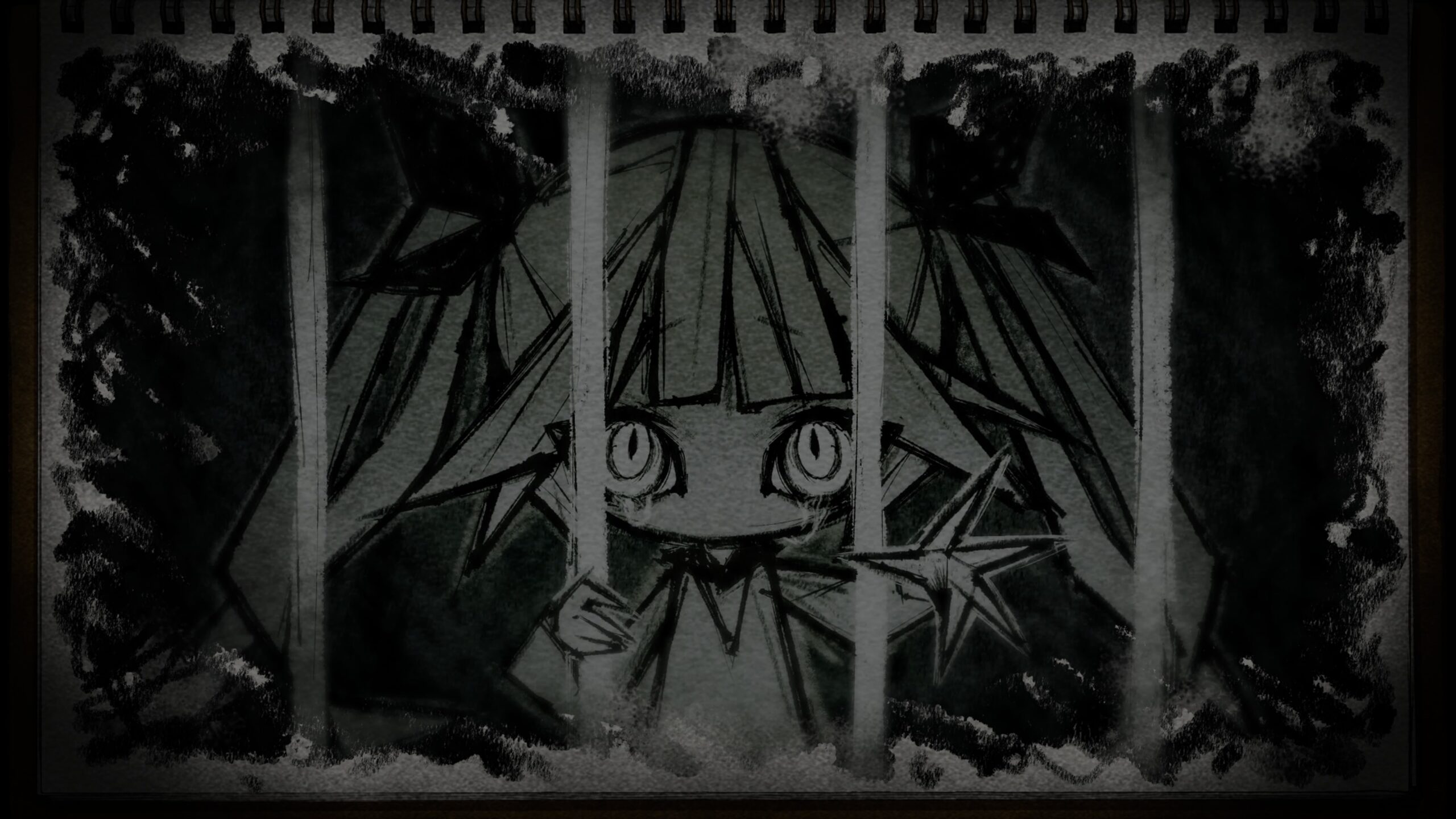
The dark vignettes are equally evocative and effective.
From the jump, Crymelight’s premise is intriguing, with heavy stakes, but it heavily suffers from poor pacing and a lack of coherence and thematic consistency. In isolation and on a surface level, each girl’s darker backstory has emotional poignancy and is effectively detailed through dark, black-and-white stylized vignettes and strong voice acting. However, the girls’ sins in Crymelight don’t really feel like especially damning faults or misdeeds. Instead, in several cases, they are exaggerated but ultimately understandable results of the deep emotional consequences and impacts of child abuse. Crymelight fails to address this with the nuance it deserves, and the plot’s overarching coherence breaks down before the end, culminating in a stunningly contrived deus ex machina that tries and horribly fails to tie everything together.
The other, brighter side of Crymelight’s plot happens mostly in the Tea Party hub, where the lighter, cuter bishoujo story elements play out. Here, the girls have tea and various sweets – macarons, cookies, and cakes galore – while ruminating on their pasts and activities they enjoyed while alive. These are mostly unremarkable and serve their purpose as adorable, lighthearted breaks from the somber breakdowns during the killing games. On their own, these episodes are inoffensive; in fact, the girls do have appealing personalities or entertaining quirks. However, their lack of substance and tonal incongruence with the game’s darker elements only make the thematic shallowness ring even hollower. It only hurts further that, narratively, the Alice in Wonderland backdrop is mostly superfluous, with thin justifications and allusions to the inspirational material, plus an equally forced explanation for Wonderland’s existence.
Nevertheless, while Crymelight struggles in the story department, its gameplay is simple but effective, even if it doesn’t incorporate all its mechanics to their full potential. Crymelight plays as a roguelike 2D action RPG with a top-down perspective. Alice controls a demonic, chained familiar – her Wonder Cryme – which can take the form of three different weapon types to attack, while also sporting a dodge with invincibility frames. Starting with an anchor, her Wonder Cryme can eventually take the form of a spear or orb-based magical attacks, all of which can use shorter-range light attacks or chargeable long-range heavy attacks. Alice’s Wonder Cryme also lets her grab and throw vulnerable enemies, and she can also use a gliding “Crymeride,” an offensive dash without invincibility frames that lets her reflect enemy projectiles or thrown enemies.
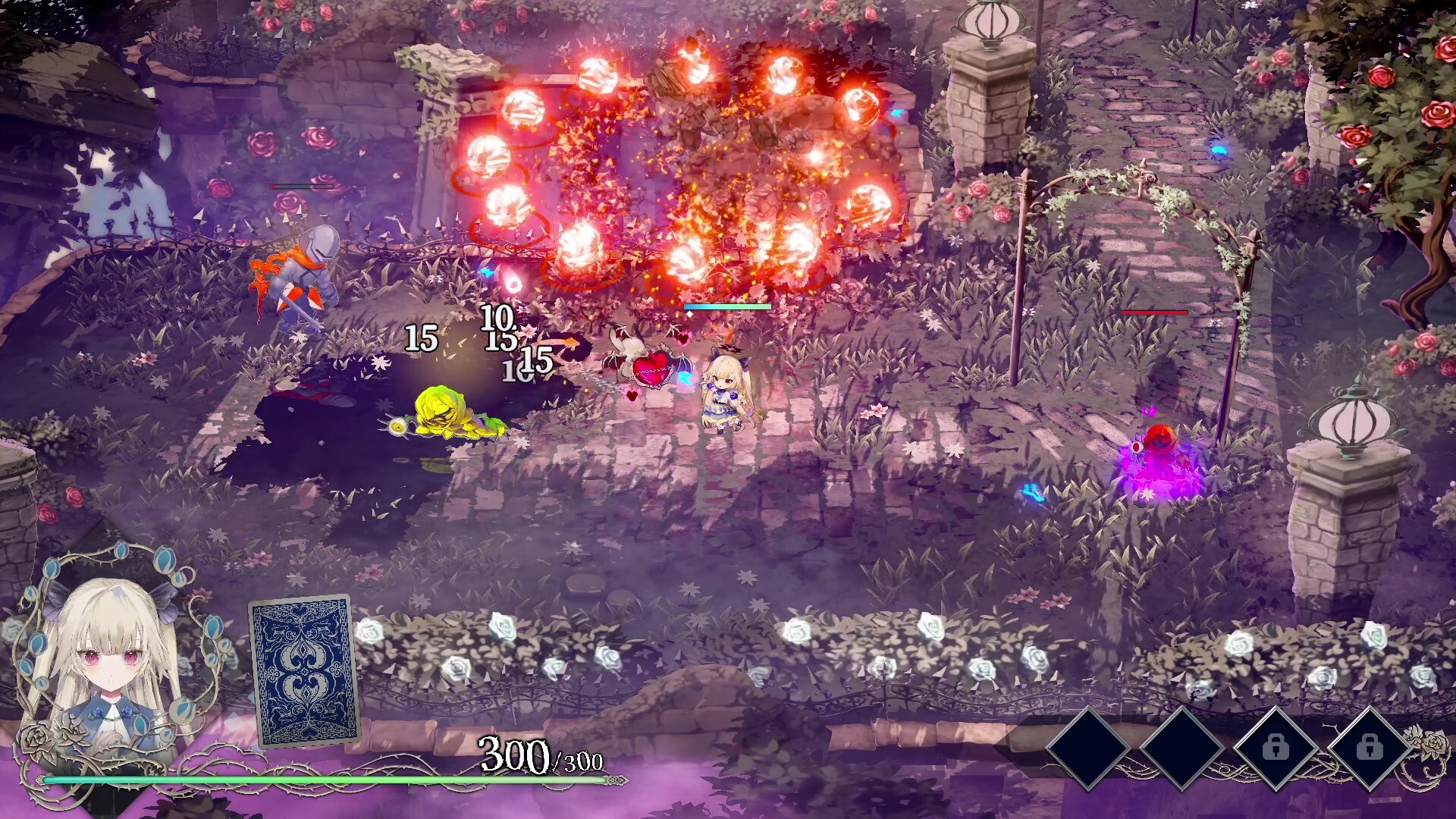
Combat quickly gets hectic.
Overall, combat movement is incredibly fluid, fast, and responsive, generally making for hectic and fun encounters. Alice’s dodge and grab, the latter especially, often make encounters turn into a chaotic and enjoyable, but ultimately manageable, frenzy. During individual sorties, Alice can equip up to four special cooldown-based Derived Skills and one ultimate ability, adding nice variety for crowd control and, in the latter case, a solid nuke button during tough, intense boss fights. That said, some mechanics fare less kindly than others given the combat’s intense speed. For example, Crymeride more often feels like a vulnerability than a net positive. Further, while the grab mechanic can “pull” some enemies, uprooting plant-based enemies or yanking shields, it leaves Alice vulnerable for too long to be of much use.
Crymelight’s roguelike elements, run structure, and upgrade systems are well-designed and effective, though they also suffer from uneven integration and occasional stunting in the progression of its reward systems. When Alice dives into Wonderland’s killing game, she faces a map of stages to clear, each with a different reward. The most common reward is Crime Cards, which confer run-specific buffs and skills. Players collect these in sets of five, forming various poker hands with multiplicative bonuses for higher-ranked hands. Different stages can offer increasing numbers of cards or specific suits, giving players a strong incentive to think carefully about the path they take through the map. Beyond Crime Cards, other stages offer Derived Skills, ultimate abilities, rest spots to restore health, or extra currency for shops where Alice can purchase run-specific perks or meta-progression items that can be used to permanently strengthen Alice at the Tea Party hub.
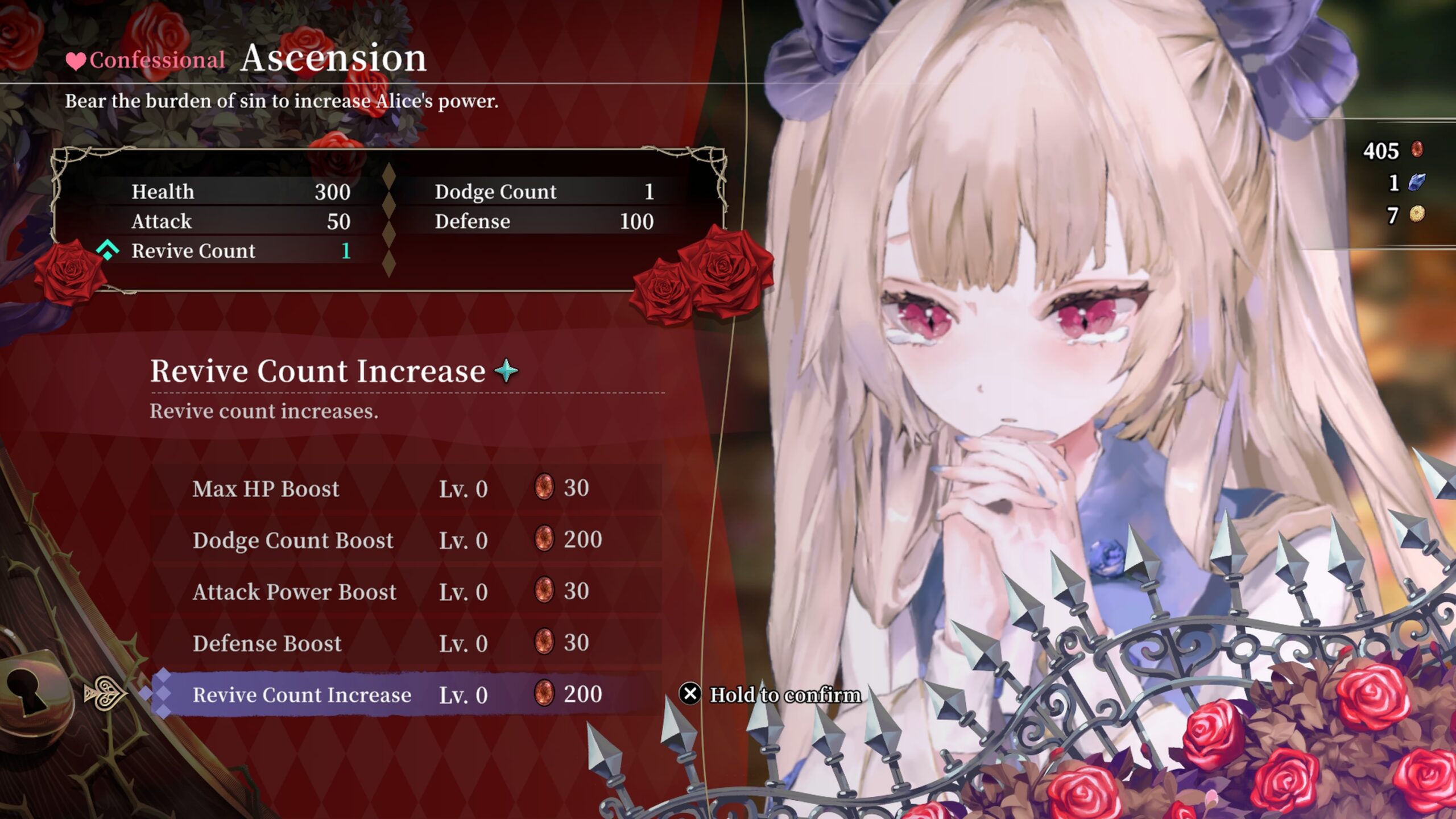
Ascension permanently buffs Alice.
While Crymelight’s run structure is rock-solid and demands interesting, cautious deliberation through its maps, the hub stations that offer permanent buffs vary in how smooth progression feels. While it generally works well, the game sometimes stalls. Defeating enemies awards Sin Points, the primary currency Alice uses to raise her stats, but the upper tiers of upgrade materials create stratified progression, which sometimes leads to an overaccumulation of Sin Points with no way to spend them until players obtain upgrade materials that are mostly obtained from bosses. If players struggle to defeat a boss, some of which are quite difficult relative to normal enemies due to the barrage of projectiles and overlapping mechanics, progression can feel stunted unless they earn them by fulfilling goals outlined in the hub’s library. Some goals are fun, but others feel like arbitrary time-sinks. Luckily, because combat is so fluid, this is uncommon.
Crymelight’s presentation is very pretty, though it lacks variety; after players’ initial foray into Wonderland, there’s not a whole lot more to see. It has an adorable, appealing storybook atmosphere with all the themes one would expect from Alice in Wonderland: cards, roses, pocket watches, mirrors, mushrooms – it’s all there. The characters are cute, creative, and well-designed. Cheshire exudes the mischief of her namesake, evoking the Disney adaptation with a pink-and-purple striped outfit. However, she also dons a cat-shaped blood bag and a host of hospital tools as her Wonder Cryme, evoking her previous life as a terminally ill child. Sadly, Crymelight suffers, quite literally, from rough edges: cutout objects in the background of cutscenes have residual white border outlines, as if improperly clipped, creating unfortunate immersion-breaking visual oddities.

Cheshire makes an astute observation.
Crymelight‘s music is a delight and its strongest element, and much kudos goes to composer Sakuzyo for amplifying the game’s emotional overtures and making the hectic battles all the more exciting. One highlight, the battle track “Miniature,” best demonstrates the game’s excellent soundtrack. It overflows with energy, featuring gorgeous strings, bouncy pianos, and airy woodwinds that jump with the vibrancy and energy one expects from Wonderland, along with quirky clock and gear sounds that evoke the game’s temporal aspect and the rewinding clock when players die and are sent back to the Tea Party. The game’s softer, intimate moments owe much of their emotional punch to the soundtrack, with impressively resonant and piercing string sections, though strong Japanese-only voice acting also lifts these scenes; Wakana Saito gives a brilliantly dramatic performance as the Queen of Hearts.
When everything comes together, Crymelight is a fun, solid, hectic top-down action RPG. The roguelike elements are incorporated well and give the game a generally good sense of progression, even if the pacing sometimes suffers from a few stunted bumps along the way. While the plot has genuinely moving moments in isolation, its heavy themes and moral questions feel too glossed over, and Crymelight’s tonally dissonant narrative is best approached with the brain fully switched off. Luckily, between the frantic, fluid combat and well-designed run structure, appealing presentation, and excellent soundtrack, plenty of bright spots remain if RPGamers choose to tumble down Crymelight’s rabbit hole.
Disclosure: This review is based on a free copy of the game provided by the publisher.


Fast, fluid combat and movement
Good run structure and roguelike elements
Cute character designs
Appealing storybook world
Excellent soundtrack
Plot themes are incoherently executed
Combat mechanics are unevenly incorporated
Progression is sometimes a little bumpy
Immersion-breaking visual oddities





Recent Comments