The Life and Suffering of Prince Jerian Review
Shatter Day
In William Shakespeare’s “King Henry IV, Part II,” one of the world’s most famous quotes was born: “Heavy is the head that wears the crown.” Being a leader often means making difficult decisions, and those decisions can often be a burden to both the ruler and his subjects. Sever Studios had players roleplay a man destined to change his lot in life in The Life and Suffering of Sir Brante; it only makes sense that the sequel would have players move from peasant to royalty. Schisma Games’ sequel, The Life and Suffering of Prince Jerian, asks RPGamers to bear the burden of a crown and make decisions that may transform the Blessed Arknian Empire for better or worse.
In the Blessed Arknian Empire, people’s lives are determined by their birth. Many seek to find ways out of a lower lot in hopes of changing their social status, though the possibility of this is next to impossible. Instead of taking on the role of a commoner, players assume the role of the royal prince of the Empire, Prince Jerian, from when he is a young lad up until his adulthood. Prince Jerian learns from an early age that he will be a great man of importance, but also must fulfill his duty to the citizens of the Empire, as someone who can bring about great change or potential turmoil.
The narrative is excellent, feeling like a game of chess. The political climate of the Blessed Arknian Empire is one where segregation between the Arknians and the humans has a large gap, and there is mistrust between both groups. As the heir to House Tempest, the ruling royal family, Prince Jerian must also participate in the Blood Tide, which allows him to connect with the souls of House Tempest’s ancestors. Since Prince Jerian starts in childhood, players will spend the first two chapters building the prince’s personality, as well as his moral compass, and whether or not Jerian will accept the various ancestors in the Blood Tide. This is apparent in the relationships he forges at a young age, and he is surrounded by many adults who all have their own agendas. While the childhood chapters are not the most interesting, they serve an important purpose in setting the tone for the possible political fires Jerian will have to put out or inflame.

Shatter all reality.
Roleplaying in The Life and Suffering of Prince Jerian is easily the best part of the game, especially in the game’s middle chapters where players will carefully plot their alliances. The decision-making in Prince Jerian is all cause-and-effect based: if Prince Jerian supports the humans, the Arknians will despise him. If the prince supports the New Believer’s religion, then the old world church and its ways will be rejected. Every decision changes Prince Jerian’s standing with different factions, individuals, and his relationship to the denizens of his kingdom. There is always someone who will be angry with one’s decision, and there is no way to balance the scales to appease all sides, but therein lies the suffering — that, like our own world, there will always be a group that thrives and one that will barely survive. Prince Jerian’s story is one of humanity — should he rule with an iron fist or find equality? There are pros and cons to both, but even then a faction will inevitably suffer.
While the narrative is solid, the challenge level feels a bit uneven. Even though players can check their rankings with the different factions and relationships, it’s surprisingly easy to get a premature ending. It’s difficult to know how to progress into the final chapter of the game. Roleplaying in Prince Jerian should feel more free-flowing than it actually is. The only way to achieve access to the last chapter is to either be fully on the side of the Arknians or humans, or give in to the Blood Tide or fight it entirely. The problem is that it undermines the authenticity of roleplaying Prince Jerian freely. Given how choices are structured, it feels almost unnatural to fully be on one side or the other. There is also the problem that some decisions feel as though they would swing one way, and instead go the opposite. Roleplaying in Sir Brante felt very freeform, whereas Prince Jerian feels a bit more limiting.
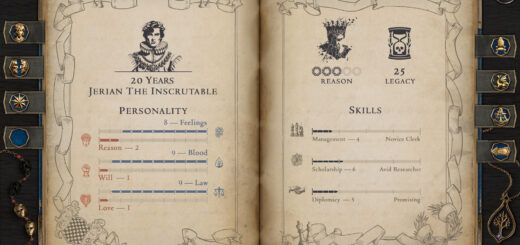
Part of its limitations may come from the fact that there is more to manage on the gameplay side. While some decisions were locked in Sir Brante, Prince Jerian offers two new gameplay elements that can assist in the player decision-making process. At the beginning of the game, Prince Jerian has five Sanity Points. These points can be used to unlock decisions that normally one wouldn’t be able to due to Jerian’s personality, but the more sanity used, the more unstable the Prince becomes. Legacy Points are the second addition, which Prince Jerian can earn based on previous decisions. Legacy Points can open blue lock decisions, which would normally be unavailable based on the prince’s relationships to specific individuals or factions. These additions can change the trajectory of Prince Jerian’s reign; though when roleplaying the game organically, some of these decisions can feel a bit out of place. That being said, Legacy and Sanity Points are a great mechanic, as players will have to manage more elements throughout each playthrough.

Heavy is the head that wears the crown.
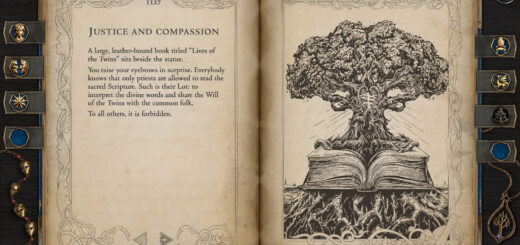
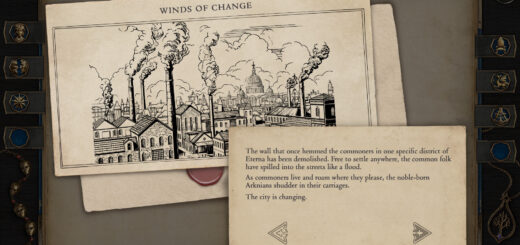
The storybook style is aesthetically pleasing to the eye, and the art style in Prince Jerian is a lot clearer and crisper compared to Sir Brante. There are a lot of little flourishes and details within the pages that add to the drama of what is occurring throughout the story. Unlike Sir Brante, whose book pages were damaged or ripped, those little extras are not present here. Similarly, the game’s art is rigid, and the book’s visuals give the impression that this is someone of high status’s writings, which feels quite purposeful given Jerian’s royal status. There are minimal animations, though the cutscenes are not quite as strong visually as the still images. The soundtrack is serviceable, still evoking dread and heaviness through piano and strings. It’s a good, not great score, and what is there complements the visuals and narrative on screen.
After four full playthroughs of The Life and Suffering of Prince Jerian, I can say with confidence that it’s a decent sequel, and taking on the role of royalty has its appeal. The story is excellent; the political intrigue does a phenomenal job of pulling the player in and reminding them that trying to appease everyone in one’s kingdom is a grave mistake. The new gameplay mechanics add a great layer to the game’s choice system, though the downside is that it removes a bit of the organic roleplaying that this series is now known for. The Life and Suffering of Prince Jerian offers a worthy challenge for fans of difficult decision-making, though those expecting the cruelty of Sir Brante may leave this sequel a little disappointed.
Disclosure: This review is based on a free copy of the game provided by the publisher.

Interesting political and world climate
Feels like playing a game of chess
New mechanics add depth to gameplay beyond choices
Not all the choices feel like they add to the overall story
Progression into the final chapter is difficult
Decisions are still depressing




Recent Comments