Taking Pride in RPGs, Part 1: Ladies Who Love Ladies, Gents Who Love Gents
It’s another year, another June, and the world needs more Pride than ever before. This month, we’re waving the flag for RPGaymer and celebrating examples of queer representation in video games. This is not meant to be a comprehensive list, but rather a sampling. There’s certainly more out there, and if anyone wishes to leave an example in the comments, that is perfectly fine.
Before we begin, let’s have an obvious content warning. I’ve always been partial to the Japanese CERO ratings logo, so perhaps something like this:

For this first update, we’re looking at the L and the G of LGBTQ+, which together make up the greater part of representation in video games, historically. That doesn’t necessarily mean there’s a lot of it, but every little bit helps.
While excellent for visual and dramatic cues, video games aren’t always the best for inner voices or subtextual elements, so there will always be instances of ‘none can say’. This is likely why so many of the examples in this update are pairs; it’s simply easier to determine or debate a character’s personal aspects when they’re put into a relationship that demonstrates them. As it is, several of our examples here are similar to the situation between Queen Ozma and Dorothy Gale in the Oz series, i.e. there is no specific and explicit evidence that they are a romantic couple, and yet there is even less evidence that they are not. In these cases, we’ll make the arguments in favor as best we can.
Richter and Aster (Tales of Symphonia: Dawn of the New World)
StrawberryEggs
Richter Abend is the primary antagonist of Tales of Symphonia: Dawn of the New World, although he’s more of an anti-villain than a straight-up bad guy. He saves Emil, the main character, from a group of bullies early in the game and gives him words of advice, including what becomes Emil’s motto, “courage is the magic that turns dreams into reality.” While Emil is impressed with Richter’s strength of character and kindness, his perception of him is soon altered for the worse when he learns why Richter is trying to look for Marta. Marta has the core of the summoned spirit Ratatosk embedded in her forehead, and Richter’s goal is to destroy it, even if it means killing Marta. Despite knowing this, Emil cares for both Marta and Richter and hopes for some way to stop Richter from hurting the girl.
Via side quests, Emil and Richter get to spend time together, and Emil learns more about the tragic backstory involving Richter’s best friend, Aster. The two were researchers and good friends, with Aster bringing Richter out of his shell through kindness and enthusiasm. And then Aster died, and it was Ratatosk’s fault. Richter’s moved heaven and earth since then to get revenge and bring Aster back to life, up to and including demonic pacts. He justifies this as being for the greater good, and not just about his personal wishes, but it is clear that this is still very personal. He may regret causing worldwide chaos and needing to straight-up murder a girl to get what he wants, yet he’ll still do it, for Aster.

Aster’s one physical appearance in the game because, y’know, he’s tragically deceased.
Richter’s relationship with Aster is left somewhat ambiguous in the game. They were friends, but were they perhaps more? Aster seems to have been Richter’s truest or even only friend, and perhaps Richter didn’t realize what Aster meant to him until after the man’s death. The lengths Richter goes to over the course of the game, however, indicate an intensity of feeling that must come from somewhere. While nothing canon has been stated about their relationship beyond friendship in the main game, one doesn’t seek to slay a primordial spirit of balance, risk planetary environmental collapse, and possibly bring about a demon apocalypse for just anyone. It feels intentional that Aster and Richter’s relationship mirrors that of the game’s official couple, Emil and Marta, and so it is impossible not to read some level of romantic subtext there.

Furthering the argument for their inclusion here, there is an official supplementary manga for Dawn of the New World that supposedly presents them as a couple. The thought has certainly crossed the mind of someone at Bandai Namco, so while the canonicity can be debated, that’s more evidence than some pairings ever get.
Albrecht Entrati and Loid (Warframe)
Kay V
Albrecht Entrati is a figure the player will have heard about long before he is first encountered in Warframe: a scientist of the old empire who first learned how to harness the mysterious Void that fuels the player’s power. As for Loid, he is only a memory forgotten. The player will have met the construct Necraloid long before they ever hear about the man he is modeled and named after. Both finally make their appearance in the main story quest “Whispers in the Walls,” which is the beginning of the current major story arc for Warframe, wherein players finally confront the mysterious entity that has haunted them for years. It goes by several names, but in “Whispers” it is referred to primarily as the Indifference, an entity of the Void that Albrecht once studied.
No one says Albrecht and Loid were in love, because there is no need. When the player first sees them Albrecht is saying goodbye to Loid; before getting into an unknown device, he cups Loid’s face in his hand, and uses his thumb to wipe away a tear, whispering something too soft to make out. During dialogue, Loid frequently refers to Albrecht as “my Albrecht.” The player finds a recording Albrecht left behind: “I need Loid to understand why I had to leave. Without him. Why I forced him to destroy the device after I had gone. And why I could never say the words he so needed to hear.”

An entire tragic romance in a single frame
This storyline is ongoing, and Albrecht and Loid have yet to reunite. Loid is actively aiding the player character, while Albrecht is still floating around somewhere, hiding or lost or both. I hope one day Albrecht will finally say the words Loid so needed to hear. After all, what’s the opposite of Indifference?
Sylvando (Dragon Quest XI)
Scar
While his sexuality is never outright stated and primarily coded through some stereotypical tropes, as the most flamboyant character the Dragon Quest series ever produced, Sylvando has swiftly risen to become a queer RPG icon.
Initially, there’s a degree of vagueness around Sylvando’s estrangement, and the reasons are left ambiguous, but the degree of euphemism very much comes across like the reactions of family members who disapprove of certain sexualities and the importance of people being accepted for who they are. Eventually, the reasons behind the estrangement are revealed, and in the end, it is up to the player to interpret Syvando’s sexuality – it’s not part of the conversation, because it’s not relevant to the conflict between father and son.

This man looks good in anything
One thing that I enjoy about Sylvando’s character is that he not at all defined by his sexuality, which is why I believe no one pries too much into that aspect of his life. He may be too over-the-top for some RPGamers, but I take it as a person that has dealt with adversity, who is trying to keep morale for those around him, up. When Sylvando is on screen, you can’t help but smile. His dialogue is some of the best I have seen in the series, and when he guffaws his signature, “DARLING!” in fights or in dire scenarios, the mood shifts to a more lighthearted one.
Sylvando additionally throws tradition to the side, and shows that you can be a knight and a hero without following the standard expectations of masculinity. A jack of all trades character, he can deal decent damage, perform heals, and also act as a support character with buffing skills. He is also capable of equipping whips, a weapon which is generally reserved for female party members. When Sylvando is reintroduced to the Luminary and has created the Soldiers of Smile Brigade, who flaunt their ruffled feathered outfits and bring joy and smiles to a world covered in darkness, it really shows what kind of character he is: extravagant, lively, sassy, theatrical, and charming, and (un)intentionally stealing the show.
Dorian Pavus (Dragon Age: Inquisition)
Severinmira
As is customary for many of BioWare’s titles, Dragon Age: Inquisition features plenty of notable romances or related character arcs, but Dorian is one who stands out. His character arc deals with a lot of the fallout of his sexuality, as it proves a hindrance to the traditional noble goal of carrying on the family line when Dorian elects to not keep up appearances and participate in an arranged marriage. His father thereafter considers the extreme measure of using blood magic as conversion therapy, which Dorian rightfully considers to be a huge betrayal of trust. This causes the rift between them which, though players can choose to start them upon a path of reconciliation during the game, is never fully resolved. Nor should such a fraught situation be taken so lightly as to be remedied through dialogue trees alone.

While Dorian comes across as stereotypically flamboyant and casual about sex, the game makes it clear that much of this is a coping mechanism. He wants to find someone to settle down with and enter into a committed relationship. However, his past as a noble means he has next to no experience with the concept of marriage for actual romance, and his insecurities prove a challenge to overcome.
Should the player choose not to romance either him or the pansexual Qunari, Iron Bull, the two will pleasingly find happiness with each other. This romance comes against the backdrop that the pair are from opposing groups who have been at war for centuries, and the duo embark in frequent masterclasses in sexual tension. Those who saw the pair hook up will be happy to find the romance going strong by the time of the Trespasser DLC.
Scarlet and Lily (The Great Villainess: Strategy of Lily)
GaijinMonogatari
The titular heroines of The Great Villainess: Strategy of Lily are the quintessential disaster lesbians. It’s hard to imagine them otherwise, given that their meet-cute involved the two of them getting wrongfully blamed for fire-bombings and a regicide, followed by Lily capturing Scarlet live on stream and forcing her to submit and flee together. Most of the time, the state of their relationship is implied as background to their two-woman takedown of the fantasy-world Empire, but in at least one of the game’s three ending paths, it’s stated outright.
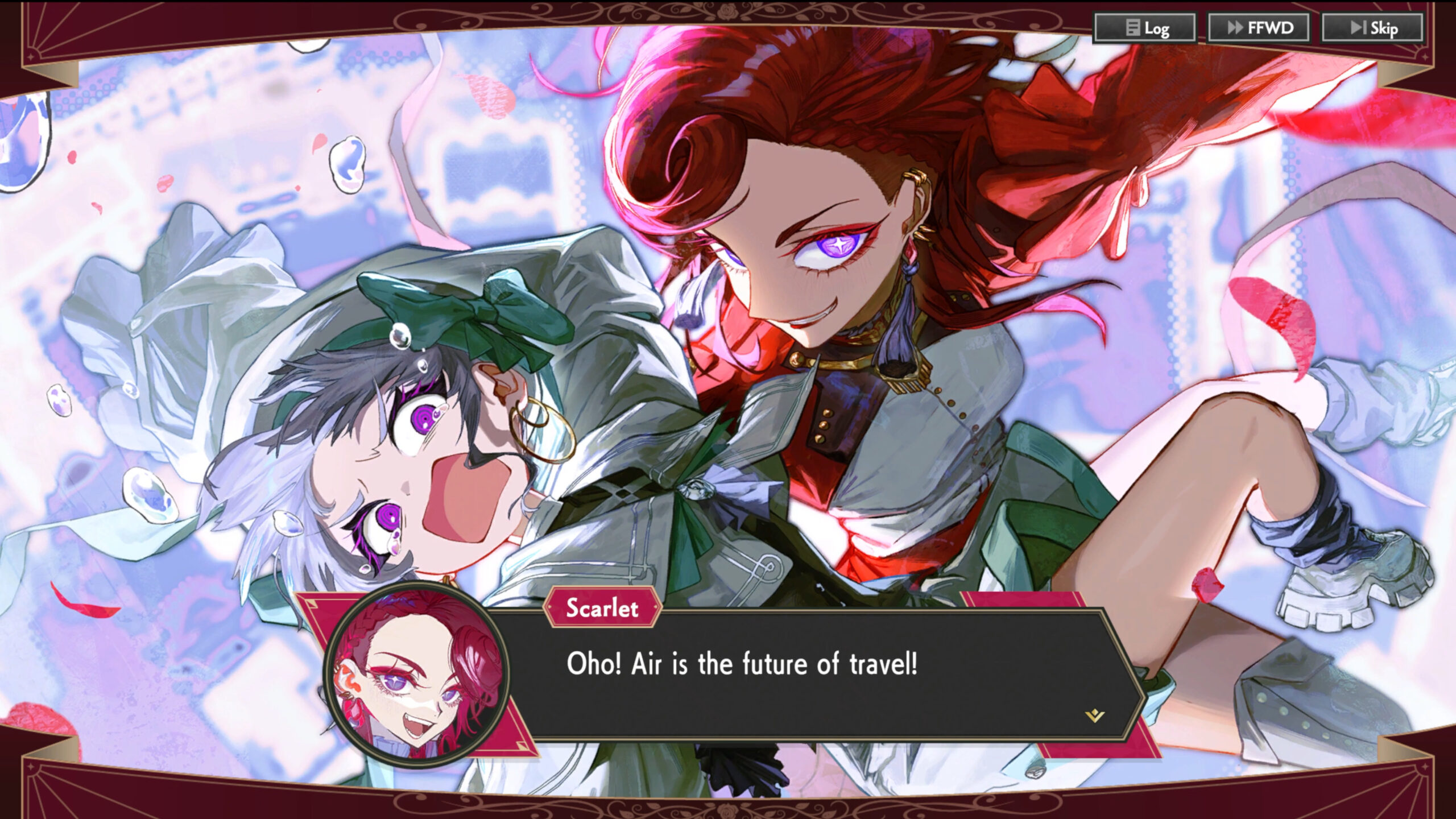
Scarlet sweeps Lily off her feet early in the story.
In the Good Ending path, at least, when the performance villain Scarlet is told that she cannot legally marry her girlfriend Lily, her immediate reaction is a call to overthrow the government and change the laws so that they can get hitched. That she is already in the midst of violent insurrection just for giggles is irrelevant; once she has a concrete goal in changing the laws concerning marriage, things get serious.
And for the rest of the continent, a lesbian disaster.
Bonnie and Formina (SaGa Emerald Beyond)
GaijinMonogatari
Of the six main characters of SaGa Emerald Beyond, two of them come as a set: the dynamic law enforcement duo of Bonnie Blair and Formina Franklin. While it is never stated that they are a couple, as the game itself does not lend itself to deep characterization and plot development, we may present the following series of evidence:
First, that Bonnie and Formina meet when they find themselves attempting to apprehend the same suspect, who is wanted by both their agencies. This is the meet-cute.
Then, the two of them engage in hot pursuit across a steamy jungle dimension, picking up some fuzzy companions along the way. That’s practically a first date.
After they return empty-handed from the hunt, they are inducted into a secret agency and find themselves moving into a shared apartment with the three combat housecats they met in the jungle world. At this point, things are feeling like the punchline to a lesbian relationship joke.

The kicker comes when Bonnie makes small-talk to cover how she’s checking for listening devices. The first thing she asks Formina is, “Do you have a boyfriend?” Tellingly, while Formina is surprised by the question, she plays along, and the answer happens to be “No.”
So, are these two a couple, beyond being a set whenever they appear in-game? There’s nothing official to say, but plenty to infer.
Ryza and Klaudia (Atelier Ryza series)
Nyx
Are Klaudia and Ryza a canon couple in the Atelier series? No. However, there is so much evidence to suggest that Gust’s writing staff wants them to be together, and I refuse to believe it is just Gust yuri-baiting its players!
All three of Ryza’s games have a focus on wanderlust and transitioning from childhood to adulthood, with Ryza constantly on the move to build her alchemy skills and help those in Kurken Island and beyond. Klaudia is a wealthy merchant’s daughter whose life is full of constant responsibility. But, what does Klaudia dream of? Both the life that Ryza has and, let’s be honest, Ryza herself.
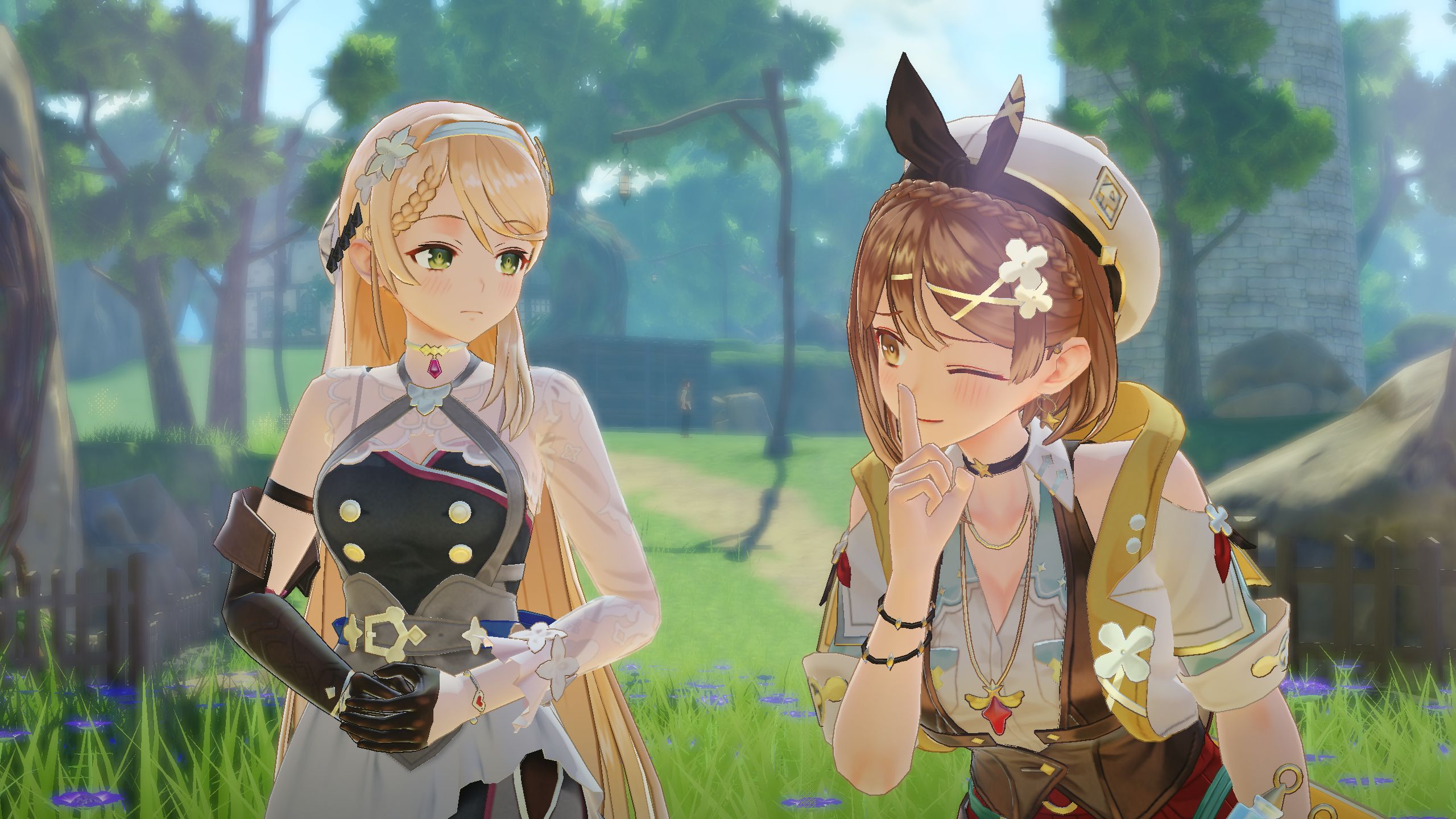
Part of the appeal of them as a couple comes from the writing across all three games. In the beginning, Klaudia holds an intense admiration for Ryza: her confidence, curiosity, and the fact that Ryza fights against a life of rigidity – something Klaudia does not have the luxury of being able to avoid. She encourages Ryza in difficult situations, and she truly believes in Ryza’s causes. However, the question is whether Ryza knows that Klaudia has feelings for her. Ryza is the typical Atelier heroine who is far too obsessed with her work to fully notice, though the last game gives some hints that perhaps she may be starting to pick up on it.
One other way the writers have chosen to tease us is how the three major male characters in Ryza’s life of adventure fall squarely within the classic tropes of otome relationship games. However, the plot goes out of its way to invalidate them as romantic options. Lent is the strong, dedicated, but not terribly bright himbo type, and when Ryza’s parents actually suggest something between them in the third game, it is immediately shot down by both Ryza and Lent as not gonna happen. Lent ends the series with a renewed focus on furthering his training and being the best warrior he can be, without romantic entanglements. Bos is a combination of the rich brat and childhood rival archetypes, and might conceivably click with Ryza in time, if he did not meet and fall in love with a certain other person in the first game, carrying that crush as a motivation in the second game, and reuniting with her in the third with the strong implication of proper courting to come after the conclusion. As for Tao, the nice-boy nerd archetype… if Ryza tried anything with him, then Patricia would cut her. Simple as.


Finally, those two make goo-goo eyes and hold hands… a lot. Obsessively so. So much hand-holding. The Ryza games saw a major improvement in body language for all character models, and there’s just so much to read in every interaction between these two, especially in the second and third games. Gust, what are you trying to imply here? That they are just “good friends”? I don’t buy it with the way in which Klaudia behaves throughout the series, and how dense Ryza is about… anything related to feelings… I ship it. I ship it so hard. I don’t see “besties,” I just see two awkward lesbeans.
And I will scream at the top of my lungs that they are a couple. Fight me!
So ends our first installment of RPGamer’s June Pride feature series. Join us next week for Part 2! And again, if you have any sterling examples you would like to share, feel free to leave a comment.




Recent Comments