Taking Pride in RPGs, Part 2: Being Who You Want to Be
For part 2 of our Pride Month feature here at RPGaymer, we’re looking at the tail end of the LGBTQ+, the T and the Q and the everything-else that comes with it. Never fear, we’ll be getting to the B eventually. There’s just a lot of material to cover. Comments and additional recommendations are, as always, appreciated. But first, an appropriate warning label.

This one is for all the queer, the out-of-place, the folks who make an active choice as to what fits them, rather than them fitting in with the vague and volatile social construct that is gender presentation. There’s a lot to cover and not nearly enough space, but we’re going to take it in a spectrum here. From simple questioning and non-conformance, to abandonment of binaries or the establishment of a whole new self, sometimes it is necessary to break the shell of your world and be free to do whatever.
So to begin, we have an example of questioning and exploration.
Princess Kenny (South Park: The Stick of Truth)
GaijinMonogatari
Bear with me on this one. Also, keep in mind that this game is the only piece of South Park media I have consumed in the past quarter-century, so I only know what is up with the character in this one thing.
Of the two main narrative threads in The Stick of Truth, the ‘fantasy’ one is a days-long LARPing session that encompasses the entire neighborhood, and every kid is taking this seriously. From Stan and Kyle as the elven rebels, to Jimmy as the bard, to Cartman as the Grand Wizard King of Kupa Keep, they hold to their characters through thick and thin. And none do this more than Princess Kenny.

The biggest thing worth mentioning here is that the other kids accept it. Even Cartman, who can always be counted on to say something crass, handwaves it in the early minutes of the game as just something Kenny wanted to try out, and treats her no better or worse than he does everybody else in the game. Even the expected off-color jokes assume that Princess Kenny is a girl, for the sake of the LARP. So she remains in character from beginning to end. In the LARP, where actions speak louder than schoolyard insults, Princess Kenny’s field actions and combat skills generally involve flirting (if not actively seducing) NPCs or enemies who get in the way. For a major attack, she summons a magical sparkly unicorn for maximum cuteness.
Yes, it is all make-believe; Kenny is not canonically transgender. But for a forever fourth-grader, being able to explore a new gender presentation without immediately getting punched down on is a big deal. To take it as far as Princess Kenny does, with a whole backstory so tragic it requires (a Trey Parker impersonation of) Morgan Freeman to narrate it, all to justify what she does as things come to a head with the somehow-real-world plot thread of tasty alien fuel-stuff turning people into Nazi zombies, this requires full commitment to the bit. And that is worth acknowledging. No matter where we end up in our choices for personal identity and presentation, we have to start somewhere, and that somewhere starts with questioning. Princess Kenny embodies this first step, and that is worthy of notice.
Now, the stuff that happens at the end, not to mention the rest of the mess that is representation in The Stick of Truth? Yeah, we’re not going there.
Something that is more common in video games, in part because it’s easier to convey with minimal investment in the plot or design, is the concept of gender non-conformity. A character in a game is free to be whatever the developers need or want, and the dissonance between appearance and reality makes for interesting narrative choices. For as long as there have been stories worthy of being called narrative in games, there have been examples of this, including such examples of Faris, lost-then-found princess of Tycoon in Final Fantasy V, who was raised as a pirate and much preferred to present as masculine in most outfits, or Flea in Chrono Trigger, who boasted that “Beauty is power, and I have the power!” and had the looks to back it up. It’s difficult to label this sort of character more effectively, because often they do identify with their assigned sex even as they present as the opposite of what anyone might expect. That is part of what makes them interesting, and what makes them potentially inspirational to those considering a move further down the road of self-awareness and personal presentation. Even if they do not go as far as one might like, they are still a stepping stone along the way.
Eluka (Dungeons & Dam)
GaijinMonogatari
Dungeons & Dam is a somewhat obscure game for the Nintendo DS, though Acquire tried hard to market it prior to its release in 2009. In it, the player follows the bookish hero Shion as he manages the town’s defense against ever-increasing hordes of monsters from the dungeons below. Assisting him are Elua and Eluka, who attend to the shrine of the Water God and its massive dam, with which Shion plans to flood the dungeon.

These two are very obviously twins, and for most of the game, the player and the entire main cast are led to believe they are twin sisters. That is only half true; Elua (on the left) is the sister while Eluka (on the right) is the brother. He never denies this fact or otherwise tries to hide it, but on the other hand, no one ever asks and it never seems to come up in conversation. This is compounded by the fact that the Japanese language rarely uses its gendered third-person pronouns in conversation. He’s simply not referred to with any form of gendered grammar, so his friends (and the player) are left to make assumptions.
In fact, Eluka’s gender reveal doesn’t come until the game’s seventh chapter (out of ten), and it takes everyone off guard. For his part, Eluka is bewildered how anyone thought he wasn’t a boy—he always uses boku, a masculine first-person pronoun in Japanese, to refer to himself. Shion has to point out that boku is also frequently used by tomboys, in classic Japanese anime trope fashion, and by all appearance and personality, Eluka fits the bill there.
This continues into the game’s epilogue segment, where the various characters have their futures outlined for the player. Eluka goes on to become a famous champion, fighting monsters across the land, and will be known by all as the Lady Knight. He obviously finds nothing wrong in the way he presents himself, and he won’t let anyone else tell him otherwise.
It’s a pity that Dungeons & Dam never left Japan. I once heard from Michael “Macstorm” Cunningham (we miss you) that the title was under consideration by a publisher, but it never saw a worldwide release. I always wondered if someone higher up was reading through the game’s plot outline, got to Chapter 7, and nixed it soon after. There’s no way to know for sure, but RPGamers outside Japan can still regret never having the chance to meet Eluka, Elua, or Shion for themselves.
Following along this spectrum of variety, we come to those who might describe themselves as either/or, and/or, neither/nor. They feel neither more masculine nor more feminine, or else represent themselves to the exact degree they feel either way. They may choose any combination of pronouns, though ‘they’ is often the safest to assume, but the important element is that they have looked at the social poles of male and female and chosen to walk away. Androgyny can be expected but never taken for granted, when things get this personal. “First above all, to thine own self be true,” and so they have made their own truth. This sort of representation has grown more common in games of recent years, possibly supplanting the gender-nonconforming archetypes in some ways.
Synthia (People of Note)
Yoru
In People of Note, Synthia is the chart-topping EDM DJ from the city of Lumina, and they are very firmly non-binary, using they/them pronouns. The other members of the band immediately accept their pronouns and gender expression from the get-go, with Synthia wearing fairly androgynous clothing. Several of their battle weapons, EDM turntables, are named with nods to Synthia’s non-binary identity, but otherwise, everybody immediately understands Synthia without question or debate. In this sense, it’s refreshing and nice to see a non-binary character included and depicted with an immediate understanding from those around them.

Hermes (Stray Gods)
Nyx
Modern retellings of mythology allow readers to see how any god can be transformed. In Summerfall Studio’s Stray Gods: The Roleplaying Musical, much liberty is taken to have the Greek Gods fit into modern life. Voiced by the amazing Erika Ishii, Hermes gets one of the more unique adaptations, as they are a nonbinary pop idol when not running errands for Athena or performing their psychopomp duties of escorting souls through portals to the underworld. Hermes explains that they were saved by the previous Hermes and were given his eidolon when he passed away. Hermes is an empathic, kind, and laid-back enby who sees Grace’s struggles throughout Stray Gods and plays a huge role in the Orpheus DLC. They are chock-full of joy and playfulness, easily making them a favorite character throughout the game’s short runtime.

Flare Varleon (Warframe)
Kay
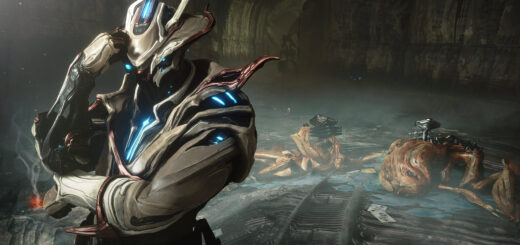
Warframe is a game that takes place in the far distant future, and also in 1999. It’s just that kind of game. That’s how the player meets Flare Varleon, nonbinary Warframe-cyborg glam rocker. The rest of their band, Temple and the Rippers, were executed by the Scaldra, the local enemy faction. To make things even more metal, their guitar, Lizzie, is a sapient mutant, and deeply possessive of Flare.
This hard-rocking duo is involved in one in-game mission, Stage Defense. Flare is in the middle of the arena, on stage and playing their music on honkin’ huge speakers. They rant into the mic about how the Scaldra killed their bandmates and suppress the people of the region, and they encourage all to rise up in rebellion. The Scaldra dislike this defiant display, so it is the player’s job to defend Flare and their performance. Stage Defense is also where players can get the component blueprints to build Flare’s Warframe counterpart, Temple. Temple is the second Warframe to be explicitly nonbinary (the first being Xaku) and their abilities reflect Flare’s spirit: They can summon pillars of flame, grant themself brief invulnerability, and time abilities to a metronome on the targeting reticle to boost the energy efficiency of their abilities.

Flare’s story is one of rage and rebellion, both against the people who murdered their bandmates, but also against forces that would suppress all forms of expression. Whether that’s society at large, which in 1999 would harshly reject a nonbinary person, or Lizzie, whose toxic attachment and symbiotic relationship to Flare threatens to crush their defiant spirit, Flare’s story—their appearance, their music, their gender—are all a piece of the whole, and they are all undeniable. Flare themself put it best: “The glare and glitter were never a mask. They were a message. Look at me, see me, because I’m not changing myself for you.”
Gin Noto (The Caligula Effect 2)
Severin
The premise of The Caligula Effect 2 is built around the virtual world of Redo, which enables those who enter it to live out new lives as high school students. This allows for a lot of playing around with identities, and as such, many personal story arcs involve characters figuring out who they truly are. One who stands out, however, is Gin Noto.
Gin’s character is notably masculine in behavior, but the clues as to his real-world origins and potential transgender status begin when his Catharsis Effect—a powered-up state that enables him to fight alongside the protagonist to try and escape the virtual world they are trapped within—displays blue roses and high-heels, which are at odds with his public persona. As the player gets to know him, he opens up more about his life in the real world, the mismatch he felt between the life he had and the life he felt, and in the end deciding that he is more of a they, having experienced both ends and seeing what did and did not fit.

The Caligula Effect 2 deserves credit for treating his gender issues like the problems of the other characters in the game with no additional fuss. It’s simply a fact of his life and as valid and worthy of the support of his allies as everyone else’s as he figures out who he truly is. While his character arc ultimately ends up walking the line between transmasculine and non-binary, Gin’s character is one of the examples of where The Caligula Effect 2 proves to be such a marked improvement over its predecessor. His gender issues could easily see him drawn fully into Redo and refuse to return to the real world, where he felt forced to suppress that aspect of himself, but his character is stronger than that and it makes him such a strong ally.
Transgender representation in media can be fraught. Whether it’s playing up stereotypes such as the aggressive trans woman hitting on teenage boys, deliberate misgendering, or other tropes often associated with gender non-conformity, finding examples of trans rep in gaming without cringing has been a challenge in the past. However, that doesn’t mean trans-positive representation doesn’t exist—and they’re more than just the solitary trait of being outside the classic gender binary. In many cases, the fact that they are trans turns out to be the least interesting aspect of their character, because trans people are really just people, and people are awesome.
Ardin (Meremanoid)
GaijinMonogatari
In a world full of mermaids, Ardin is different. No one is sure why or how, but the green-haired mermaid from the backwater reefs is a thing apart from other mermaids. This is shown in flashbacks, where other lasses make fun of her; in the present, where she is mocked for being the most flat-chested mermaid in town; and going forward, her true nature will be the key to a mystery that changes the undersea world.

Yes, Ardin is a boy, in a world where every mer is assumed female at birth and raised as such, because there is no other option to assume. For various tragic and plot-important reasons, there have been no mermen born since time immemorial, and the few individuals and institutions aware of the ancient history of merkind don’t wish anyone to know, for vague reasons. From an outside perspective, his true nature is obvious from the start and made even more so by various social interactions and game elements. Even in battle, different voice clips are used to announce status ailments for party members, and only Ardin’s is recognizably masculine. The only reason nobody realizes he’s a boy in the game is the simple fact that they do not have any concept of a gender that is not female, and so he is left to wonder what is wrong with him, that he feels so ill-fitted to the waters around him.
It’s an interesting narrative twist that could probably have been managed better, but it’s also one of the few examples of affirmative transgender representation from the early PSX era.
Vivian (Paper Mario: The Thousand Year Door)
Strawberry Eggs
Vivian is one of the Shadow Sirens/Three Shadows in Paper Mario: The Thousand Year Door who work for the main villain, Grodus. She starts off trying to stop Mario and his partners from collecting the Crystal Stars with her sisters, but Mario’s kindness convinces her to leave the other Shadows and help him in his quest. Vivian is a trans woman, which is rather surprising for a game that originally released in 2004. She has a fraught relationship with her sisters, mainly with her eldest sister Beldam, who is cruel and unwilling to acknowledge Vivian as her sister. Mario is accepting of her gender identity, as are his other partners, and they don’t mind that she used to be an enemy. It is quite heartwarming to see her find such an accepting group after being berated by her own relatives. At the end of the game, while it’s kind of glossed over, Vivian returns to her sisters, with Beldam apparently having a change of heart and promising not to be mean to her again.

Despite being clearly transgender in the original Japanese release, both the English and German localization of the GameCube version obfuscates Vivian’s gender identity, with Beldam making fun of her appearance instead. Other localizations retained her true self, with Vivian declaring in the Italian version “I’m proud to have turned into a woman!” It’s rather sad that her LGBT status was erased in some versions of the game, but not all that surprising, considering it was the mid-2000s.
For the 2024 Switch remake of Paper Mario: The Thousand Year Door, Vivian’s trans status was retained in all versions of the game, with her even stating in English “Truth is, it took me a while to realize I was their sister…not their brother.” Curiously, Beldam’s transphobia was considerably toned down, but not entirely absent. She didn’t like Vivian referring to the Three Shadows as the Shadow Sisters, and Vivian says that her sisters’ bullying became harsher after she came out. It’s awesome to see Vivian’s true self acknowledged in the game at last.

And last, we have the eggs. These are the folks who haven’t broken out completely, or haven’t begun to break out, or possibly don’t even realize there is a way out. This is tricky terrain to cover, as this is not something that is often said outright in regards to a character, and most every example one could name is going to be hypothetical and extracanonical.
That said, we have at least one good candidate.
Lebanne (Pokémon Legends Z-A)
GaijinMonogatari
Each of the major faction leaders in Legends Z-A has their second, a trusted partner character who stands by them and supports their efforts in the Royale. Usually, this is someone very close to them, such as a doting grandfather, a frazzled little sister, a loyal henchman, or a fellow veteran of past mistakes. And then there is Jacinthe and her second, Lebanne.

From the first time she appears, Lebanne is obviously stiff and uncomfortable in her impeccably tailored maid outfit. She does not want to be where she is, doing what she is, but she lost a major fight, and possibly a major bet, with the pastel purple girly-girl Jacinthe, and playing this role comes as part of her debt. Her true personality—rude, aggressive, and competitive—comes as a surprise to everyone when it makes an appearance in the narrative.
Why does Lebanne acquiesce to Jacinthe’s demands, beyond the reality that the high society diva has far too much money and not nearly enough concept of personal boundaries? Theories abound, but mostly orbit the idea that for some reason, the green-haired dragon trainer secretly likes it. In the French translation, and likely others I haven’t read, their relationship reads as a domme-sub setup, and force-femme is not out of the question. This wouldn’t even be the first example of potential transgender characters in the Kalos region, with Beauty Nova in Pokémon X/Y noting that she used to be a Black Belt.
In the end, as with most egg-related discussion, we are left without definite answers, only arguments for and against. Nintendo has not deigned to give players a straight answer about the relationship between Jacinthe and Lebanne, but it’s clear that no answer about these two could ever possibly be straight.
We hope you have enjoyed this ongoing feature and will be back soon for Part 3. Let us know what you think of the games mentioned in the comments and please join our community and tell us what you’re currently playing on Discord.



Recent Comments