Vixen 357 Review
MIDNIGHT BLUUUUUE!
Former RPGamer staff writer Mike “JuMeSyn” Moehnke always had a knack for finding the most unique retro titles to review. He was a wealth of knowledge on obscure Sega Genesis titles my little SNES brain couldn’t have imagined. Mike and I also bonded over our love of giant robots and mecha anime. When he reviewed Vixen 357, I remember being so curious about this lost tactical mecha RPG, though I gave up on the idea that it would ever be released in English. Now, in 2026, Masaya’s lost gem has been released worldwide thanks to Ratalaika Games and Shinyuden, complete with a new translation and cheats, allowing this title to be enjoyed by mecha nerds and beyond.
Vixen 357‘s story takes place in the year 2396, an age where mechas roam the battlefields. War rages on, with military organizations in an arms race to develop a superior type of machine to the original SERD mobile suits. When an unidentified militia attacks Earth’s military forces, it’s clear they are after the newly created, super experimental Vector units. Earth’s defenses are put to the test, and it’s up to Tetsuya and his special forces known as Team Slash to not only give the new Vector Units a test run, but also push back against the nefarious forces trying to steal the Vector’s unique technologies.
Players who grew up in the late 80s and early 90s will feel a lot of familiarity in both Vixen‘s story and its character archetypes. Tetsuya is the stoic hero and leader who will stop at nothing to defeat his enemies; Harry Gibson is treated like an old man at the age of thirty, while female pilots Choy and Nina are both cheerful and slightly hot-blooded. Team Slash is full of charm and energy, and is truly a likeable crew given the simplicity of the game’s story. Vixen clearly draws inspiration from popular mecha anime such as Mobile Suit Gundam in terms of narrative and world, but it actually has much more in common with Mamoru Oshii’s Patlabor, as the characters are more comedic and down-to-earth, as opposed to Gundam, where politics often take centre stage. Given the game was originally released in 1992, it absolutely shares its DNA with these mecha classics, and pays homage to the genre wonderfully. It’s also clear that the localization team had an understanding of this, as the characters are so energetic, poking fun at each other as any true team would. Although the story isn’t particularly deep and the events that occur are more camp than serious, it’s hard not to love the story beats when they are on screen.
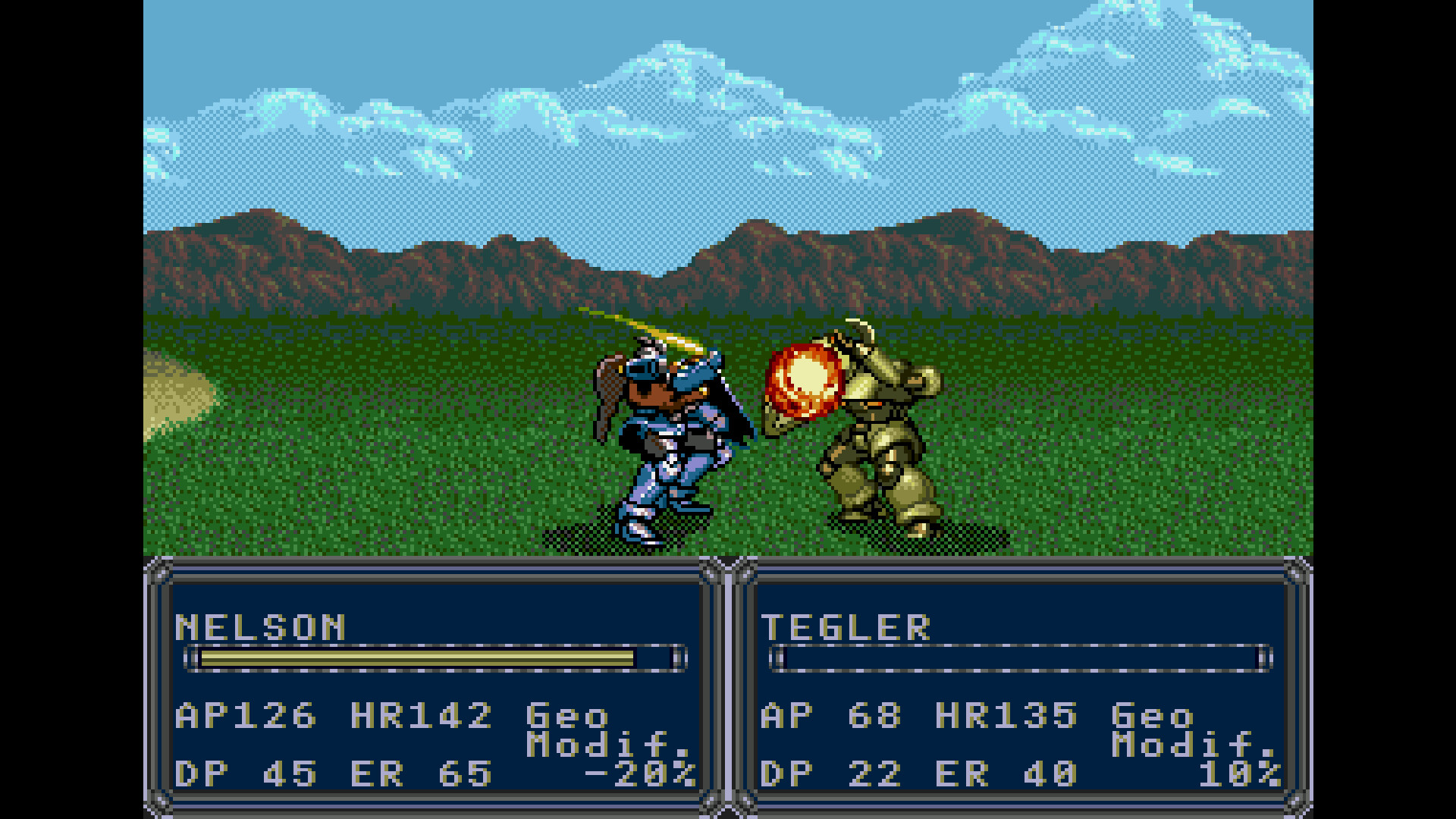
Toy robots go smashy-smash!
Combat sees players work through sixteen challenging stages in tactical mecha combat, with every stage having an enemy leader to destroy. Given that this game was made in the early 90s, a lot of the game’s win conditions are mainly to destroy all enemies or an enemy leader. There are no escort missions or holdouts to a specific turn; battles are straightforward without any deviations. Players will set up their units on the field, and they will go head-to-head with other enemy units. What is unique for its time is that Vixen 357 allows players to customize Vector units with melee and long-range weapons. Early on, the options are fairly limited, but as units level up, more options become available. Units will take turns moving across the battlefield and can use long-range weapons to attack enemies from a great distance, or get up close and personal using the fighting command. Interestingly, using both the Fire and Fight commands offers a lot more distance, as Fight doesn’t just refer to the enemy in front of the player; it can even hit numerous enemies within a targeting cluster, offering more choice on which enemy to attack. Similarly, using the Fire command offers different long-range attacks, from laser rifles to full-on missiles. These commands can be used repeatedly; weapons and ammo never run out of energy. Some mechs also come with Tech Skills, though they cost MP and can be used to repair damage, boost defenses, and perform large-scale attacks. It’s a simple but effective battle system, and it works quite well.
That being said, Vixen 357 is an incredibly hard game, and the difficulty ramps up exponentially as the game rolls on. Character deaths will prompt immediate restarts, and while the enemy AI isn’t the most intelligent, it will frequently gang up on party members, bashing them relentlessly until they are dead. While only three of the game’s cast matter at a time, this is a game that features permadeath, and the more characters lost to the player, the worse the challenge becomes in the latter half of the game. However, for those who do not wish to feel that sting, Shinyuden has added cheats to make the game much more accessible for those who want to enjoy the experience over the challenge. Cheats include giving the player access to the entire team right from the get-go, which is hilarious when a particular character defects from the enemy forces; he’s already on the team, and the player will have to fight his clone because there are two of the same character on the battlefield. Players can also knock the final boss’s health points down to a single hit point, and give Team Slash full invulnerability to attacks. Other quality-of-life improvements with this release are the ability to rewind during the battle if the player makes a mistake or wants to adjust their positioning, and a turbo mode to move through enemy turns at a much more brisk pace. Without either of these functions, having to sit through battle animation after battle animation would be a slog.
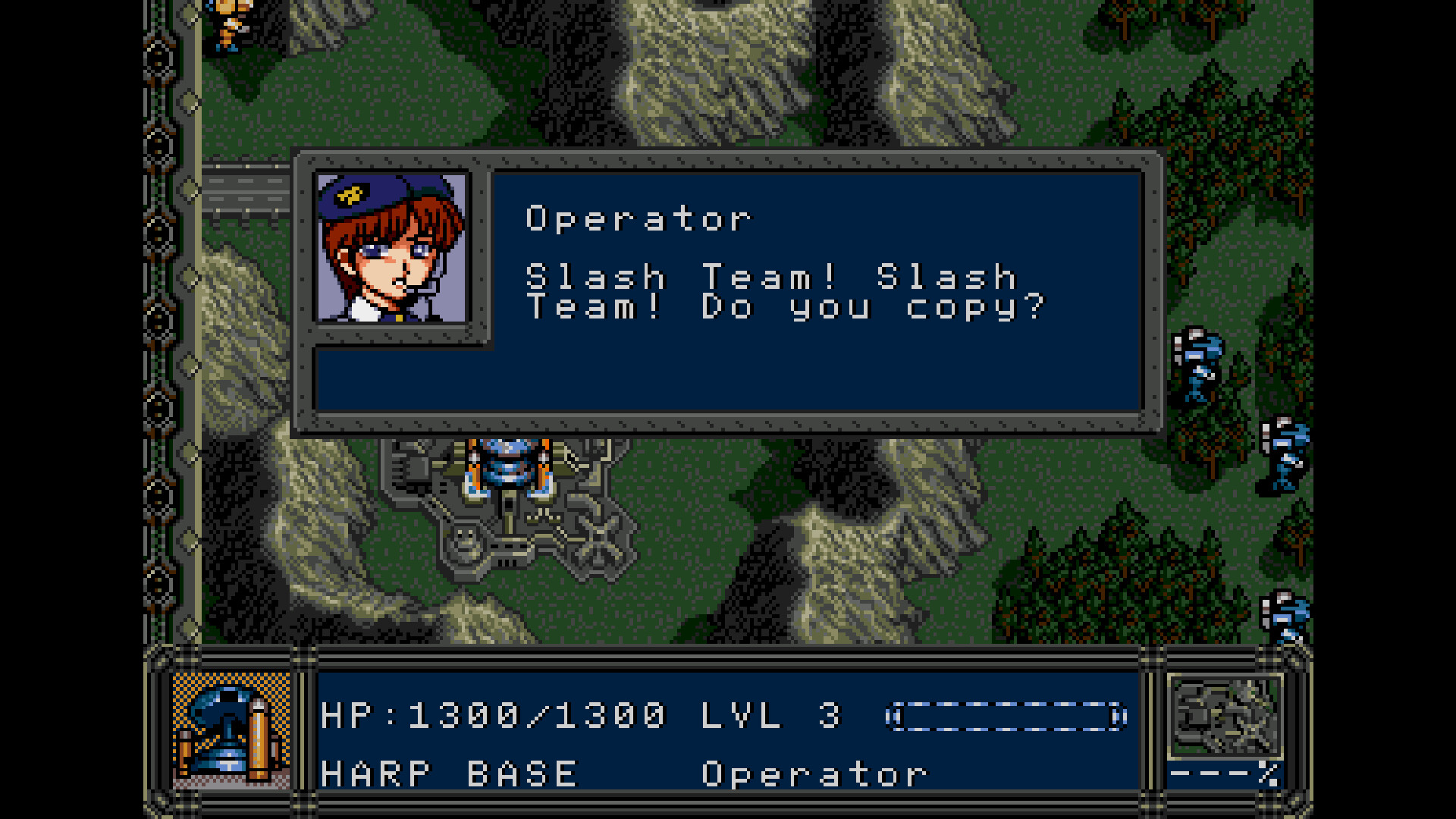
Team Slash… roll call!
An area where Vixen 357 falters is in its audiovisuals. Players will work through sixteen stages that all look nearly identical, right down to area design and colour palette. Maps are uninspired, drab, and offer the same types of physical obstacles, such as lakes, mountains, and trees, in the same flavour of blue, brown, and green. The map colours blend too much, and it can be a struggle to see where units can move to. Mechs also look like tiny dots on the maps, with each of them looking too similar to one another, meaning the player will need to click on each one to remember which ones belong to them and which are AI-friendly units. Enemy units, thankfully, are always a different colour, but the same issues apply given they have the exact same designs as the friendly units. Where the graphics vary is in the story portions, where characters have multiple facial expressions, including happy, neutral, and death. The mech animations are well detailed and designed for combat, but the changes in detail come from colour and possible weapon equipment. The soundtrack is also fairly annoying and bland, with the same few tunes repeating throughout combat. Turbo mode comes in handy here as it silences the music when in use.
Unlike Shinyuden’s previous re-release of Traysia, Vixen 357 is actually an interesting piece of both gaming and mecha history. The game doesn’t outlast its welcome and can easily be completed in under twenty hours, and possibly far less with the use of cheats. Battles are challenging, the story is campy and fun, and there’s a lot to like in this tiny package. It is a relic of its time, but also a classic example of strategy RPGs and how the genre has come a long way. While it’s no Super Robot Wars, Vixen 357 is an interesting title that is worth investigating if one has a passing interest in classic mech games and early strategy titles.
Disclosure: This review is based on a free copy of the game provided by the publisher.


Campy early 90's anime fun
Localization is great
Cheats create a more accessible challenge
Great mech and character designs
Battles are challenging
Uninspired map designs
Grating soundtrack
What happened to Vixen 1-356?




Recent Comments