Tales of Eternia Remastered Review
Everything’s Easy Breezy!
I am no stranger to the Tales series, and for those who don’t know, Eternia is a favourite of mine. I had the pleasure of playing it for the first time when I was in the UK visiting some RPGamer staff. We wandered around London, and I managed to pick up the PSP version that had only been released in Europe. It’s quite the treasure in my collection, as it reminds me of that visit and the many adventures I had. When I popped the UMD into my PSP, I found myself glued to the game, with the characters and world lighting up the screen. This game is special to me, and with the recent release of Tales of Eternia Remastered, replaying this game felt like being reunited with some old friends. While the game offers a highly enjoyable story and cast of characters, it’s still a game from 2001, meaning it can be rough around the edges for those more versed in recent Tales releases.
Tales of Eternia is set in the worlds of Celestia and Inferia, two worlds that co-exist in a space where neither knows much about the other. The story sees a young girl from Celestia named Meredy, who, in Clark Kent fashion, is sent to Inferia in a spaceship, with the task of warning the Inferians about a potential catastrophic event known as the Grand Fall. Crash-landing onto Inferia, Meredy meets the young hunter Reid and his best friend Farrah, his best friend, and the game’s events begin to unfold. Reid and Farrah decide to help Meredy on her quest by finding the divine beings called the Great Creymels in order to prevent the Grand Fall and ensure harmony between Celestia and Inferia.
While the basic story has been told many times before, what sets Tales of Eternia apart comes from the likeability of the game’s cast of characters, each brimming with personality. Reid has a strong desire to always do what is right, and his childhood relationship with Farrah and Keele is grounded in a mutual love for one another. The way in which the characters banter back-and-forth absolutely comes from a place of respect, and the three of them have zero trouble calling each other out on their flaws. Meredy gets the best development of all, embodying childlike wonder, full of curiosity and joy. The interactions between the main cast truly sell the game’s story and world, as there is an excellent balance of serious storytelling and wholesome interactions. Even the game’s overall narrative constantly stays interesting, as the hunt for the Greater Creymels has the cast interacting with some wild and wacky summons, each bursting with their own story to tell.

Efreet is such a bro.
The Tales series’s battle systems have evolved over the years, with recent entries being far more flexible, and, unfortunately, parts of Eternia‘s combat have not aged well. Unfortunately, parts of Eternia‘s battle system have not aged well. Eternia‘s combat feels more like a fighting game than other action RPGs, as Reid moves along a linear path back and forth across the field. He can dodge, parry, attack, and use skills known as Artes. Artes consume technical points (TP), which can be TP regained quickly through items or slowly when Reid lands basic attacks. Companions are controlled by AI, though players can select which Artes and spells the party members prefer, each with a quick cooldown after use. Artes and spells are learned as characters level up, and they can be hotkeyed to different face buttons and directions on the D-pad.
The positives of Eternia‘s battle system are that it moves at a brisk pace, with battle never taking too long to complete. Boss battles, for the most part, are very fair, though there are numerous difficulty spikes, particularly at the very beginning and towards the very end. Unfortunately, the only way to get ahead in battles is to drain a character’s TP, and the constant cycle, especially early on, of having to spend money for items to consistently replenish TP can be quite annoying. The party AI can also be quite dense, and often players will need to turn spells on and off depending on the fight; otherwise, party members will spam whatever spells they like willy-nilly. It’s not that Eternia‘s battle system is bad; it’s more that it feels very limiting given how expensive items are and how much TP attacks cost.
For this remaster, there’s not a lot new for those who have played Eternia before. Players can switch between remastered and original graphics, as well as change the game’s difficulty and encounter rate. There is also the option to turn on different boosts, such as changing how much experience or gald one receives from an encounter, to changing the character’s attack proficiency. There are also new additions to make the battle system more manageable, including being able to retry battles and quick recovery, and while these are nice features, they are now commonplace. The biggest improvement the remaster adds is that navigation has vastly improved. The game now features waypoints, which make it much easier to navigate between plot points and even find side quests, which were fairly difficult to find previously.

Once I bash your head in, it’ll be time for lunch!
While many of these new features are welcomed, Eternia still has some notable blemishes. First, the game’s minigames are still horrifically explained, even with the game’s revamped localization, and terrible to control; the only godsend is that players can now skip them entirely. It also doesn’t help that many of the minigames are poorly explained, even with the game’s revamped localization, and in particular the white water rafting game controls like a wobbly shopping cart. None of them are fun to play, and while it’s nice they are not mandatory anymore, all they add is unnecessary frustration instead of a fun distraction. The second blemish is the game’s puzzles, which vary in quality. While some of them are fairly simple to complete, there are a lot of them that are exercises in frustration, particularly one at the end of the game that requires the player to time a moving source of light between walls. Much like the minigames, the puzzles don’t feel well thought out or entirely enjoyable to engage in.
When Tales of Eternia was released in 2001, it had an iconic English dub that is well loved by fans of the series. In the new remaster, players can choose between English and Japanese voice-overs, with the English dub entirely a new cast. The new dub is utterly fantastic, as the actors truly showcase how well they understand the characters they are portraying. Praise must be given to Anjali Kunapaneni, who voices Meredy and absolutely nails both her curiosity and innocence, providing an incredibly wholesome portrayal. Similarly, Joe Brogie nails the awkwardness and brattiness of Keele. There is truly no bad performance, as even minor characters such as the Creymels shine.

Max is a special boy.
Furthermore, Eternia has always had a fantastic soundtrack, crafted by longtime Tales composer Motoi Sakuraba, who absolutely understands when the music needs to pump the player up for battle, just as he understands the more serene melodies of the small towns. The music does differ between Inferia and Celestia, with the latter providing a more synth-heavy focus to suggest how strange and foreign Celestia is compared to Inferia. It’s a great soundtrack with a lot of energy, doing a great job of complementing what events are happening throughout the story.
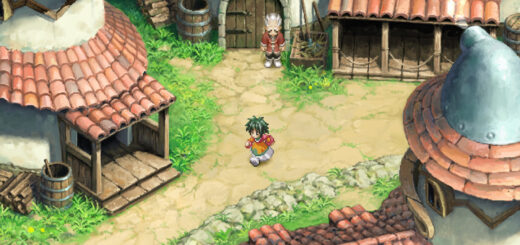
While players are given the option between the remastered graphics and the original, the remastered graphics are not anything to truly write home about. They are much brighter, though the game’s colour palette overall is a lot of brown and greens, and the original graphics were quite muted for their time. Character sprites pop on the screen, looking great, but not outstanding. Regardless of whether the player uses the original or remastered graphics, what they are getting is serviceable overall but doesn’t do enough to stand out compared to other recent remasters.
While there are shortcomings in Tales of Eternia, it remains a favourite of mine. The characters and story left me with so many happy feelings, and in the world we currently live in, a power-of-friendship story is welcome in times of sadness. The new boosts added to make the game more accessible are mostly excellent and help prevent the game from becoming a slog, which is a frequent issue in older games. While it’s not a perfect package, Tales of Eternia Remastered offers so much joy to its players as it wears its heart on its sleeve and is unabashedly itself. I loved my time back with it, despite the poor aging of the minigames and puzzles, though I am happy that I won’t have to fight Maxwell ever again.
Disclosure: This review is based on a free copy of the game provided by the publisher.


Adorable cast of characters
Strong narrative
Solid music and English Voice Acting
Frustrating puzzles
Terrible minigames
Maxwell still sucks






Recent Comments