Terrinoth: Heroes of Descent Review
Tabletop to Digital
Adapting a massive, decades-old cooperative board game into a digital tactical RPG is a tough balancing act. Based on the popular tabletop game Descent: Journeys in the Dark, Terrinoth: Heroes of Descent manages to capture the mechanical pacing of a physical session. It stands as a technically sound, faithful translation of its roots, but the final product is bogged down by a generic story, wooden voice acting, and flat characters.
The game is split into sequential campaigns, each featuring five distinct maps built to take about an hour to clear. This rigid, mission-based layout is one of the game’s best features. It creates an excellent pick-up-and-play loop that mirrors a standard standalone dungeon crawl.

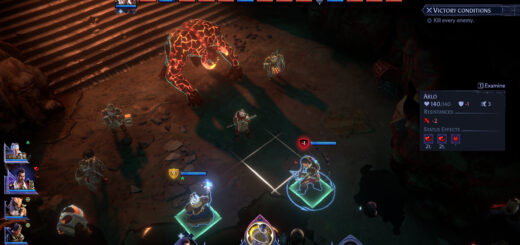
Tactical engagement shines on the turn-based grid, where players can leverage height advantages, destroy environmental hazards, and slam foes into walls for massive collateral damage.
On the grid, the tactical combat feels right at home. It uses a traditional turn-based system in which movement, basic attacks, and skills all drain an immediate pool of action points. However, clever positioning can extend one’s turn, such as a rogue securing an extra action point by landing a killing blow.
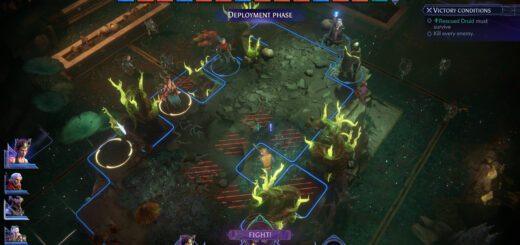
The battlefields feature verticality and physics that keep fights dynamic. Players can use specific traversal tools, like an archer’s grappling hook, to claim high ground for damage multipliers. Environmental awareness pays off: players can detonate explosive barrels or use a shield bash to slam enemies into walls and each other, causing collateral damage. Mission objectives rotate between straightforward annihilation, escorting fragile NPCs, and destroying mystical anomalies to keep the loop from getting stale. For the most part, strategy veterans will cruise through these encounters. Still, the game suffers from abrupt difficulty spikes that derail an otherwise smooth learning curve.

Between grueling dungeon runs, players return to the hub screen to recruit their four-adventurer squad, purchase skill cards, and weigh tough tactical choices with the game’s restrictive ability and gear system.
Before deploying, players pick a squad of four adventurers covering classic tank, DPS, mage, and healer roles. Story requirements often lock a specific hero into the party, forcing players out of comfortable team compositions. Progression carries across the entire campaign arc, and exploration pays off: consistently smashing breakable walls and checking side paths reveals chests filled with gold and gear.
Between missions, players use the character selection screen to buy advanced skill cards and gear. The system is deep but restrictive. Instead of a full armor layout, heroes only have two slots for active abilities and items, forcing some tough pre-mission choices. That said, the game is very forgiving of failure. If a party wipes or an escort target dies, players can reload an autosave from right before the fight, or simply head back to the hub, keeping all the gold and gear gathered during the failed attempt, to improve their party and try again. Cooldowns also reset after every individual fight, removing the usual RPG anxiety of hoarding powerful spells.

Despite over twenty years’ worth of rich franchise history to draw from, the game’s narrative moments are heavily bogged down by a paper-thin script and uninspired, monotone voice acting.
Where Heroes of Descent stumbles is the narrative. The world of Terrinoth has over twenty years’ worth of lore and every character features a long biography in the menus, but the actual script squanders it. The plot relies entirely on defeating an anonymous big bad in a localized scenario, ending in a repetitive cycle in which the heroes vow to stay together just long enough to hunt the next threat. There is zero character growth, leaving a potentially rich cast completely unmemorable.
The presentation is further hurt by the voice acting. The game is fully voiced, but the performances are flat. Line deliveries lack urgency, turning high-stakes fantasy confrontations into monotone read-throughs. Fortunately, the technical side is a different story. The game features excellent quality-of-life toggles: players can fast-forward enemy movement animations and entirely mute repetitive character combat barks. Mid-combat saving is also supported, making save-scumming easy. Performance is well-optimized; outside of a single crash triggered by detonating a massive map grid with an ultimate ability, the engine locked at target framerates on Xbox Series S and scaled down easily to low-spec PCs.
Ultimately, Terrinoth: Heroes of Descent delivers a solid mechanical skeleton, but it lacks a soul. While strategy enthusiasts and fans of the original tabletop game will find plenty to love in its deep tactical combat and rewarding gameplay loop, those looking for a compelling fantasy narrative will likely come away disappointed. It is a technically sound translation of a tabletop classic, but one that fails to breathe true life into its world.
Disclosure: This review is based on a free copy of the game provided by the publisher.

Authentic tabletop pacing
Forgiving progression loop
Rewarding exploration and physics
Smart quality-of-life toggles
Generic narrative
Unmemorable characters
Bland voice acting




Recent Comments