Veritas Tales: Witch of the Dark Castle Review
Once Upon a Time
Does anyone remember the ‘Choose Your Own Adventure’ books that were so popular in the 1980s? Tabletop gamers in Japan do, and they developed their own twist to the formula. For four decades and counting, there has been a niche in the hobby gaming market for game books, a variation on the choose-your-own formula that incorporates elements from popular Japanese tabletop RPGs such as Sword World. The reader-player must keep track of stats and items on a sheet, as well as roll dice on occasion to battle monsters or to determine which page is to be next in the adventure. While they have never been much more than a niche in the market, it is apparent they have a long hold on the hearts of developers in Japan, whether for tabletop or computer. This is how we get a game like Veritas Tales: Witch of the Dark Castle, in which a former Vanillaware developer shares his love for the genre, including making it available to a new audience in the West.
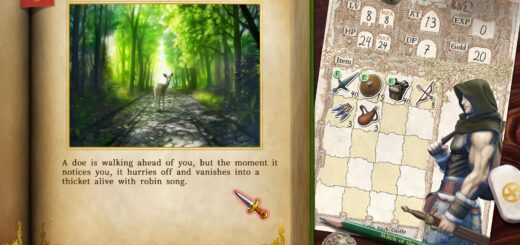
The game functions as a story within a story, as its framing device sets the reader-player in a wizard’s magical library, reading a book about the adventures of someone long ago and far away, and yet still quite immediate in the consequences of the reader’s choices. From time to time, the wizard will even raise the stakes by providing a coin to flip, playing one half of a dice-rolling chase scene, or setting a magical pocket watch to tick down the seconds and encourage swift choices of page-turning. From the start, the reader has a choice of narratives to follow: the brave warrior Havelock or the mystic novitiate Paneri. Each has their reason to travel to the city of Erishing, which has of late fallen under dire influences. Golems block the city gates and formerly living residents roam the streets beyond the walls of the last safe zone. The castle itself is in the hands of the Witch Ingeborg, whose designs are unknown but unlikely to be of any good to the rest of the world. Havelock and Paneri cross paths regularly, but the nature of the narrative choices means they are separated often as they pursue their goals.


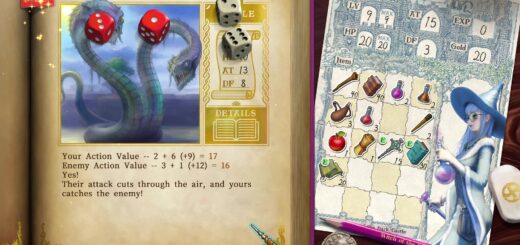
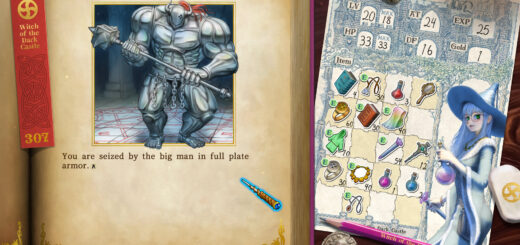
One thing that is immediately evident is that Veritas Tales has all the tropes inherent to Japanese Westernized fantasy fiction while playing nothing like any sort of JRPG one might ever have experienced. Beyond the simple act of page-turning, the action is tied to the narrative so strongly that it is easy for the reader to be snagged by the ill fortune of a poor choice. Valuable equipment may be lost to a plot point and then never recovered; this plays against the inherent use-limits of all attack and defense items and incentivizes the reader-player to use everything at their disposal without hesitation. It also encourages replays, forward thinking, and meta-planning, as there are times where not having the right item immediately on hand locks the reader out of specific choices. A click of the bookmark allows the reader to save a location, in addition to the game’s auto-save, and if the reader’s choices lead the hero or heroine to the fateful Page 14 (You Are Dead), then the option is given to turn a few pages back to where the current predicament began.
A first read-through of the game book takes around ten hours or so, depending on the vagaries of the dice rolls and how often the reader feels like going back to previous bookmarks to avoid mistakes. A second read-through with the other protagonist, however, both speeds things up and is influenced by choices and actions in the first.
As a primarily literary form of game endeavor, text localization is an essential matter. And in general, the narrative elements read fairly well. There are no obvious grammatical issues of the sort arising from a bad Japanese-to-English translation, and in general the text feels around the level one might expect of a choose-your-own adventure. On the other hand, the text has issues with punctuation. There’s emphatic quote-marking that makes more sense in Japanese, whereas in English it looks like misapplied shock quotes. There’s also a kerning issue where the starting quote mark, for whatever reason it is used, has a full space coming after. It’s a notable stain on what is otherwise perfectly readable and enjoyable text.

The most-viewed page in the game.
On the plus side, it does a good job with hyper-text, allowing the reader to quickly double-check the identities of people or places named in text. However, it isn’t used where it’s needed most, which is the explanation of the game’s combat resolution and damage calculation. This tutorial text is repeated every single time the attack choice page appears on screen (roughly ten to fifteen times per combat) and swiftly becomes grating.
The game has a nice, soothing background soundtrack, perfect for reading along with the adventure. There is voice acting, but it’s all in Japanese. The Library Wizard even acknowledges that the reader is a foreign visitor who speaks a different language, but that the magic of the library accounts for this.
Veritas Tales: Witch of the Dark Castle is an experience that needs to be read through multiple times to catch all the possibilities, nuance, and meta-knowledge to make the best of the narrative choices. Dice rolls will still make outcomes uncertain, but that’s what makes it a game. As an avid fan of the written word, it was an enjoyable experience for me, but it does require a different mindset from the usual JRPG grind.
Disclosure: This review is based on a free copy of the game provided by the publisher.

A different sort of game experience
Actual text in localization well done
Issues with punctuation in localization
Not compatible with Steam Deck



Recent Comments