Two Years Into the Eternal Calm: How the Show Goes On in Final Fantasy X-2
The adage that “beauty is in the eye of the beholder” is very apt when it comes to enjoying video game sequels. Often under intense scrutiny by players, the fine art of creating a great sequel hangs in a precarious balance of familiarity and novelty. After all, rinsing and repeating the same formula to a T creates disengagement, whereas entirely reinventing the wheel can leave players feeling disconnected.
Square Enix’s Final Fantasy X celebrates the 25th anniversary of its Japanese PlayStation 2 release this month. The iconic JRPG is critically acclaimed for being the first in the Final Fantasy series to be fully 3D and to feature full voice acting. Following its success, Final Fantasy X-2 came along in 2003 on the PlayStation 2 as a direct sequel, but with a catch — although still set in Spira, it would feature a huge tonal shift in narrative and mood, while also replacing the prominent turn-based combat system of Final Fantasy X. At first glance, it’s understandable why many fans found the differences to be jarring. However, others, including myself, have taken to the unconventional yet intriguing direction of Final Fantasy X-2, a stylish sequel with its own share of iconic moments.

Just another day in Spira!
Do You Believe In Life After Sin?
Many familiar faces return to the sequel, with varying amounts of screen time. Yuna was a playable character with a huge influence on Tidus’s story in Final Fantasy X, but this time, she steals the spotlight as the main protagonist. Joined again by her peppy cousin, Rikku, and a reserved individual named Paine, the three girls form the main party as the Gullwing sphere hunters, becoming the first Final Fantasy title to have an all-female main cast.
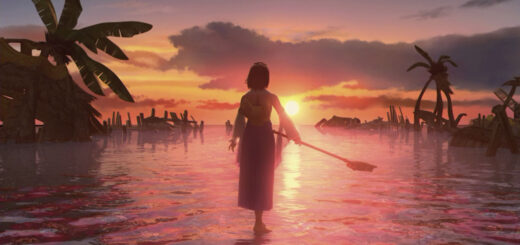
Although Yuna was already a strong and resilient character in Final Fantasy X, she continues to grow with impressive maturity in the sequel. Two years into the Eternal Calm, she is a retired summoner who strives for a new life purpose now that she is finally free to make her own decisions. Yuna keeps a cheerful demeanour while life keeps moving forward, despite being irrevocably changed by her past experiences. Instead of trying to forget the pain, though, she becomes stronger by keeping the memories alive, learning from past mistakes, and living her new life to the fullest. Yuna is extremely well-suited to being the protagonist in Final Fantasy X-2 as her choices once again change Spira’s history.
From the opening dance sequence, players immediately realise that the deep and bleak world of Final Fantasy X is gone and replaced with a light-hearted, jovial, and heavily feminine presentation. There are many interactions throughout the game where the girls giggle, cheer, dance, and have heartfelt conversations with each other. The encounters with Leblanc, the trio’s voluptuous rival, as well as Brother’s comedic crush on Yuna, also keep the tone humorous. This tonal shift seems fitting, given the premise begins with Spira being largely at peace. As the world continues to rebuild itself, however, players learn that underneath the song and dance lies a tragedy that must be confronted.

Yuna’s got a new life and you could hardly recognise her.
Old Spira, New Memories
Returning to the beloved world of Spira is a dream come true for many players. Final Fantasy X-2 removes the linearity that underpinned Final Fantasy X, reintroducing Spira as a setting that can be freely traversed. A large portion of Spira is accessible from the start of the game and remains so throughout (with some exceptions), providing opportunities for players to leisurely explore and pursue the prolific side quests. There are certain areas closed off or altered, such as the temples, but the map is largely familiar.
Divided into chapters, the world of Final Fantasy X-2 feels alive and progressive, particularly when players return to an area to find NPCs doing something new. The runtime of Final Fantasy X-2 is also initially shorter but may require multiple playthroughs for players looking to achieve a 100% completion rate. Doing so unlocks the perfect ending and is arguably worth the effort.
One feature that makes a return is mini-games, some that rival the frustration of those in Final Fantasy X. Fortunately, they remain optional, but completing them yields great rewards. For better or worse, Blitzball is now a sports management mini-game in the sequel and is largely traded for Sphere Break, a new coin-based mini-game where players must defeat the opponent in limited turns. Similar to Blitzball, players receive an introduction through the main story but can decide how much time they want to invest in the tournament, which offers exclusive prizes. Players can also play through Last Mission, a roguelike-style epilogue that takes place three months after the events of the perfect ending (available in the Final Fantasy X/X-2 HD Remaster for those outside of Japan), providing challenging gameplay and more lore.

Who runs the world? Monkeys!
Dancing Through Life
A noticeable difference between the two games is the combat systems. Where Final Fantasy X has strategic, turn-based combat, Final Fantasy X-2 features a fast-paced style based on the Active Time Battle (ATB) system. The sphere grid is absent in the sequel. Instead, the strategic character customisation comes from the dressphere, which lets a character change classes, base stats, weapons, and appearance. Like curating a capsule wardrobe, each character goes into battle with a garment grid that houses a custom selection of dresspheres, primed with special effects unique to each garment grid. Party members change outfits when switching dresspheres, embellished with a Sailor Moon-style animation sequence.
Each outfit is distinct from one another, evoking a sense of individuality. Players won’t catch the girls wearing the same outfit despite equipping the same dressphere. For instance, Yuna dons a black and blue outfit with a ruffled, sleeveless blouse that extends down to one side of her legs, ribbons, a skirt, and knee-high boots for her songstress dressphere. Rikku’s outfit is also a sleeveless top, short skirt, and knee-high boots, but features a warm orange and purple palette and is adorned with ribbons in different areas. Paine, meanwhile, rocks a bikini underneath a high-collared jacket and white pants with chains, with bold turquoise touches on her jacket and boots.
There are many dresspheres and garment grids to collect, taking a great deal of time to master, and with many combinations. Although the ATB system is not without its flaws, it is a refreshing and dynamic combat style that gels well with the female trio. If Final Fantasy X-2 inherited the turn-based combat and sphere grid systems of Final Fantasy X, character growth and development might have felt more rigid, with a temptation to stick to the traditional archetypes. The change of systems can take time to adjust to, but ultimately creates more opportunity for player expression and allows each character to complement each other’s “outfits” on the battlefield, so to speak.

Yuna after her transformation into the white mage dressphere.
It’s Showtime, Girls
The sound design is a fascinating area where the two games also differ. One of the highest praises for Final Fantasy X is the unforgettable score with many tracks composed by legendary composer Nobuo Uematsu. Noriko Matsueda and Takahito Eguchi instead act as the primary composers for Final Fantasy X-2 and give the score a lighter feel, while Jade from Sweetbox and Kumi Koda also contribute vocals for the iconic pop tracks. Despite not being as memorable as the first game, many of the tracks are still a great listen, with uplifting motifs that symbolise this hopeful era. Voice acting is still also prevalent in Final Fantasy X-2.
Final Fantasy X-2 may not have had Uematsu continue the musical legacy of its predecessor, but it deftly embeds its musical tracks into the foreground of its narrative. As a result, the in-game musical cinematics of “real Emotion” and “1000 Words” are popular, even amongst audiences who have never played a minute of Final Fantasy X-2. During combat, players may even catch Yuna singing the Gullwings’ theme song. Additionally, there are missions centred around helping a particular band and their production woes. Final Fantasy X-2 really makes the most of the soundtrack in an entertaining manner and is subsequently a huge boon for the game.

One of the best opening scenes of all time.
For those who are willing to look past any sequel bias, Final Fantasy X-2 takes the fabric of Final Fantasy X and weaves it into a sturdy blend of new and old material. It offers an expressive narrative and creative game design decisions that set it apart from its predecessor, while remaining faithfully grounded in the beloved setting of Spira and its people. While it may not be the beautiful masterpiece that is Final Fantasy X, Final Fantasy X-2 paints an appealing and credible representation of life after Sin, and is thus a very deserving sequel in my eyes.





Recent Comments