Wuchang: Fallen Feathers Review
Feathering the Storm
First revealed in 2021 at a Chinese gaming festival, Wuchang: Fallen Feathers made an even wider splash at last year’s Xbox Games Showcase, showing with a trailer and a 2025 release date. Developed by Leenzee, Wuchang comes off the heels of the widespread success of 2024’s Black Myth: Wukong, which helped burst the Chinese video game industry onto the global stage. As a Soulslike action RPG, Wuchang releases into a crowded market for this genre, but luckily, it delivers distinctly agile and challenging combat, accompanied by mostly brilliant boss encounters, excellent RPG mechanics, and a gorgeous, detailed world and presentation steeped in Chinese history, mythology, culture, and philosophy. These elements form the basis of Wuchang’s premise and plot, but sadly, its delivery is oftentimes underwhelming and, in some cases, notably worse.
Taking place at the end of the Ming dynasty in the 17th century CE, Wuchang: Fallen Feathers is set in the land of Shu in southwestern China. With the ruling dynasty’s power declining, the territories and cities of Shu find themselves in a state of ravaged collapse due to various rebellions and the spread of the mysterious “Feathering Disease,” an affliction that causes the infected to sprout feathers and spiral into insane, aggressive monsters. Amidst this conflict, protagonist Bai Wuchang – a pirate from the southern archipelagos – travels to these lands in search of answers about her missing sister. Upon arrival, she becomes afflicted with the Feathering, finding herself losing her memories but also endowed with power.
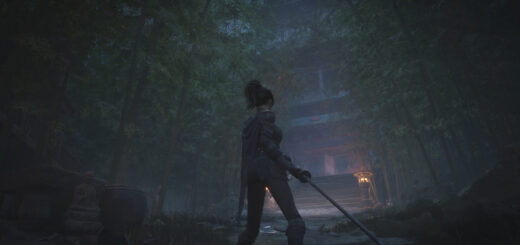
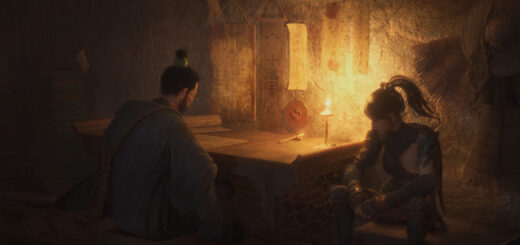
The premise of Wuchang is quite captivating, and it establishes its setting, themes, and characters quite well. At the beginning of the game, Wuchang finds herself awoken in a temple, overseen by a devoted Taoist medicine man, Xuanyangzi, who is caring for many of the diseased Feathering patients. Just one floor below, players will note a severely diseased man, riddled with feathers and wounds. Stepping just outside and progressing further into the game, players will come across ruined Buddhist monuments and Taoist temples, ransacked villages, and strange red, mercurial elements of the Feathering on enemies, dead bodies, NPCs, and even the wildlife. All these elements synthesize into a mystical, foreboding atmosphere that lends well to a pervasive feeling of utter ruination and chaos.

One of the many temples occupied by the rebellion.
Wuchang’s exquisitely crafted worldbuilding contains quite a few layers of intrigue. For starters, many of the characters are historical figures from the Ming period, and elements of Taoist and Buddhist philosophy are woven into the game’s later plot subtext. More interestingly, the mythology and historiography of the ancient Shu civilization and Bo people thread in nicely with the lore of the Feathering. Unfortunately, Wuchang suffers from a massive core issue that drastically and sadly weighs down so many of these beautiful and meticulously crafted elements: its confusing plotlines, quest progression, and often obscure storytelling. At times, this is so severe as to hinder or, in the case of an ending on a second playthrough for this reviewer, entirely halt forward progress on certain branches of the plot. At far too many junctures, it feels like Wuchang is actively fighting the player in telling its own story as it becomes bogged down in riddles, ambiguity, and lack of direction.
It is often difficult to locate NPCs, even with the game’s shrine checkpoints indicating an incomplete questline with a character portrait and the in-game compass signifying their general direction with a yellow arrow. Worse yet are the quest items, which are often hidden in out-of-the-way locations in levels that, while visually impressive and detailed, are usually excessively labyrinthine or too sprawling. For both quest items and NPCs, their descriptions and dialogues are often unhelpful. This is an absolute shame, because there is so much to love here conceptually, but the story’s execution is close to an unmitigated disaster, and navigating and completing the game’s branching paths is far more difficult than necessary. As a final note, it is glaringly odd how little attention Wuchang herself gets in the writing, and her lack of a personality or agency feels like a missed opportunity to explore world-character interactivity, especially with such a strong setting.
Fortunately, despite its narrative and level exploration elements not working ideally, Wuchang is massively bolstered by its extremely tight, well-formulated combat. While she initially wields a longsword, Wuchang can utilize two dozen different weapons across five classes – longswords, short swords, dual blades, spears, and great axes – each of which has a distinctive move set. Every single weapon has a unique ability and can be further equipped with Disciplines, which are powerful combat abilities. Wuchang can equip two weapons at once and effortlessly switch between them by using a powerful Swift Draw attack. Disciplines, statistical growth, and some other abilities are obtained through a skill tree called the Impetus Repository, where Wuchang can spend Red Mercury, the game’s level-up currency, to grow more powerful.

The Impetus Repository and its various branching paths.
In addition to her weapons, Wuchang makes use of a wide variety of spells, both of which draw on the game’s Skyborn Might combat mechanic. This sees Wuchang accumulating “stacks” of Skyborn Might, up to a maximum of five, which can be acquired primarily through perfect dodges, but also specific attack combinations, parrying, or properties unique to a weapon. It can then be expended to use Disciplines, Swift Draws, weapon abilities, or spells. In addition, players can also modify their weapons using Benedictions, which serve as damage, status, or defense modifiers.
The primary factor that makes Wuchang’s combat work so well, and ultimately defines the game, is the way Skyborn Might interfaces with dodging and Wuchang’s inherent dexterity. She moves with a fun, deft nimbleness that makes nearly every combat encounter a sheer joy to navigate; particularly, the Swift Draw ability keeps the pace of combat relentless. This is especially true of the boss encounters, which are mostly expertly designed and rank among the best in the Soulslike genre due to their variety, but also because of the demands they make of the player. While almost all center around dodging in some way, each fight has a distinctive approach, with players forced to manage different statuses, weapons, dodge timings, and spatial considerations.
When bosses do miss the mark, it is largely due to issues with invincibility frames when she is knocked down or hit with a barrage of multiple spells that cause knockback. Being fairly light, many attacks can completely knock her down, even with the heaviest armor in the game, and getting up too quickly while being assaulted with a long combo chain can sometimes result in frustrating deaths. While this can be adapted to by learning to stay down until the right moment, it’s a bit of an oddity. Regardless, even though approaches to successive boss fights can be diametrically opposed, they are always interesting due to Wuchang’s extraordinary build variety and other gameplay intangibles.
During her adventure, Wuchang picks up quite a wide variety of armor, which makes a massive difference in combat, especially when it comes to defensive statistics and status resistances. More than many contemporary Soulslike titles, which have tended to lean harder into action elements, Wuchang prominently and refreshingly leans quite heavily into its RPG elements, incorporating them in a wonderful, striking balance with the action-based dodging. Players will frequently find themselves adapting their armor, spells, weapons, and especially statistics to the wide diversity of situations Wuchang offers. Because players can re-allocate nodes in the Impetus Repository for free at any given time, Wuchang is never precluded from utilizing that one timely and extraordinarily powerful spell she doesn’t quite have the stats to use efficiently.

Wuchang can be a youxia… or a court maid.
One last interesting element of Wuchang’s gameplay and combat is the Madness system. As part of her Feathering affliction, Wuchang can grow increasingly mad, indicated by a meter at the lower-left corner of the screen. Dying repeatedly or slaughtering human-type enemies increases madness, while killing beasts and staying alive reduces it. As Madness increases, Wuchang suffers more damage, but she also dishes out more herself and gains access to special combat abilities. If Wuchang dies when her Madness is maximized, a demon clone known as her Inner Demon spawns at the site of her death. This demon has all her abilities, equipment, spells, and armor, and will guard the dropped Red Mercury but also attack other enemies in the vicinity if players hesitate to engage the demon. This results in a very satisfying risk-reward balance that players must manage with the frenetic combat, and gives players a neat way to tackle tough enemies within levels.
From a presentation standpoint, Wuchang excels in its visual design, although it is held back by some textures that look blurry or muddy upon closer inspection. The levels, enemies, and environmental features are lush, and there is an impressive amount of rich detail put into the various levels and their architectural and landscape designs, but at times, the game looks notably better in motion than it does when still. Even if levels are sometimes confusing, it’s impossible not to be amazed at the towering hills of Shu or repulsed at the scope and grit of the rebel camps occupying and desecrating Taoist temples. Sadly, these details are occasionally slow to render, with textures and draw distance both suffering throughout, and certain areas have frame-rate dips or even momentary freezes. The game constantly feels like it’s walking a fine line, struggling to fully express its visual design and maintain a high level of performance, and it shows. Nevertheless, these don’t too heavily weigh on Wuchang‘s fantastic setting, and aspects of the Feathering and its impact on the world stand out as an especially remarkable visual element, especially later in the game.

Wuchang stuns with its landscapes.
The soundtrack of Wuchang is also quite good, making use of a wide array of traditional Chinese instruments, wonderfully fleshing out areas and solidifying the game’s proud Chinese identity. A lively orchestral score peppered with erhus, guzhengs, and guqins all flourish with beauty, accompanying and elevating many of the game’s boss fights, and the ambient music within levels and locations works to generally good effect as well. Wuchang’s English voice acting is quite good, with the actors delivering convincing and believable performances that, given the occasional sparsity of dialogue, will likely leave players wanting more, especially regarding Wuchang herself, whose near silence is palpable in contrast to the rest of the cast. There are too many biting emotional moments in her adventure for Wuchang not to have a more audible or even visible reaction.
All in all, Wuchang: Fallen Feathers successfully distinguishes itself as worthy of attention for multiple reasons. Beyond its riveting gameplay and exceptional character customization, Wuchang crafts a vibrant, mystical, and interesting world deeply rooted in Chinese culture. Sadly, the game’s awful quest progression, storytelling mishaps, and occasionally overbearing level design keep the promising concepts, plot premise, and beautiful world from shining like they should. Nevertheless, Wuchang’s sheer excitement is too attractive and makes for a gameplay experience that fans of action RPGs and especially Soulslikes will not want to miss.
Disclosure: This review is based on a free copy of the game provided by the publisher.


Fast-paced, fluid combat
Outstanding boss lineup
Fantastic worldbuilding
Gorgeous presentation
Immersive soundtrack
Sometimes-confusing level design
Very poor progression and storytelling
Minor but noticeable performance issues
Looks better in motion, blurry/muddy textures




Recent Comments