OFF Review
Forsaken Surrealism
Mortis Ghost’s OFF presents a surreal world that takes abstract philosophy and a touching story, all while wrapping it into a dream-like turn-based RPG. Fangamer has helped remake this influential title to be more accessible to modern masses by releasing it on official platforms. The process does leave a few presentational elements feeling hollow, though its core ideals still shine through for an immensely thought-provoking title.
OFF follows the entity known as the Batter, who is aware that they exist outside their reality. The player inputs a name to introduce themselves to the Batter in a bit of fourth-wall breaking that happens a few times along this journey. The Batter and player then meet the Judge, a verbose and philosophical cat who quickly agrees to assist the Batter in fulfilling their sacred duty to purify the world. This drive for purification leads the Batter from one colourful zone to the next, all bathed in a eye-catching hue such as neon green or magenta. These zones are defended by servants of the Queen, who would very much like to preserve the status quo. However, the status quo is far from the utopia she proclaims, as players slowly uncover its fundamentally unnerving nature. OFF has a way to consistently put the player on edge, by visuals, storytelling, character philosophy, or musical accompaniment, with a sense of wrongness that only deepens as the plot unfolds.

Too true Judge, there will be much admiration for the visuals by the end of this game.
The player is a passive guest on this journey as every accomplishment comes from the Batter’s sole purpose to purify things as they see fit. Outside of the Judge, none of the characters directly interact with the player. Among the other characters are the Elsen, a race of beings that look like tired businessmen. While some are frightened, others are hyper aggressive as they begin to act out various stages of mental illness stemming from their living conditions. Compounding the Elsen’s troubles are Spectres, beings that have recently appeared and simply try to kill the Elsen and the Batter. This stresses the Elsen out, and when they snap, they turn into Burnt, who attack on sight. While some of the situations the Batter explores offer a reflection on the human condition through the treatment of the Elsen, the Batter feels nothing, as a relentless machine of purpose, purifying everything nearby regardless of the praise or consternation of the residents.
Things are never quite as they seem in OFF. Starting with the player’s lack of knowledge and the Batter’s lack of caring, every interaction adds a bit to this surreal tableau. This web of knowledge is reflected by the overall hub that connects each zone to another, the green connections spreading from a centralized red point. It can feel easy to get lost in the analogies and subtext that the visuals and dialog bring, but the threads begin to make sense as the plot progresses.
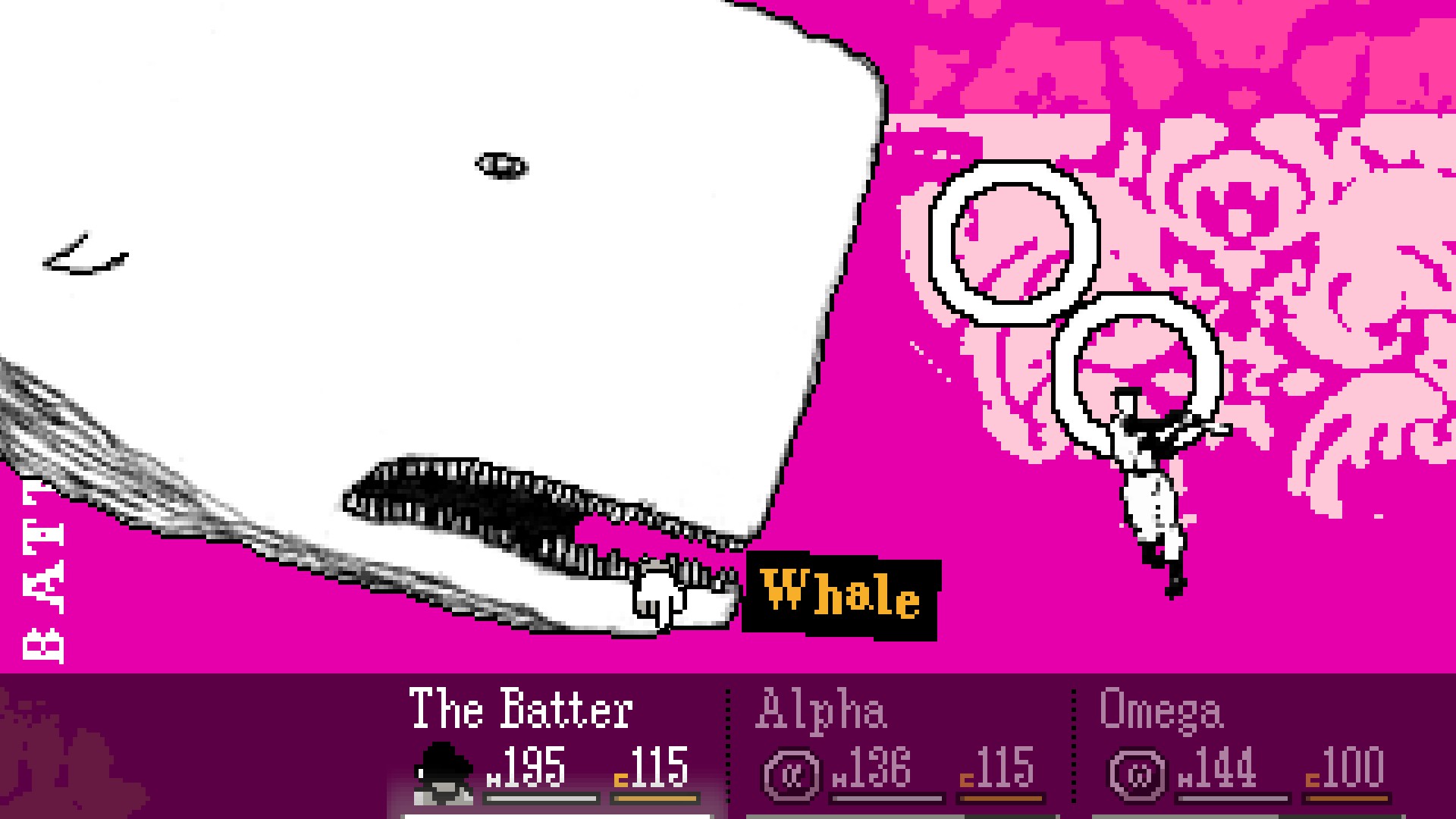
Yes, the Batter fights a whale, what of it?
This dream-like state is enhanced by the remade soundtrack. The music to each area has a hollowness that evokes a sense that the somber dream can shift to a nightmare at any moment. However, the soundtrack lacks gears to progress through, and its constant nature makes it feel like nihilism overrides any other potential themes. The original soundtrack displays a lot more expression, creating a more complex read into the surrealist visuals and story themes at work. While the new soundtrack perfectly captures the overt themes, it leaves a lot of subtext behind and the doubling down on despair leaves a hole in the presentation.
The turn-based combat of OFF is passable, never losing its visual charm, but not adding anything exceptional to the experience. Fighting is more measured in its approach, as in the original there were health totals that reached in excess of a thousand, but here maximum HP for the party in the end game is only a few hundred, with battles lasting up to at most a minute or two. This is turn makes buffs and debuffs, such as poisoning enemies, harder to exploit as they are balanced in a way to not end boss fights quickly. Random encounters feel like they chip away at resources and attributes until making it to the next checkpoint, these always feel earned, and without a reliable option to flee also makes them worthwhile. Luckily, there are a decent amount of collectable healing items that come from rewards to combat that make treks between save points less perilous. The Batter gains three companions called Add-Ons over the course of the game; each of them is a machine-like ring that does not speak, named after a letter of the Greek alphabet: Alpha, Omega, and Epsilon. Each member fits into a different combat role: Alpha is the secondary damage dealer, Omega cures status ailments; and Epsilon buffs the party. When all are together, fights are more enjoyable.
The active-time combat system sees enemies getting more turns but hitting considerably less hard than the player. There’s never a moment when regular enemies feel like they could defeat the party unexpectedly, but skills are needed to avoid taking damage and surviving over the long haul. Party strength is never overpowering, even with grinding, so this tension of slowly losing health and magic never goes away. This means whether it is from replenishing at a save point or using a consumable, some forethought is needed to keep progressing through the zones.

The visual instructions and exposition have layers of subtext even in one frame.
Some backtracking is needed as clues for the numerous puzzles that block progress can often be found in a prior area. Luckily, the random encounter rate is generous, and it’s rewarding to come across the outlandish and enjoyable designs of enemies that are only found in specific places within a zone. Basic shapes for Spectres and Burnt duplicate, but there are little pencil-lined details on each hand-drawn variation that are quite eye-catching to behold as, for example, Spectres have differing symbols for eyes that dictate which debuff they will be able to employ. The remake also adds six new bosses, which are tucked away without any hints to their locations. However, the new bosses fit in perfectly with the game and provide exhilarating challenges with new mechanics.
The puzzles of OFF typically involve tasks such as hitting blocks in a specific order or inputting a code by piecing together other visual clues in the background or reading books. These answers are not always readily deciphered, which encourages exploring everywhere and paying attention to everything found, and players may need to note certain clues down themselves. Clues are presented in a very interesting manner, utilizing a different visual medium, such as torn and faded book pages, hastily crayon-coloured art pages, and newspaper clipping style instruction manuals, which makes reading everything a joyous occasion. Puzzle difficulty can vary between easy-to-figure out to having to meticulously search for clues everywhere until the answer is deciphered. Mixed in with these puzzles are the occasional mini-games that change up the gameplay and art style from the norm and always provide a fun distraction.

This mini-game involves falling through rings and avoiding phantoms to reach the bottom of a silo.
OFF is visually stunning in its simplicity. Despite utilizing a dream-like abstract surrealism, everything is created with a keen eye for detail, making everything feel distinct. The stylistic usage of pencil works to pop outlines as everything is detailed in thick black lines. Backgrounds utilize bright colours, and OFF combines these with an absence of colour to accentuate the characters that pop out with their deliberate hand-drawn style that ensures they stand out. There’s something magical in the way the surrealist imagery matches with the varying, hand-drawn art pieces and enemy designs, which mesh wonderfully with the dialog and musical accompaniments. OFF feels like a truly artistic expression that could only be conveyed in a video game.
OFF is an unnerving dream that steeps one foot into a fever-soaked nightmare. This surrealist approach makes it a truly trendsetting experience with how the characters, story, and visual presentation meld into a highly artistic personal journey that is not like anything else. Combat is always serviceable and the new balanced approach to buffs and debuffs allows extra time for deciphering puzzle clues, making them less frustrating to deal with. The nuanced layers added from the original soundtrack are definitely missed, but the muted melancholy the new soundtrack provides is still a trip to experience. If surrealism mixed with an uncanny sense of wrongness sounds enticing, then OFF will not disappoint.
Disclosure: This review is based on a free copy of the game provided by the publisher.


Visually outstanding, with use of hand-drawn pencil work recreated wonderfully
A thought provoking fever dream of surrealism
New boss fights are very engaging
While trying its best, the new soundtrack hits differently than the original
Some puzzle clues can take a while to decipher





Recent Comments