Zero Parades: For Dead Spies Review
Becoming Many Masks
The history of ZA/UM following the success of Disco Elysium is messy to say the least. The internal knowledge required to comment accurately and succinctly about the goings-on is beyond scope here, but the result is that many of the creative forces behind that title are now elsewhere. Nonetheless, ZA/UM has persisted, putting its weight behind a new title much in the gameplay vein of Disco Elysium, Zero Parades: For Dead Spies. Labelled a narrative espionage RPG, Zero Parades: For Dead Spies is ultimately an engrossing and engaging experience, even if it might not move the needle as much as players might be hoping.
The game is set in a 1980s corollary that blends elements of the Cold War and the Americas. It takes place in the city-state of Portofiro and follows Hershel Wilk, an agent for the Opera, the clandestine arm of the communist Superbloc, one of the world’s major powers, with Portofiro caught in the number of the powers’ machinations. Hershel, codenamed CASCADE, returns to Portofiro five years after a mission gone wrong — leading to her being stuck in the “Freezer” by her handlers — for a special assignment and the promise of absolution. However, upon arrival and before learning anything about the mission, she finds that her partner has been rendered catatonic and ordered to return. Undeterred, she must first find out what the assignment actually was while also uncovering what happened to her former crew after she abandoned them five years before.

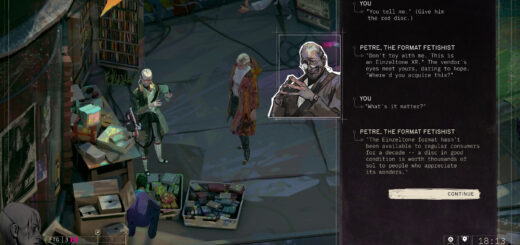
Hershel needs to interact with all manner of people to uncover and pull off her assignment.
Gameplay sees players wandering around the limited district within Portofiro, exploring locations and interacting with the various people and objects while seeking out useful information and items or progressing quest objectives. Most of the game is driven by conversations and dice-based skill checks, with Hershel having fifteen skills split across three disciplines. She can also equip various items of clothing that provide additional skill modifiers, also potentially helping to ingratiate her with certain characters or allow her to get into certain places more easily. Each of the skills contributes to the game’s narration, providing commentary during events on conversations, while the three disciplines also correlate to Fatigue, Anxiety, and Delirium scores that represent Herschel’s physical, social, and mental limits. These readily move up and down — though mostly up — during events and conversions, but can be mitigated by consuming items or sleeping.
Skill checks are handled by rolling two dice and comparing the target score with the total plus any relevant modifiers that come from the skill, equipment, prior conversations, etc. In addition, players can choose to exert on individual skill checks, letting players add a third die and taking the two highest for the result, at the cost of a bump to her relevant Fatigue, Anxiety, or Delirium score. Higher scores can potentially convey advantages, but reaching the full 20 score will force players to lower one of Hershel’s skills. In addition to regular events and conversations, there are special events called dramatic encounters, where Hershel will need to react to a dangerous situation. These largely act as a framing for a series of quick decisions or skill checks, though players have all the time in the world to actually make the decisions.
As Hershel completes quest objectives or uncovers new information, she gains experience. Every one hundred points of experience grants her one skill point, which can be spent to either increase one of her twenty-one skills or unlock a new conditioning slot. Conditioning slots are thoughts unlocked throughout the game by discovering or witnessing their triggers that players can imprint on Hershel’s personality, granting potential bonuses, increasing skill point maximums, or dialogue options at the cost of providing status effects if players fail to adhere to that thought. For example, one allows players to try and claim diplomatic immunity if things go badly, but loses the bonus and conveys a disadvantage if selecting conspiratorial options. It gives players a lot of freedom for how they act with Hershel, letting them choose a consistent approach or tailor her thought processes or outfits for each given character and situation.

The game’s skill system is the driving force behind many of the gameplay mechanics.
Zero Parades feels at its best when it fully embraces the espionage, but the majority of the game is primarily spent playing detective, and it feels like it would’ve benefitted from having more of the dramatic encounters, which work well at heightening tension but are few and far between. It is appreciable that most of the quests have multiple ways of completing them, and there is a lot of variety in the choices players make in what resources they can use and who aids them in the finale. Some more outlandish moments in the game provide a little bit of welcome levity, and there is the opportunity to leave some characters in a better place. Ultimately, however, the game is very dystopian — including at least two very uncomfortable torture scenes that are thankfully conveyed primarily through text and narration — and the “most successful” ending requires some particularly ruthless decisions that will likely not sit well with many players, but it is thematically on point.
The most interesting parts of the story come from putting together the various mysteries or from learning some of the historical events of Portofiro and its neighbours. The world-building is very strong, with plenty of smaller touches and details that end up tying together very nicely. However, the game can get unnecessarily verbose and prone to navel-gazing at times, particularly when it starts talking about the spread of culture, such that some players will simply end up zoning out. Meanwhile, Hershel herself is somewhat of an enigma. Given the entire based around espionage, this is evidently deliberate on the part of the developers, but the way players can wildly pivot their choices from one conversation to the next — as well as Hershel’s own thought patterns in the game’s mechanics — also means she is less of a realised character than everyone else in the game. However, despite those weaknesses, the narrative overall works as a strong point, giving players plenty to uncover and do, and it is very satisfying to be able to piece things together and come out of the other side.
Many of Zero Parades‘s skill checks are at the whims of the dice, though all white-texted skill checks can always be retried at a later point if desired. There are some game overs possible by either making poor decisions or failing notably risky skill checks, though its single autosave slot updates constantly. While it is encouraged and more fun to accept the role of the dice and deal with the fallout in the moment, provided they haven’t actively chosen an option to prevent it, save-scumming with manual saves before skill checks is easily done. In-game time progression is tied solely to actions and conversations, and doesn’t advance as players move around. Time and the day-night cycle have a relatively minor impact, with certain characters not being available (or conveniently absent) during certain parts of the day and for how long buffs and status effects might last, but there aren’t any obvious hard time limits.

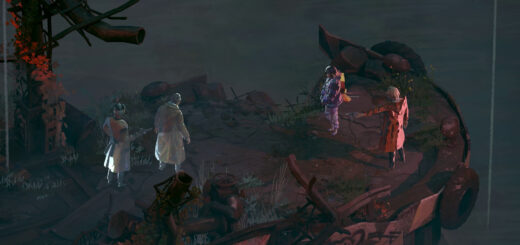
Dramatic encounters provide some of the more tense moments in the game.
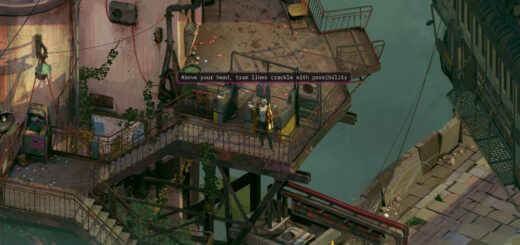
The game’s art style is recognisable and works at imparting the dystopian nature of the setting without ever really impressing. By design, Portofiro itself isn’t a nice-looking place, but it is well realised. Meanwhile, the character art does a decent job of making everyone distinct from each other, but at the same time no one is really individually memorable. The game also suffers from some technical hiccups. Most of these are minor, and the game has been receiving fixes since launch, but during the review playthrough on Steam Deck, there were cases of it frequently crashing in certain places or UI elements not disappearing until the game is fully exited. On the audio side, the game fares a bit better, with good voice acting performances and a very engaging narration from Boo Miller, and some good use of in-game music, but there are numerous cases of the audio not quite matching the text or starting while the text is waiting for the UI to load in.
While unlikely to strike the same chord as Disco Elysium, Zero Parades: For Dead Spies is still an interesting and engrossing title. Running at around twenty hours, potentially less, for a full playthrough, there’s lots to uncover in the game, alongside a lot of scope for replayability, particularly if players spend their first attempt taking what the dice gives (and takes away from) them. How long it remains in the memory in the future remains to be seen, but its strong world-building and interactive mysteries keep players engaged in an ultimately very satisfying experience.
Disclosure: This review is based on a free copy of the game provided by the publisher.

Rewarding gameplay loop
Interesting connected questlines
Good amount of depth to the setting
Unnecessarily verbose at times
Some technical hiccups




Recent Comments