Magical Princess Review
It Does Exactly What’s On the Tin
As someone who consumes a lot of media, execution is a major part of how I come to enjoy a work. A premise can be interesting on its own, but I have little patience for wacky premises if the essentials of the medium haven’t been achieved. This is how I came to count Christopher Nolan’s Inception among my favorite movies. Nolan thoroughly explores his “dream within a dream” idea, taking it to some interesting places both narratively and visually. The soundtrack is iconic, the visuals are mind-bending, and the editing is so clean that the film still makes sense despite there being four different situations happening simultaneously during the climax. How is any of this relevant to Magical Princess? Simply put, a lot of my appreciation for Magical Princess comes from the same appreciation of where it demonstrates excellent execution. The developers over at Neotro Inc. and publisher MAGI Inc. had a premise and set off to execute it. While the narrative itself isn’t groundbreaking, nor are any of the mechanics present, the quality of the game is still such that the familiarity of certain tropes and ideas don’t detract from its successes.
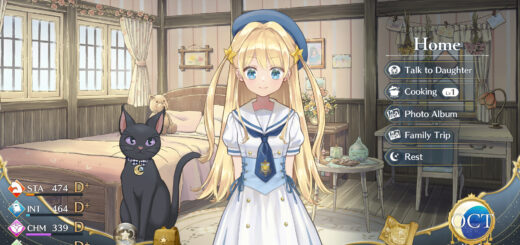
The game features Alice, the titular Magical Princess (though she isn’t actually royalty) who attends the Royal Magic Academy in the capital of Panetelia. Players take control of Marc, Alice’s widowed father, who is responsible for raising Alice. Technically, players play as both Marc and Alice, as there are several instances where players will take control of Alice in both character interactions or gameplay, but the narrative is told from Marc’s perspective most of the time. Alice also has a magical talking cat named Ebon who serves no gameplay purpose other than to add color commentary every so often.

Players will see this screen at the start of every month.
Magical Princess’s structure is relatively simple, but reveals a surprising amount of depth as one progresses. The game takes place over the course of Alice’s three years at the academy, broken up month by month. At the beginning of Alice’s tenure at the academy, she can choose between three tracks; the Swordfighting Track Gladius, the Magic Track Magia, and the Social Track Nobilis. Whichever track players choose informs which classes Alice should focus on, of which she can take a set number each month. Classes are one of the main methods of increasing Alice’s stats. tats are broken into four categories: STA represents Alice’s physical abilities, INT refers to her intelligence and magical abilities, CHA corresponds to her social aptitude, and SEN covers her creative pursuits.
After classes, Alice can partake in several activities around town, such as working part-time jobs, spending time studying or practicing her creative pursuits, and more. However, most of these activities require Alice to spend a certain amount of energy, which is limited month-to-month, and most of them interact with both Alice’s stress gauge and her morality meter. Alice’s stress gauge is fairly self-explanatory; if her stress reaches a certain threshold, she will be more likely to fail her activities and her progress will be stunted, so it’s a good idea to do things that lower her stress, such as resting or hanging out with her friends.
The morality system has quite a bit more going on. While at first it may simply seem like a purely narrative device, it actually has a few gameplay consequences. Certain activities, most of which are found if players choose to have Alice sneak out at night, cause Alice to become more “evil.” If Alice falls below a certain threshold, players will no longer be able to speak with Alice during the day and interact with her, which makes stress management more difficult, in exchange for some admittedly powerful items and abilities that can only be obtained when going out at night.

Each class Alice can take will contribute to a specific stat.
The morality and stress mechanics take what could have been a fairly by-the-numbers time management game and make it into a constant balancing act of making sure Alice is not only able to be actually successful in her pursuits, but also able to manage her stress well and foster a healthy (or unhealthy) relationship with Marc. This balancing act, combined with incredibly snappy and responsive menus, intuitive progression systems, and a staggering variety of endings to be achieved, makes Magical Princess an absolute joy to play.
Unfortunately, the game does have some rough edges. Alice’s journey towards adulthood is highly engaging, but her friends, of which there are seven, take a bit of a backseat in the grander narrative. While the characters themselves are incredibly well-realized, they end up seeming a bit tertiary to the overall narrative of Magical Princess, which has a bit more going on than simply following Alice as she goes to school. As such, they feel a bit more like vehicles for this game’s spin on their tropes, such as the boyish but pretty knight lady Fran, or the edgelord-with-a-heart-of-gold Hasis, rather than actual characters that play a role in the overarching narrative.
The other issue, and maybe a bit more glaring, is that combat feels at best like an afterthought. Midway through the game, Alice can form a party with two of her friends and go on expeditions to slay monsters. Alice has a separate Battle Rank that is effectively a party-wide level and can only be increased by participating in battle, meaning combat scales largely separately from Alice’s other progress. During combat, every participant has an Active Time-style cooldown bar. Physical actions happen instantly but have a cooldown after they are taken, while magic spells take a while to charge up but have a much shorter cooldown.

Combat at least has a fun visual presentation.
While on its face the combat system is functional and works well enough, unfortunately there simply isn’t enough variety to be found in the game that it comes across as an afterthought. The amount of skills Alice has access to is painfully small, and while her friends do have access to unique abilities, often battles fall into an attack, block, and heal loop that becomes repetitive after a full playthrough. Couple this with the uninspired enemy designs and an equipment system that largely consists of simply choosing the item with the highest stats, and the combat feels less like a fun aspect of the larger loop and more like a chore that is tacked onto the larger experience. While the overall experience is still very strong, the issues with combat are unfortunate, as it can result in plenty interesting story outcomes, and a more engaging system would round out the package ever further.
Getting back to the positive, presentation is another element that Magical Princess excels at. The game has a storybook aesthetic that it simply nails. Every animated character is incredibly expressive, and the voice acting, while not dubbed in any language besides Japanese, is equally as expressive. Certain story events and dates are presented with a simpler comic panel style that, while not animated, is charming in its own way and does a good job of conveying the events at play. The static artwork that is present for most important story and relationship events is always amazing, and the writing, music, and dialogue almost seem to crescendo into these moments expertly, especially in relation to Marc and Alice’s relationship. The music doesn’t stand out as much, but it does do a good job of conveying every moment and gels with the rest of the package quite well.

The artwork does a wonderful job of conveying the emotions behind every scene.
Ultimately, Magical Princess doesn’t reinvent the wheel on any of what it sets out to do. The game does just about everything that can be expected from it, but does so with an almost effortless grace and elegance that it’s hard to find fault in its lack of innovation. At the heart of it, Alice is just a wonderful character, and the game’s systems expertly flesh out the ideas of how while there is no right way to raise her, there are always consequences to actions. Aside from some hiccups regarding the relationship system and the combat, Magical Princess is an incredibly easy recommendation for both fans of the genre and newcomers.
Disclosure: This review is based on a free copy of the game provided by the publisher.

Superb writing and characterization
Intricate and intuitive character progression systems
Fun and expressive visuals
Combat is underbaked and a bit of a chore
Relationship system feels somewhat incidental to the main plot





Recent Comments