Doloc Town Review
Vertical Farming
Most farming sims come in one of two particular visual styles: top-down 2D and full 3D. RedSaw Games and Logoi Games’s Doloc Town eschews those options in favour of a distinct side-scrolling view that affords it the ability to play around with verticality in its farming and building systems, as well as more Metroidvania-style exploration. The game uses these well to help separate it from the crowd, even if the underlying systems follow many of the usual templates. Nevertheless, it’s a welcome and largely successful entry into the space that players will be able to get plenty of enjoyment and satisfaction from.
Doloc Town puts players in the role of a returnee, with the default name Proti, to the eponymous settlement after spending time trying to survive in the hostile wilderness. The game takes place in a post-apocalyptic world, with its populace of humans and machines trying to survive and make the most of their situation. Fortunately, Proti’s arrival allows them to start carrying on the work of those who put in motion plans to revitalise and restore the environment while they try and build up the farm of their dreams and find a place to call home.

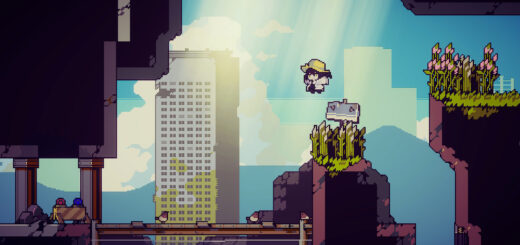
Doloc Town’s side-scrolling view allows for more Metroidvania-style exploration of its locales.
The game follows a very similar structure to other exploration-based farming sims, with players spending time tending to their own farming while going out into the world to find resources, hunt down important artifacts, complete requests, and spend time building relationships with locals, though the latter is less of a focus than in most other games of the sub-genre. Most of the main story content involves exploring the local regions in search of clues or objects needed to help restore the environment, which includes helping to find a way into new areas and regions.
The story can be broadly summarised as fine. There isn’t anything particularly noteworthy about it, but it does provide enough elements of interest and impetus to keep players progressing forward. The characters are at least charming and engaging, with some interesting sub-stories helping to give Doloc Town a homely feeling despite the post-apocalyptic setting, as well as showing the strong bonds between those that live there. The English localisation is generally well done, with some visual effects applied to the text to give it a bit of extra charm.
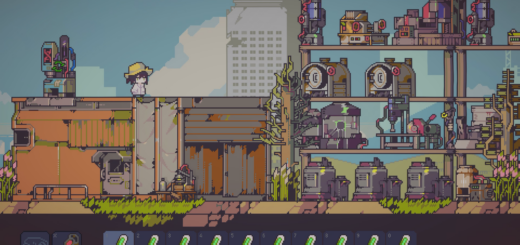
Doloc Town’s side-scrolling perspective works well in opening up farm building for player customisation as players quite literally build from the ground up. Rather than planting crops into fields, players make use of combinations of planters and platforms. In addition to crops, players will need to find room for various crafting and farming tools, generators, ore smelters, and more. There are a lot of things for players to place and craft as they unlock new options, and plenty of customisations. Players can also place buildings, primarily tents and shipping containers, which affords them even more space to put or organise things or protect them from the elements. The game offers a ton of freedom and flexibility for players to layout everything as they wish, whether that be for aesthetic design or straightforward efficiency.

Players build their farms vertically, with tons of freedom for design and layout choices.
The game features an annual four-season cycle of mildly rainy, heavily rainy, mildly sunny, and heavily sunny, with each season lasting four in-game weeks. Weather is an important consideration, as players will need to deal with acid rain, lightning storms, and scorching heat. Both acid rain and scorching heat will need players to protect their crops with plastic coverings, while storms require using lightning rods to safely channel the electrical strikes. Weather can be beneficial, as rain (both normal and acidic) means that players don’t need to worry about watering outdoor plants, while lightning storms offer an opportunity to harvest free electricity and some days of constant rain will produce a proliferation of mushrooms to collect.
Proti has a limited amount of carrying space and will need to place down any storage items in the farm as needing to hold the various resources collected. Cardboard boxes are of vital importance, especially in the early game, as they can be readily used to increase Proti’s carrying capacity. Items that need immediate access or use are best kept available separately in the quick use bar, but crafting resources are best stored within boxes. Exploration necessitates some light platforming, with players fairly quickly unlocking a double-jump, and the regions are crafted well to offer players plenty of secrets and rooms to explore in their quest, as well as giving plenty of resources to find. Players are readily able to obtain all sorts of useful resources and items, not just from obvious sources like trees and ore, but also from garbage bags and metal scrap (suspending disbelief on quite how they respawn so quickly), as well as enemies and foes they defeat. Doloc Town also naturally includes fishing, with numerous spots dotted around the world, as well as ranching options and the ability for players to raise their own fish. The gamepad controls work well, with the quick use bar and inventory systems pretty intuitive after a little bit of time getting used to them. Players will likely find themselves accidentally selecting the wrong thing occasionally, but it’s a commonplace issue throughout the genre without an apparent solution yet.
As players undertake activities such as farming, crafting, etc., they will earn background experience in various aspects, such as agriculture or industry, and occasionally level them up. Levelling up grants points that can be used in the tech tree to unlock new crafting options or machines. Other crafting recipes or new seeds can be unlocked by completing requests or submitting research to various people in town. It follows a tried and true structure that has served the genre well and does the same here. There is lots of depth in the systems that will ensure players are unlocking new recipes or tools throughout the game, as well as finding new ways to make produce that they can sell for money. However, the primary black mark against Doloc Town comes in some of its main story roadblocks. Certain objectives are unclearly worded or open for misunderstanding, and the very ending of the main quest requires first completing a set of other requirements that seem optional, but will need players to have engaged with and significantly progressed almost every other aspect of the game.

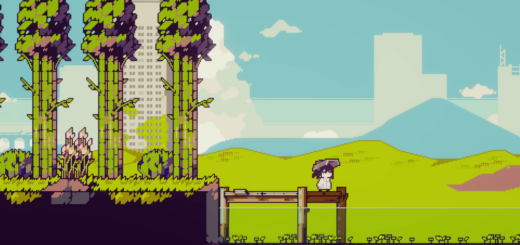
The people of Doloc Town make it a charming place, despite the environmental damage and rusty buildings.
During exploration outside, players will encounter various enemies, most in the form of hostile drones and machines. While players can use their tools to directly attack, most combat is handled by their automated combat drone as they look to avoid attacks while making sure the drone is within range. The drone is customisable and upgradable to a limited, but decent enough, extent that includes different weapons and enhancement chips. The system works well enough at giving the impression of Proti as a regular person looking to survive a hostile world, and it’s quite satisfying seeing the drone handle the threats, though the threats that players have to deal with and avoid start to get a bit tiresome later in the game.
The pixel art style very much adds to the charm of Doloc Town with strong consistency across the design and UI, and it manages to make a world filled with ruins, tangles, scraps, and rust surprisingly pleasant. There are a few times where it’s not initially clear, whether a piece of scenery is the background or harvestable for resources, but on the whole the game offers enough enjoyable and sufficiently varied environments to keep visual interest. There’s not much to complain about on the audio side either, with the game featuring a reasonable selection of decently catchy tracks, including the option to create and listen to personal playlists should they manage to find the tapes scattered around the game.
Doloc Town is another strong energy in a sub-genre that is currently in rude health, with its side-on view and pixel art style helping the game to stand out. While the gameplay systems may not ultimately deviate greatly from established formula, it nonetheless provides a charming experience with enough depth and farm customisation options to keep players engaged for a significant amount of time. Farming sim fans should find plenty to like here.
Disclosure: This review is based on a free copy of the game provided by the publisher.


Charming presentation
Strong farming, production, and building systems
Some progression requirements can be unclear
Unnecessarily annoying final roadblocks for main story




Recent Comments