Mega Man Star Force Legacy Collection Impression
The Mega Man Star Force Legacy Collection offers all seven games, quite faithful to the originals, with some technical workarounds to display on modern televisions, some light quality-of-life options, and a wide compendium of art and music.
When the Mega Man Battle Network series concluded in 2005, as the Game Boy Advance was on its way out and with the Nintendo DS on the horizon, Capcom looked to follow it up with a new series, and this spawned the Mega Man Star Force series. Star Force was released in 2006, followed by Star Force 2 in 2007 and Star Force 3 in 2008. Now, two decades later, Capcom is due to re-release these games as part of the Mega Man Star Force Legacy Collection, and RPGamer was able to get an early look at the collection and some of the updates and tweaks players can expect when it releases later this month.

The selection of games on offer.
Each of the three titles was released with distinct versions, equaling a total of seven games, though it’s important to note that core features like the plot remain the same across versions, with the differences mostly amounting to available Battle Cards, transformations in battle, and a handful of boss encounters. Mega Man Star Force was released with Leo, Pegasus, and Dragon versions; Star Force 2 was released with Zerker x Ninja and Zerker x Saurian versions; Star Force 3 had Black Ace and Red Joker. All seven games are included, with the original version differences.
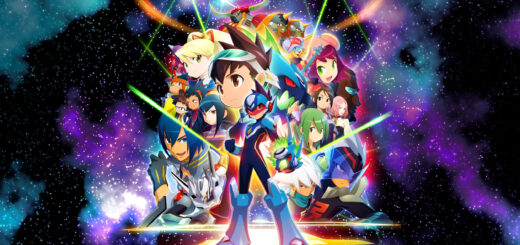
The Star Force games take place in 220X, roughly 200 years after the Battle Network games, on a utopian-adjacent Earth where EM waves enable humans to live in prosperity and connect seamlessly with one another. They all follow Geo Stellar, a fifth-grade student who is initially withdrawn and sullen due to the presumed death of his father in a space station accident. With aliens, or “FM-ians,” from the planet FM invading, Geo Stelar finds himself merged with the seemingly friendly FM-ian Omega-Xis. Together, they become Mega Man and must fight the FM-ian invasion and viruses while navigating the EM Wave World, which is normally invisible to humans not merged with FM-ians.

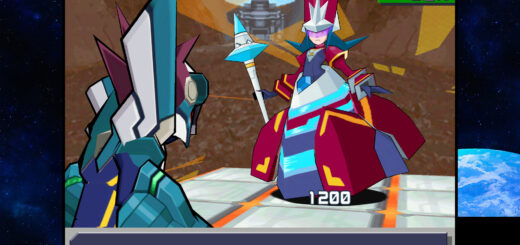
Mega Man fights on the grid, Power Bomb at the ready!
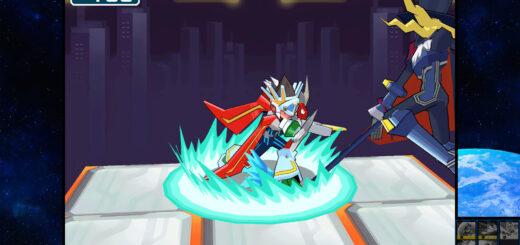
As action RPGs with deckbuilding mechanics, the Star Force games’ combat takes place on a 3-by-5 grid, with Mega Man able to shift left and right across rows and execute abilities based on randomly selected cards from a prebuilt deck. In a fight, the “Custom Gauge” slowly builds, and once full, players can select another combination of cards. Aside from cards, players also have constant use of a shield and the Mega Buster to shoot. It offers relatively simple, easy, understandable, and satisfying combat. By connecting with others, players can form “Brother Bands,” essentially a friendship system, which allows them to trade cards and battle, a feature the Legacy Collection carries over and makes significantly easier due to the wider network of people available.
Originally designed for the Nintendo DS, the Star Force titles made use of the handheld’s hardware, including the touchscreen stylus, dual-screen layout, and Wi-Fi for connecting with other players. These games are presented as close to the originals as realistically possible, and for all games in the collection, to account for the hardware discrepancy, the bottom of the two screens is minimized to a corner of the screen, which can be toggled and switched with the main screen at will, enabling players to switch whenever needed. While it’s appreciable that Capcom elected to preserve the games in their original format, it isn’t exactly the smoothest or most intuitively navigable presentation, and while it works, players may find that their mileage and patience vary.

The second screen is minimized into a corner.
Aside from the obvious workarounds to make the Star Force games work on a television, the graphics are touched up a bit, looking smoother than the DS originals, with many of the icons, text, and smaller details appearing much sharper and cleaner. This is especially true in the game’s battles, where Battle Cards and especially enemies benefit most from the boost in visual fidelity. Aside from the graphics, there are some appreciable quality-of-life options, with the adjustable encounter rate being particularly helpful when traversing through the EM Wave World, though many players will also appreciate the speed boost options, damage adjustments for difficulty purposes, and autosave.
Other than modern conveniences and necessary technical changes, the games are by and large faithful to the original releases, though the biggest addition to the Legacy Collection is the Gallery. Included in this compendium of materials are a wide array of official Star Force artwork and design documents, the full original soundtracks of all three titles, as well as a few bonus tracks, and illustrations for all available Battle Cards, including Bonus Cards. It is an expansive collection of content sure to interest Mega Man fans, especially those fond of the Star Force games.

There’s quite a lot of audiovisual material on offer.
The Mega Man Star Force Legacy Collection offers all seven games, quite close to the originals, with some technical workarounds to display on modern televisions, some light quality-of-life options, and a wide compendium of art and music. Players interested won’t have to wait much longer, as the Legacy Collection will release on March 27, 2026, for PC, PlayStation 4, PlayStation 5, Xbox One, Xbox Series X|S, and Nintendo Switch.




Recent Comments