Trails in the Sky 1st Chapter Review
It Takes A Village
The art of conversation is often ignored in video games. NPCs repeat the same dialogue, either hints of the next quest, or a quick line about current events. Not so with Nihon Falcom’s The Legend of Heroes franchise, which among its many accolades boasts worldbuilding on an intricate level rarely seen in RPGs. The sheer depth to worldbuilding, with how every bit of plot progression leads to every NPC having something to say is staggering. This makes revisiting Trails in the Sky 1st Chapter, as the start of such a rich story filled with foreshadowing, so interesting with the benefit of hindsight. Adding new dimensions to the combat, with action elements to blend with the traditional turn-based, as well as redone visuals and voice acting, all reminiscent of the newer Legend of Heroes titles, breathes new depth into the start of Nihon Falcom’s storied franchise.
Estelle Bright is the excitable and driven daughter of Cassius Bright, a senior Bracer at the local guild in the secluded village of Rolent. Bracers are effectively mercenaries with a heart of gold that help those in need for a modest reward. One day, Cassius brings home an injured young boy around Estelle’s age named Joshua, and tells her that Joshua’s going to be living with them. Flash forward five years and Estelle and Joshua are planning on taking an exam to become junior Bracers. During this time, Cassius is called away after a mysterious ominous letter arrives. This gives Estelle and Joshua a good excuse to go off themselves and gain experience on their quest to become senior Bracers, which involves gaining recommendations from the five regional Bracer branches around the Kingdom of Liberl. Said adventure involves exploring the regions, helping and befriending the locals, and frequently finding themselves in the middle of nefarious plots.

Bread is indeed more complicated than electronics to the technologically gifted.
There are times where the pace of the journey gives Trails in the Sky 1st Chapter a laid back and thoughtful attitude that stretches to the point of tedium. There are overarching quests to each of the regions, which begin with an almost vacation-like start before a lengthy period of getting to know the features and characters of the area, after which come the reveals of the local scheme that needs to be thwarted. The frequent switching between a snail’s pace and urgent action will encourage some players to simply skip sidequests or talking with townspeople in order to find the next thrilling moment. Doing so would be a disservice, as plot points grow and gain considerable depth organically, if slowly, from experiencing the worldbuilding surrounding Estelle and Joshua’s journey. Although, by the end of Trails in The Sky 1st Chapter, there are more questions then answers to the inner workings of many characters both ally and villain, even from seemingly humble beginnings the story still truly pays off in exciting and interesting ways.
There’s always something brewing in every region of the Liberl Kingdom. Many NPCs are given names and entire story arcs that are played out in the background of every town, with some spanning the entire adventure. Characters pop in and out of Estelle and Joshua’s peripherals as they live out their lives in minor yet relatable ways. An example of this is a love struck couple that begins in Rolent with a shy boy sharing his feelings with his crush, and can see their whirlwind romantic tour of the Kingdom, only to end on the question of whether or not he will propose to the love of his life. These little stories help make the slower pace of the main plot feel worthwhile as they enrich the world as the main plot grows larger in scope.
Trails in the Sky 1st Chapter is full of these heartwarming micro stories that are only experienced if players actively look for them. Luckily, players can fast travel to each notable location after reaching it the first time. Speaking with every new conversation, shown on the mini-map as coloured circles that fade out when they’ve been spoken with, can take longer than most dungeons to complete. They also pop up regularly during new points of plot progression, which can include a cutscene or ending an in-game day that leads to hours of talking. Skipping these small moments can start to be enticing to even the most ardent fan of noticing the small things; one stopping to smell the roses while on a walk will rarely stop to smell every single flower they come across after all.

Only one conversation point left before this round of dozens of interesting micro stories is over.
The other party members, who come and go throughout the game, all blend into this highly realized world easily and leave their marks on Estelle and Joshua while having their own moments and have secrets that the player won’t fully uncover until subsequent games in the series. Learning everyone’s quirks and eccentricities feels natural and yet still packs surprises as the others learn to trust Estelle and Joshua more and open up to share their personalities and pasts, even if some parts can be a bit telegraphed ahead of time. The layers for characters and storytelling run very deep as everything is connected through masterful levels of foreshadowing that makes every conversation a potential drop in the ocean that cascades into a later emotional tsunami.
Appreciating all this character work means Bracer jobs must be completed. Regions are massive set pieces where the ability to explore is only restricted due to plot reasons if the main story has something time or location sensitive that forces players to stay in a small section. This means that players are best served exploring everywhere when they can, as it is not always easy to tell what will be available after the next main story section is completed, with locations or side quests potentially being cut off. While exploring, there are destructible objects that drop ingredients or Sepith currency, with ingredients also dropped by enemies. Ingredients are used on recipes that provide healing consumables with additional benefits like curing specific debuffs that are learned by purchasing meals or snacks from restaurants and shops, which unlock their recipes for future use after being consumed.
Exploration is helped by the remake’s new combat system, which borrows from the most recent Trails through Daybreak games. Except for scripted battles, monsters in the field can be attacked in real-time without swapping to turn-based combat. Combining enemy groups, running away, or just hammering away with strikes until the enemies are defeated are all possible through the action system. Fighting this way does typically take longer against most foes as attacks are less powerful compared to the turn-based system. However, fighting long enough to stun the enemy is worthwhile, because swapping to turn-based combat when an enemy is stunned leads to an immediate advantage in combat, including a free follow-up attack. These advantages, also activated when players do a critical hit during turn-based combat, build up a meter up one tick each time, which lets players use more powerful follow-ups of a double attack or even a devastating full party Burst. Engaging with this system is a fun mechanic to eliminate weak enemies, but there’s a hierarchy on which characters should be used. Only physical attacks can be done during action combat, giving a definite edge to controlling the more physically-inclined party members during exploration.

Burst finishes are both incredibly strong to use and flashy to watch.
Seamlessly transitioning into turn-based, often gaining an advantage in the process, makes combat quite snappy against regular foes. While turn-based party members have access to magic orbal arts that use energy points (EP) as well as personal special abilities that use craft points (CP). Orbal arts can be strategically implemented to hit an enemy’s weakness or heal quickly and are boosted when a character has the “Zero” icon in the turn order, which makes the casting time immediate and use no EP. Special abilities can be damage dealing, buffs, or debuffs, and when CP is over one hundred, up to a max of two hundred, a flashy finishing move known as a S-Craft can be used that drains all remaining CP. Energy points can be regained from items or resting, while craft points build while engaging with the enemy. The special icons shown in the turn order help shake up routines in combat as a well-timed critical hit, as shown by a exclamation point, or a Zero can shift strategies, creating a sense of excitement in defeating enemies that persists throughout the game.
Orbal arts can be customized to fit every character however players choose. With a few exceptions of party members needing to equip a particular element into certain slots on the orbment device that determines their arts, anyone can equip the quartz that unlock arts. Even a basic Attack 1 quartz that boosts physical damage also gives one point in fire, which is enough to unlock the base Fire Strike spell. The more powerful the spell, the greater the variety or level of quartz that needs to be equipped for it to be available. In addition to granting access to arts, quartz can boost attributes, cause enemies to more likely avoid party members, or otherwise affect their role in combat in ways beyond accessing different spells. This variety of quartz can allow players to tailor different strategies despite having the same party members.

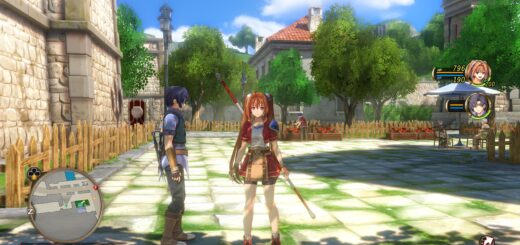
Joshua is right to be that worried over something that makes Estelle’s eyes sparkle so brightly.
Little details in the visuals show the care and love Nihon Falcom’s developers have for these intricate stories. Cutscenes are directed beautifully to capture the essence of these characters. Humourous moments are punctuated with cartoonish white circles, spirals, or symbols that replace the eyes in a way reminiscent of special 2D character portraits, but are added here as appreciative flare to the 3D models. Important scenes and many NPC introductions are fully voiced with a high level of passion and quality coming through to add a new layer to the high quality character work. The redone soundtrack takes moments all across the emotional spectrum and heightens them with elegance that adds a sense of whimsy to the adventure with notable work coming from the piano, trumpet, and a whole host of other percussion instruments with the option to switch back to the originals if players want.
Trails in the Sky 1st Chapter is a wonderful remake where it is easy to see how much the team cares about the story and characters. Little touches in the revamped visuals and voice work add a vibrancy to the adventure that is much appreciated. This vibrancy loses some luster with an uneven pacing that highlights far too many meandering moments at the speed of everyday life, though it does build to just as many unforgettable crescendos of incredible storytelling. The hybrid action system, combined with the orbal arts system, adds a variety to combat that makes it enjoyable throughout. Altogether, the best and worst of deep worldbuilding are in full display and makes for a delightful re-entry into this long running franchise.
Disclosure: This review is based on a free copy of the game provided by the publisher.

Worldbuilding is unmatched in scope
Action combat brings in a new dimension to enjoyable combat
Visuals and little flourishes are done with a lot of care for the franchise
Voice actors show a lot of emotional range and passion
Uneven plot pacing drags things to a halt at times




Recent Comments