The Life and Suffering of Sir Brante Review
I Want to See You Sad
The world is very depressing world for many at the moment. The cost of living is constantly rising, jobs are becoming more precarious, and those of a lesser lot are craving change. Although different from our own, Sever Studio’s text adventure RPG The Life and Suffering of Sir Brante transports players to a world of familiar themes, with poverty and political intrigue where those with wealth have all the power. It’s also the story of a man who, throughout his lifetime, is given a chance to change his stars. It’s a depressing game that asks the player to work through horrific events throughout Brante’s lifetime in hopes that meaningful change can occur. Players will have their hands in being judge, jury, and executioner, and it’s a wild ride.
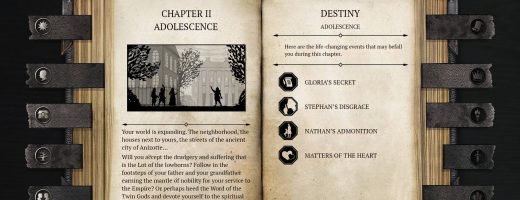
The player is born into the fantasy world of the Blessed Arknian Empire as Sir Brante. As a lowborn knave, players are introduced to his family: his father Robert, a noble man who has had children out of wedlock with a common-born woman named Lydia; brother Stephen, who was born to a noble mother and wishes to uphold the family name; Gloria, Lydia’s daughter from a previous marriage; and Nathan, who is born after the player and struggles with mental health issues. During childhood and youth, a lot of the story focuses on the Brante family’s status amongst the nobles in Anizotte, as well as the friendships and foes one will meet based on the player’s decisions. While childhood decisions at first will feel somewhat superfluous, they are, in fact, some of the most important decisions one makes in the game, as they are the starting points for how the player will develop Sir Brante as the story progresses. Whether it’s saving a young girl from being smushed by a rogue carriage, befriending the town bully, or returning a handkerchief to a high-born woman, all of these small moments are pivotal in terms of both character development and early faction advancement. Does Sir Brante wish to be a noble of pure heart? Does he wish to follow in the church’s teachings? Or perhaps become a spy in a network looking to overthrow the current regime? There are so many decisions and layers to these choices that keep the story both intriguing and replayable.

Homecomings are always emotional, aren’t they?
As players progress through the game’s lofty five chapters of Sir Brante’s life, they will have to make many decisions that will alter personal relationships and the political climate. How the player chooses to portray Sir Brante is up to them, though it can be challenging to foresee potential consequences along the way. With every choice made, the game will show the player how a relationship with a character has altered, or how their relationship status with a faction has changed. Even Sir Brante’s personality traits can change dramatically depending on a choice, meaning it can be very difficult for the player to navigate all of these elements that need to be managed. While players can see how a choice affects Sir Brante’s overall status, players will need to play the long game to determine which characters or events will need to be sacrificed throughout the story. It’s incredibly depressing, as it constantly feels like everyone in this world is being oppressed, and every choice feels heavy, often meaning someone lives and someone dies. There is so much weight to every decision that it can constantly feel like one is trapped in a never-ending cycle of woe. It’s not impossible to have Sir Brante change his stars and the world around him, but the game purposely makes it difficult because suffering is a huge part of the story.
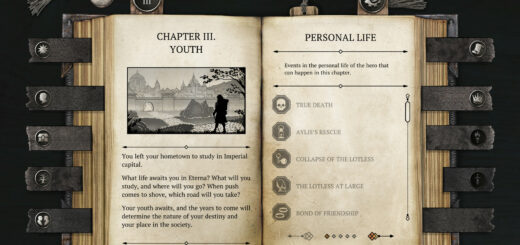
That being said, the game gives players multiple ways to track their standings with different individuals and factions. Players can check their family tree to see the status of family relations, check on the political status of the world, and even check all past decisions. Death also plays a key role in the game, as it doesn’t always mean a game over. If Sir Brante is killed in a Lesser Death, he can be reborn thanks to the Twins, who are the religious governing body in the Blessed Arknian Empire and who have shaped civilization, deciding who lives and who truly dies. However, there are also situations where True Death can occur, and once it does, players will be given a series of choices to determine the last rites of Sir Brante’s life. Players can also use this moment to rewind the game and start at any previously completed chapter to make different decisions. True Death is painful in the story, often with gory details, but the rewind mechanic lets players choose how much progress they wish to lose when they try again.

Every choice you make will have consequences.
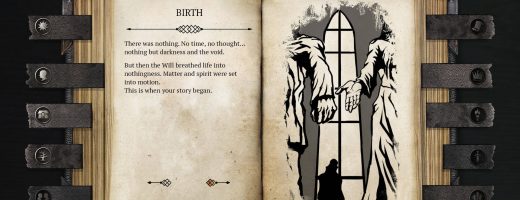
Visually, The Life and Suffering of Sir Brante is simplistic, featuring sepia tones and very detailed character designs. The majority of the gameplay takes place in a journal, so pages are constantly being altered, sometimes with small flourishes such as burns, water damage, and even rips. The design is very smart, as it really gives the effect of feeling as though the player is writing Sir Brante’s history page-by-page, and while there is the odd cutscene, it’s mainly there to display the change in chapter. While the art style is unique, it does a great job of signifying the grimdark world of the Blessed Arknian Empire. The choices in character and world design visually feel oppressive, dark, and horrific, as though there is no hope left in this world. The score is equally atmospheric, as the use of pianos and string instruments often provides a sense of dread and discomfort. Even when the soundtrack has moments where it is idyllic, it still feels sinister somehow.
Having finished multiple playthroughs of The Life and Suffering of Sir Brante left me feeling angry, depressed, and even frustrated. No matter how hard I tried, I found roleplaying Sir Brante so difficult and never managed to get out of the Commoner’s Lot, because I am stubborn and I believe in the power of people and organized gathering. That being said, all of those feelings made for such an engrossing experience, as replaying Sir Brante’s story over and over again gave me a deep appreciation for how strong the game’s storytelling is, and how deeply woven the decisions and consequences are. RPGamers who prefer games with strong narratives and deep decision-making mechanics will find a lot to love in Sir Brante, but it comes with the warning that it will make you depressed, no matter the outcome.

Choose Your Own Adventure-style narrative is strong
Game overs allow the player a chance to rewind their choices
Horrific and gut wrenching decisions
Depressing
Really depressing
You've been warned




Recent Comments