Tales of Seikyu Review
Playing Human
ACE Entertainment’s Tales of Seikyu is one of the most recent entries into the ever-burgeoning life-sim RPG space. Offering a neat spin on the regular cozy premise of the genre, it sees players putting down roots in a setting populated by yokai. Though it ultimately does little else to really distinguish it from the crowd, Tales of Seikyu nonetheless provides an engaging and well-executed gameplay loop, aided by a fun mix of characters for players to interact with.
The game begins with players creating their customised character: a fox yokai currently stuck in their human form, accompanied by their younger sister, Kon, who is stuck in her fox form. The pair disembarks from a voyage to the island town of Seikyu after following a message left for them by their disappeared parents. Seikyu’s citizens swiftly give them a warm welcome, giving them access to the old ranch, where they set up their new home and begin investigating the disappearance of their parents while looking to restore the former fox clan.
Tales of Seikyu’s setting is the part that most stands out about the game. Its world is one where humanity has disappeared and is populated primarily by yokai of all different forms, but which mostly try to live as humans. As a fox yokai, the player is able to take on multiple forms that provide vital exploration and farming abilities, starting quickly by obtaining the boar form that lets them churn land for farming. Other important forms include slime and tengu forms, which are necessary for exploring the ruins where much of the main story progression takes place, as well as making it easier to farm or travel.

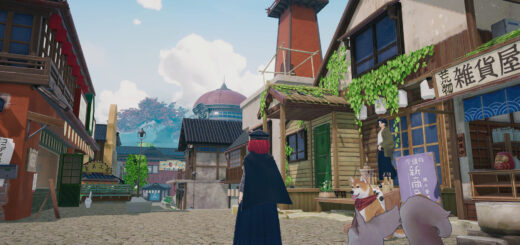
Players get to meet a fun mixture of characters.
Story-wise, the game does a decent job of making sure there are things to do and ways to progress, and the overall narrative is solid enough to keep interest. The strength in the game comes from its individual character arcs, including those of the player character and Kon as they find their home in Seikyu and uncover more about the fox clan and its history. That said, its twists are not particularly surprising, and it feels like there could have been a lot more to the main narrative’s conclusion. Fortunately, the people of Seikyu are always enjoyable to interact with, and their own side stories feature a good mix of subject matter as a result of the different types of yokai they inhabit, while the town always instills a great sense of camaraderie that remains welcome throughout the game. Players will be able to finish the main story and most, if not all, of the individual character stories within the first in-game year, and there’s currently little reason for players to keep going afterward, with special in-game events and festivities also being quite sparse.
The ruins are made up of getting close to a hundred rooms in total, each containing a mixture of enemies and collectible resources, with a small number of boss arenas thrown in for good measure. Most rooms require that players either defeat the enemies and/or break some of the rocks or ore within, though some will not be accessible to players until they are able to obtain certain forms or by solving small puzzles. There are a decent number of fast-travel points that make exiting and reentering much easier, as well as plenty of treasure chests and resources to find. It does the job it needs to without pushing the boat out very far, making for another area where the game is largely successful without being any more compelling than other titles out there.

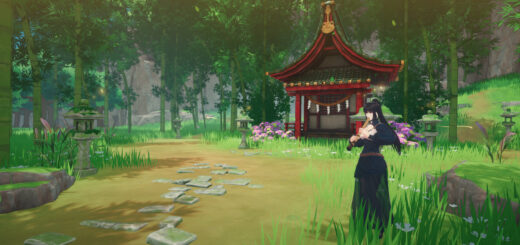
New forms are necessary to get through the ruins, but also helpful outside of it.
Combat is certainly part of the game, but very much not its main focus. It’s fine for what it needs to do, which is give players a way to defeat foes or go hunting, but there’s very little substance to it. Players can attack with a regular combo or a charged strike and dodge to avoid attacks, and that’s really all that needs to be done. The different yokai forms can be used in combat, but — with the exception of being underwater, where the slime form is enforced — it’s not at all necessary; the regular difficulty’s balance is such that players should be readily able to progress and defeat all of the bosses with very little trouble, just eating a bit of food for healing and stamina from the menu as needed.
Tales of Seikyu has a solid mixture of active and passive progression. Players can gain levels in a variety of disciplines, such as farming, combat, fishing, and so forth, which unlock new items and crafting options. Players can also level up their forms, including human form, to unlock new abilities or gain more health, though this costs money and talismans — earned by completing rooms in the ruins — rather than coming through experience. Other progression comes simply from the ingredients and resources players are able to obtain from their ruin exploration and ranch as they progress from bronze ore to iron ore and the like, allowing them to gain better or different items and tools.
Players will be able to get into a good cycle of spending the waking hours tending to their ranch, starting with sowing seeds, watering, or harvesting crops — and later also looking after animals — before making use of the various automated tools they can craft and install. After that, it generally makes sense for players to interact with the townsfolk and raise relationships where they can, before spending the rest of the day on whatever goal is most appropriate, such as exploring the ruins, collecting resources, and progressing events and quests. There is a good amount of breadth to the variety of crops and items that players can obtain, with some events and quests requiring that players generate specific produce or craft specific items to progress. At the end of the game, the amount of things that feel necessary or useful to do really starts to narrow down, but up until then it does a strong job of giving players enough activities and ways to keep expanding their ranch or the things they can produce.

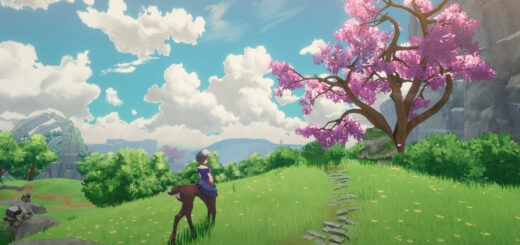
Seikyu is plenty charming.
Tales of Seikyu’s UI and controls work well without doing anything particularly noteworthy, and it performs solidly on Steam Deck. Presentationally, the game has a strong cozy and welcoming presence, with a pleasing and decently colourful art style and some charming music. Animations can be a bit limited at times, and there are a few glitches, though the ones encountered could be readily resolved by selecting the “Unstuck” option from the menu. The game doesn’t have any voice acting, though it doesn’t feel like it’s actively missing out because of it.
It may not manage to do anything particularly spectacular, but Tales of Seikyu is nonetheless a fun and charming game. Its yokai-themed setting, alongside its heartwarming and welcoming nature, goes a long way to giving it its own character, even if much of the gameplay fundamentals do little to stand out from the rest of the genre. Those looking to spend their time in a welcoming setting while building up their own ranch and exploring some underground ruins will find an enjoyable experience here.
Disclosure: This review is based on a free copy of the game provided by the publisher.


Interesting yokai-themed take on the traditional cozy setting
Charming characters
Effective progression systems
Cycle starts to tire towards the end
Combat is lacking
Not currently much reason to stick around after finishing the story




Recent Comments