System Shock 2: 25th Anniversary Remaster Review
Shock and Naw, Insect
System Shock is a widely known and influential series, perhaps even more so now than in its heyday. The fact that it spawned a spiritual successor in the BioShock franchise, among others, rightly gave it continued limelight even after well over a decade since its initial release. Now, on the heels of the remastered System Shock, developer Nightdive Studios has released the System Shock 2: 25th Anniversary Remaster. There is a deep satisfaction in delving into a piece of gaming history in this way, to potentially fill a starship-sized gap in one’s video game education that fans of sci-fi horror, first-person shooters, and (with the sequel’s heavier emphasis on character customization elements) lovers of RPGs will surely relish. However, it is also painfully obvious that the gaming landscape has changed dramatically since 1999, and despite the strides forward it represented back then, as well as myriad tweaks and facelifts implemented by Nightdive for this remaster, the reality that a two-decade old game is badly showing its age is impossible to escape.
The game takes place 42 years after The Hacker defeated the malevolent AI SHODAN in the franchise’s first outing. The universe has moved on, and even the evil TriOptimum Corporation has been reincarnated as a respectable conglomerate under new leadership. Players take on the role of a nameless soldier on board the company’s latest flagship, the Von Braun, currently on its maiden voyage to the stars. Not wholly surprisingly, the anonymous soldier finds themselves rudely pulled out of hypersleep only to learn that they are one of the last living humans left aboard the ship, surrounded by walking abominations of flesh and steel that tell a horrifying story of something unspeakable having occurred in the meantime. It doesn’t take long before further details begin to crystallize, revealing that the ship had followed a distress beacon where it landed a ground crew who investigated and subsequently became infected with parasite worms that twisted them into surreal nightmare creatures. Now it is up to the player to wrest control of the Von Braun back from its main computer XERXES, who is understandably not too thrilled at this idea. And that’s only the beginning, before plot twists abound and a hauntingly familiar voice once again rises from the ashes like a bad dream.

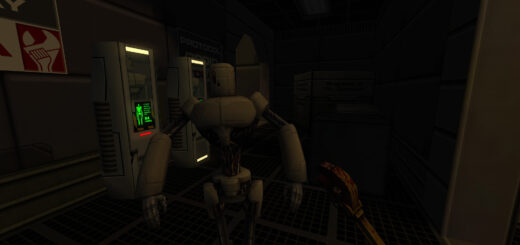
New ship, same sh*t. It’s a bad day to wake up from hypersleep.
Putting the player in the shoes of a blank-slate soldier opens up a number of possibilities for the game to bring in its RPG elements, in the form of offering the player character customization options. The way this is accomplished is rather clever, with a short playable prologue section in which the nameless soldier, at the beginning of their career, must select a branch of service, which determines their character class, as well as several duty deployments they underwent prior to their posting on the Von Braun, which grant additional stat bonuses relating to each assignment. Backstory thusly established, the game ricochets back to the present day, with the soldier in hypersleep aboard the Von Braun, about to receive their rude awakening.
The way the narrative unfolds is largely identical to what was seen in the first System Shock, with the bulk of exposition occurring via collectible audio logs and voice transmissions broadcast directly to the player or over the ship’s PA system and radio communications. There’s also a large amount of environmental storytelling inherent in the game’s design. Observant players will be able to piece together interesting bits of behind-the-scenes narrative by paying attention to their surroundings. For example, the telltale traces of some crew’s desperate last stand in the cargo bays, indicated by disabled elevator platforms on certain floors and cargo crates stacked in defensive fortifications. It’s also possible to intuit glimpses of what life must have been like aboard the ship before it all went down the wormhole, such as a full-fledged shopping arcade with storefront signs still lit in garish neon colors or stumbling across blood-spattered basketball courts and swimming pool halls in the recreation area.
It’s interesting to note that the game that eventually became System Shock 2 was initially conceptualized as a standalone property that was only tied into the established universe after publisher Electronic Arts came onboard, forcing some changes to the story to make it a true sequel. Credit to the development team, then, for making this merging of ideas feel mostly seamless. Connections between the games won’t be obvious at first, but there is a definite moment where all pretense is thrown out the window and the story lurches into sequel territory. However, it doesn’t come across as jarring at all, what with the name on the tin already advertising it as such, and the explanations that tie together characters and events from both games are generally plausible. In fact, the biggest moment of narrative whiplash comes in the game’s opening cinematic, where it’s revealed that the Von Braun’s military escort ship, the Rickenbacker, is helmed by none other than Captain William Bedford Diego — yes, the son of the same Edward Diego who created bedlam on the Citadel fourteen years prior. What are the odds?

An upper-level shopping arcade is clear evidence that normal life once ran its course here.
Sadly, this is where praise for the game slows down to a trickle. Sure, having character build options is nice, leading to some variety in how combat can be approached. But the fact of the matter remains that combat often feels like a war of attrition and careful abuse of the save system. Fighting can be done up-close and personal with melee weapons as well as at a distance with conventional firearms, though these have the downside of not only burning through ammo but also degrading over time with use and requiring regular repairs. There are also psionic powers that can be learned, and though each starting class leans toward a particular set of skills, players are never locked in and may spend cyber modules found throughout the game to learn or upgrade any skill they see fit. A nice addition in this sequel is the ability to conduct research on enemies and alien tech found on the Von Braun to gain passive damage bonuses and access to new weapons. Research on an item, once manually initiated, progresses automatically as long as players have the requisite chemicals in their inventory, making it extremely beneficial to take the time to find the chemical storage rooms dotted throughout the ship, since inventory space is rather limited.
Even with built-in options, however, combat never feels particularly strategic or satisfying. Rather, it’s a matter of saving the game at opportune moments and being prepared to replay sections that go badly, with enemies often lying in ambush or tracking the player down over great distances, particularly once spotted by the ship’s cameras. In contrast to the previous game, where destroying SHODAN’s cameras would lower the station’s security level and allow access to some new areas, here they really are just an extension of the on-board surveillance system, sending hordes of enemies to hunt the player down. There’s nothing inherently satisfying about repeatedly running sections of a level until nearby threats have been located, then reloading a save file and clearing them out one by one. Medical reconstruction machines have also returned from the first game, which, once powered on, will respawn the player upon death for a small price. Though these reduce the challenge significantly — essentially taking away the penalty of death and allowing for a kamikaze-style combat tactic since respawning is faster than reloading — they also void the point of careful play and resource management, at its worst making the game feel like rote repetition of run, shoot, die, and repeat, since enemies don’t respawn along with the player.

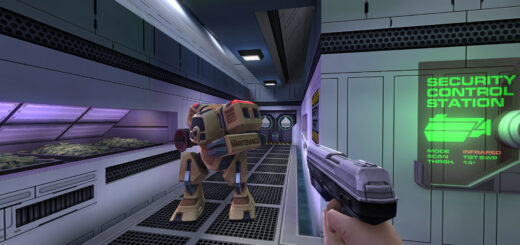
Slay, Queen! Literally.
The result is a certain level of identity crisis. At its core, the game is built to be incredibly challenging, bordering on cheap, with systems that are all designed to put the player at a great disadvantage. Rather than careful tweaks to swing the balance back to true, respawn bays feel like the system is actively undermining itself, leading to a lack of satisfaction for a challenge conquered, even if it’s often the only way to avoid hitting a brick wall. Difficulty can be lowered in the game’s menu, but even at its lowest settings, combat never truly feels fun — it’s always a toss-up between winning undeserved victories and suffering intense frustration. Additionally, respawn bays only work if players die within the same maps that they are located in, and dying after stepping through a bulkhead and loading into a new area, no matter how geographically close to a respawn point, will automatically result in a game over and potential hours of lost progress, so even this mechanic can’t be relied upon with any regularity. And since some areas have no respawn options whatsoever despite being loaded to the brim with environmental hazards and scores of nothing but the toughest enemies, the whole experience comes up wanting.
Elsewhere, there are some notable improvements from the franchise’s previous outing that address the previous game’s labyrinthine design. The most prominent of these are a far more streamlined plot progression and improved signposting of what is expected of the player at any given moment, even if something like an objective log is still oddly absent and the in-game map is perplexingly toggled off by default. Though backtracking is still occasionally needed, there’s far less of it here. Thankfully, the same applies to the large amounts of numeric codes required to progress in the original System Shock. Along with less cryptic gatekeeping, the game sees the removal of the first outing’s cyberspace shooting sections, which have here been replaced by a simplified but rather bland hacking mini-game. And while the dual antagonistic AIs represent an interesting development — teaming up with a former foe in the process — the game’s final boss fight is an anticlimactic letdown compared to the previous game’s, particularly coming after a final stage that already saps enjoyment by putting certain character builds at an unfair disadvantage through sheer overwhelming force.
It’s no surprise that System Shock 2 is graphically a step forward for the series and subsequently even further refined in this remaster. Environment geometry generally looks sharper than ever, and enemies and character models are more detailed, though that really just exposes their wooden character models and often stilted and floaty animation in greater detail. It’s safe to say that Nightdive did not reinvent the wheel here, and results will vary based on each player’s nostalgia level, as animation meant to resemble organic movement remains as artificial as before. It’s worth noting that System Shock 2 can be quite a visually dark game at times, and the environments on offer aren’t as memorable as those of its predecessor. Gone are the days of making one’s way up from the industrial areas of the Citadel to the posh living quarters of its most decorated officers, or of hopping on the nearest magrail train to explore the station’s verdant garden Groves. On the Von Braun, environments are more uniform, though there are at least some exceptions. Those playing on console will also have the added inconvenience of dealing with the game’s inventory and menus, which populate three distinct areas of the screen and, as a result, are proportionally challenging to hop between with a controller, but that was always going to be the case when not having a native keyboard/mouse setup available.

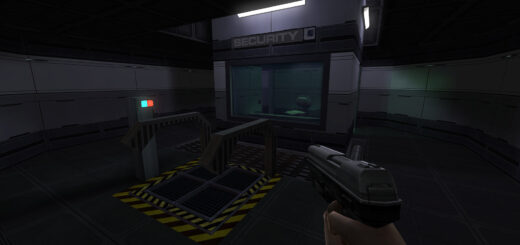
The game’s final levels explore the origins of the alien menace more closely.
The sequel maintains its predecessor’s penchant for telling large portions of its narrative via its many, many fully voiced audio logs liberally distributed throughout the two ships, along with frequent public address announcements by the station’s AI overlords and direct radio messages from surviving crew to the player. The quality of the voice acting is generally good, and while some members of the dev team also turn in some pinch-hit performances that aren’t quite on the same pro level, there’s nothing so noticeable that it breaks immersion. Of course, there’s only one voice role anyone will truly care about, and yes, Terri Brosius indeed reprises her iconic role as well, but the amount of post-processing for her role as SHODAN to give it its constant feedback loops and pitch changes is and always has been a little on the excessive side, and really a question of personal preference. There’s far less variety when it comes to music, which often disappears entirely to let ambient noise play its part in stretching out the tension. Once enemies go on alert and firefights begin, however, they are accompanied by frantic EDM dance hall beats that may mirror the accelerated heart rate the developers were aiming for, but they get old rather quickly.
So how does this remaster of a vaunted classic stack up in the end? It’s a strange beast, where each step taken by Nightdive to inject some modern convenience is countered by an outdated design decision, though fans of the original will be happy the developers decided to hew closely to what they remember so fondly. It’s all very much a case of “one step forward, one step back,” resulting in a game that absolutely honors its source material, for better or worse. For new audiences, however, that same approach leaves a lot less to latch on to. A classic it may be, though it never quite manages to be as memorable as its equally punishing predecessor despite coming close. Between its crass difficulty, clashing gameplay systems, and at-times-puzzling implementation, System Shock 2 is a game that aims to take the player’s breath away but winds up running dangerously low on oxygen instead.
Disclosure: This review is based on a free copy of the game provided by the publisher.


The whole classic series is now widely available for all to play
Established narrative continues on an interesting trajectory
New options expand character building and combat options
The game carries its 25-year age as a heavy burden
Ricochets between a brutally unfair challenge that is often trivialized by in-game systems
A lesson in video game history rather than a fun escape




Recent Comments