Starbites Review
Not Bitter, But Not Gourmet
IKINAGAMES’s Starbites is fairly obvious about its inspiration from classic RPGs. Its turn-based combat and pathfinding exploration very much follow the template of a few generations ago to decent effectiveness, and the cast and setting has enough about it to generate initial interest and enjoyment. On the whole, the game does a solid job of inserting all of the requisite elements of an enjoyable RPG to a decent standard, but in the end, it doesn’t really offer anything that helps it stand out from the crowd.
The game is set on the previously prosperous planet of Bitter, which became caught up in an intergalactic war and is now largely desert ruins with the remaining populace getting by on salvaging what remains and the wreckage from the conflict. It stars Lukida, a young woman working as a scavenger trying to pay off a heavy debt carried over from her parents to Fennec, the woman who runs her hometown of Delight. Dreaming of escaping her debt and exploring the stars, Lukida’s primary goal at the start of the game is to get hold of a ticket off world alongside her pals Gwendoll and Badger. However, this quest soon ends up leading to some deeper mysteries that involve the secrets of Bitter’s past.

Lukida is an entertaining protagonist.
Starbites’s story is mixed in its effectiveness. Its strength lies in its characters; Lukida is an entertaining protagonist despite a propensity for poor decision making early on that can be put down to the impetuousness of youth. The other party members she picks up and characters she meets along the way likewise provide strong support and good interactions. It also moves along at a decent enough pace, with the game lasting around 25 hours, and never really getting bogged down. However, it fails to make the most of its setting, with potentially interesting elements falling by the wayside, and it doesn’t quite manage to give its grander reveals the setup and depth to make them fully effective.
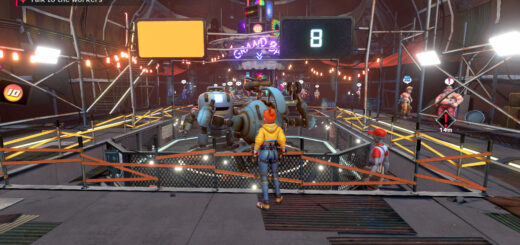
Basic gameplay sees Lukida traversing the world map or dungeons, travelling through pathways and corridors with plenty of treasure and a reasonable amount of pathfinding to keep them engaging. Puzzles related to progression are always quite simple and generally a matter of searching or flipping switches until the correct path is found, but there’s enough variation to the routes and enough loot reward for searching everything to make it enjoyable. The game contains a selection of straightforward sidequests, which consist of talking to relevant people or going and finding something in the world. They help add a little bit of extra flavour to the setting, but ultimately aren’t anything to write home about and dry up in the late stages of the game.
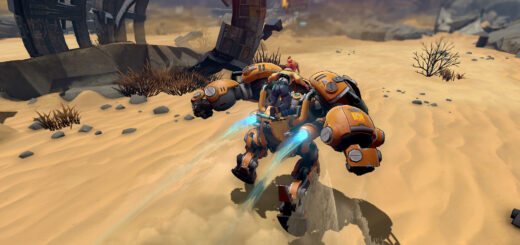
Starbites sees the party of three active members fight using mechs called Motorbots. Individual turn-order is based on each combatant’s speed attribute, with each turn offering the usual selection of actions: a basic attack, a skill, using an item, or guarding. The prime differentiator for Starbites’s combat is attack types; each enemy has a Barrier Point number by its HP bar and a number of initially-blanked out icons denoting its weaknesses. Each character’s regular attack follows a particular type, with skills potentially offering additional attack types, and hitting an enemy with its weakness will reduce its Barrier Points. When this is reduced to zero, the enemy becomes Broken for a period of time, during which it cannot act and takes additional damage.

The game’s combat largely works well, though doesn’t necessitate much strategising.
Another notable element of the combat is the Driver’s High system, which can definitely help get players out of sticky situations or bring a quicker close to combat. Each party member’s DH Gauge is charged by attacking, using skills, or getting hit. When filled, players can activate Driver’s High at any moment, which gives them the opportunity to immediately perform an attack or skill, with skills also being upgraded to have more power or additional effects. Each character has their own set of skills and tactical specialty, though players can readily pick out a party that they prefer and not really have to worry about handling the remaining characters, who will still provide some extra assistance in support.
Ultimately, the battle system has just about enough depth to maintain interest across the playthrough, although it does start to tire near the end. The game comes with three difficulty levels that can be switched between at any time. For the most part, the standard difficulty is generally forgiving and, unless they actively avoid regular combat encounters, players will easily be able to keep themselves appropriately levelled. After the first couple of acts, it’s easy enough to get through most encounters and boss fights by following a standard set of tactics, with the exception of a couple of bosses that require some specific tactical changes. Defeat does equal game over, though manual save points are common enough, and the single auto-save slot happily jumps in even more often, so any defeat is unlikely to result in notable time loss.
Upon level up, each character gains a Talent Point that can be spent on the Talent skill tree, which is split into three separate groups and provides extra upgrades to base stats or battle skills. New skills are automatically learned at specific levels. Players also have four equipment slots for their Motorbots: one for their weapon and three armour slots, though the equipment is purely stat-based and doesn’t provide any extra passive effects. Passive effects are instead granted by the Motorbot’s separate engine and cores. The engine provides some extra base attribute modifiers, with up to three cores providing passive and reactive effects, such as a counterattack chance or a buff at the start of battle. Much like the combat overall, there’s not a huge amount of depth, but still just it has enough about it to keep players engaged and offers worthwhile rewards for engaging with the systems.

Starbites features traditional pathfinding exploration with plenty of loot to find.
The English voice acting is good throughout and goes a long way to helping make the characters enjoyable to spend time with, but the script doesn’t offer a whole lot of opportunity to fully let the voice acting shine. Music is likewise enjoyable, and a few of its tunes are certainly catchy, though without ever becoming particularly noteworthy. The visual style of the game very much follows that of the mid-to-late 2000s era that seems to drive much of the game’s inspirations. There is good use of style in the overall design and a pleasing colourfulness to it, with some welcome touches and decent character designs, but specific locations and enemy designs are almost immediately forgettable and there’s a definite disparity between the 3D character models and 2D artwork.
Starbites ultimately sits firmly in the middle of the RPG spectrum, never really approaching either end of it. There are plenty of enjoyable moments involving the character interactions or when the combat and exploration get into a good rhythm, but it never really takes that extra step needed to stick in the memory. Nonetheless, it’s an enjoyable enough way to spend the time, and there’s a strong base for IKINAGAMES to be able to build upon going forward.
Disclosure: This review is based on a free copy of the game provided by the publisher.


Entertaining characters
Solid, if unspectacular, gameplay
Not much that stands out
Locations aren't particularly interesting





If the exploration is like an old JRPG, I’m in xD I’m buying this once it gets released