Megaton Musashi W: Wired Review
Get in the Robots, Everyone!
Level-5’s Megaton Musashi has had a long journey to finally getting released outside of Japan. After struggling commercially with its initial Japanese release, the game managed to find new life by going free-to-play before finally getting a worldwide paid release as Megaton Musashi W: Wired that adds new missions and a story expansion. Going under the radar, the game itself is a flawed, yet enjoyable mecha action RPG.
In the town of Akagicho, the citizens live what seems like a normal existence. High school student Yamato Ichidaiji and his rival Ryugo are recruited by the organization Oblivion Bay. After joining, it is revealed that the town is actually a shelter that protects the remnants of humanity, with 99% of the human population having been annihilated by a group of aliens code-named the Draktor. Yamato is motivated to join the fight against the aliens upon discovering that his family was killed in the invasion, as opposed to the house fire he initially thought thanks to the fake memories implanted in him by the organization. To fight the Draktor, Yamato must pilot the Megaton Musashi, a giant robot that is referred to as a Rogue, along with Ryugo and their classmate Teru. Additionally, potential Rogue pilots are being assassinated, with Yamato himself being the target of Arshem Laia, the princess of the Draktor, who is killing potential Rogue pilots under the orders of her mother Queen Crouzade. With new revelations that tie the fate of Yamato and Arshem together, they are set upon a path to end the conflict and bring peace between Earth and the Draktor.
The story is presented through a mix of 2D visual novel-like conversations and a decent amount of anime/CG hybrid cutscenes. The latter are used during significant moments that show off the spectacle of the narrative’s more bombastic moments. The Japanese voice acting does a great job of committing to the super robot melodrama, with several veterans in the cast really selling their parts. The music isn’t really anything to write home about, but it generally does well establishing the tone of the game’s story along with the appropriate accompaniment to the mech battles. The most notable parts of the score are the variety of vocal themes littered throughout that create the feeling of playing through a mecha anime, and given Level-5’s history it’s no surprise that there’s a tie-in anime.

Yet another set of high school students being forced to pilot giant robots.
Megaton Musashi’s story has several moving parts, and its sizable cast receives focus on both sides, which is a strength in some ways and a weakness in others. Over the course of the game, the story dives into the motivations of several characters and the various dynamics and relationships between them. Yamato and, in some parts of the game, Arshem, are effective viewpoints characters for the narrative. As they and their opposing sides repeatedly cross paths, the contrast between their views becomes apparent as they get to know each other. That doesn’t mean that other characters don’t get their chance to shine, though, as other Rogue pilots such as the idol Jun, the athletic Momoka, and the cat-obsessed Reiji all have their own moments that make for some interesting subplots.
However, some characters get more focus than others, and some feel like they fade into the background after a while. Kota, for example, is a bullied student who is revealed to be an android specifically designed to help people relieve stress; for example, allowing bullies to beat on him to protect other kids. He joins with Oblivion Bay due to his abilities that make him useful in helping delivering intel to Rogue pilots. However, his arc pretty much ends as soon as it starts and exemplifies issues that plague the late stretches of the game. The big elephant in the room is an age-gap relationship between two characters that ends up being important to later developments in the plot, which is really uncomfortable and never properly addressed in the story. There are enough enjoyable moments to help carry the game in the first half, but flaws in the storytelling really start to catch up with it, especially in back third, where plot progression turn to just sound and fury, signifying nothing. This is a shame, as the story shows real promise in the early goings.
Every major story event has the player partake in a combat mission. These take place in linear stages where players pilot one of the designated Rogues, defeating enemies and fighting boss monsters known as Fusion Types. At the end of each mission, the player is rewarded with points that increase their Player Rank, as well as loot. Loot can include different Rogue parts that are used to upgrade their mechs and bonus items that can be activated before taking on each mission. Bonus items can increase earned experience points and the chance of getting legendary loot after a victory.
Upgrading Rogues is key to getting stronger and better handling the increasingly stronger enemies in later missions. As players complete missions, they obtain Rogue parts that are used to upgrade them and increase their stats. They can also use the Laboratory to upgrade existing parts and to craft new ones using junk parts that come from dismantling parts. Many parts are obtained as loot gained from completing missions, allowing for several options for players to customize their mechs. One method players customize them is by equipping microchips enabling all kinds of abilities and passive buffs into a Rogue’s Motherboard. Most of them are obtained by a skill tree-type grid that is accessed through the Laboratory and even upgraded into stronger versions using junk parts. Going through this game often feels like tedious busywork due to the sheer size of the grid, though a list selection makes things somewhat more efficient. It’s important to check what microchips have been equipped, as the enemies in each mission have a recommended element and weapon type that maximizes inflicted damage.

Showing confidence is one way to ensure victory.
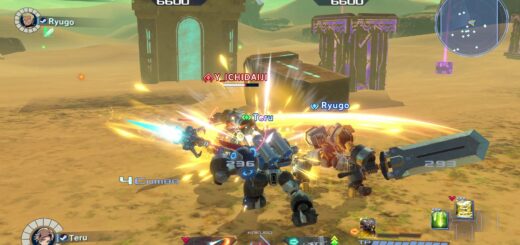
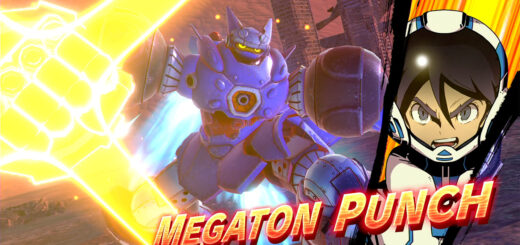
While Rogue customization is where a lot of the game’s depth lies, combat itself is far from lacking and is where the most enjoyment in the game is found. During a mission, the player will take down waves of enemy mechs as they go through a linear level. Defeating enemies boils down to having the right elements and weapon types equipped, which are always shown in the pre-mission screen. There are interesting wrinkles to the game’s combat. One example is that Rogues can suffer damage to their various parts, causing a Rogue’s functions to become compromised. For example, damage to the head component disables use of the mini-map and damage to the legs causes reduction in movement speed. Rogues can have these parts repaired in the middle of a mission by entering cockpit mode, and a crucial tactical decision is to decide whether to continue fighting in a compromised state or to take a risky chance at repair. There are also Combination Moves that allow the player and another pilot — one controlled by AI in offline modes or by another player in online multiplayer — to combine their powers to activate a powerful attack. Another set of powerful and useful attacks are Kabuki Functions, which are varying kinds of super moves that can be used by filling up a gauge. This gauge is filled by executing special moves that use Tech Points (TP), which is gradually recovered over time, meaning players should regularly use these whenever possible.
Between missions, players explore locations through 2D-side scrolling, where they can accept sidequests and help NPCs. Completing these unlocks inaccessible areas, and players can also find stickers that unlock optional side stories that flesh the characters out. Various objects are also scattered throughout the town areas that can also be exchanged for items at certain vendors. Unfortunately, the stickers are a pain to collect because they only show up at certain times of day. Despite the ability to change the clock at any time, this still amounts to excessive backtracking and tedious pixel-hunting. This is especially sad, as the side stories typically do a good job of showing a deeper side to characters outside of the central plot.
Other than side missions, players can take on other kinds. Treasure Missions allow certain loot to be obtained, Shelter Missions provide information on what occurred at other isolated Shelters, and the Stronghold Campaign mode lets players pick from a list of available missions as they fight through the God Hammer Stronghold and obtain emblems that can be equipped for specific stat effects. There are also missions where strong boss monsters can be fought that are generally best handled with other players online, which thankfully allows for crossplay between other platforms where Megaton Musashi can be played. Unfortunately, there’s no guarantee that enough players will be available online due to the lower profile of the game’s release, so a dedicated friend group will most likely be necessary.

Prepare for a lot of sifting through Rogue parts if you want to make the best mechs possible.
There is also the matter of the free-to-play vestiges that are still in the game, such as daily log-in bonuses. This can feel deeply awkward but thankfully there are no in-game microtransactions to worry about and it doesn’t negatively affect the play experience that much, but it is worth noting to anyone interested in playing it, especially long after release.
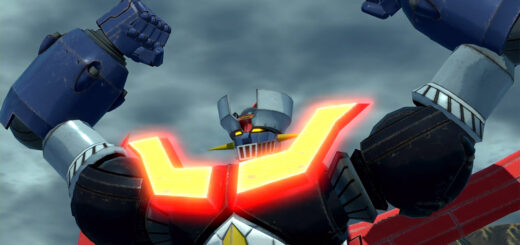
In-game visuals switch between a relatively basic but serviceable 2D presentation during the exploration segments — with character designs akin to anime series geared at a younger demographic — and the full 3D seen during the combat missions. The Rogue models and various parts they are built from are impressively detailed, especially since the various parts can be customized and switched out, which is reflected in both gameplay and cutscenes. The mission areas are graphically serviceable, but ultimately unimpressive, consisting mostly of basic textures and geometry. Thankfully, this isn’t that distracting of an issue, as the Rogues and combatants are very much meant to be the star of the show here, with visual effects and animations that do a good job giving the mech combat some genuine impact. The game performs well enough on the Switch, mostly keeping a consistent 30fps, though there is the occasional performance hiccup during combat when it gets a bit busy. There are also curious delays when navigating the in-game menu.
Megaton Musashi W: Wired offers plenty in terms of a dumb, fun giant robot game. While story issues and performance issues on Switch hold it back from reaching greater heights, the depth of the mecha customization and combat is entertaining overall. The entire package is a bit of a mixed bag, but it’s one with just enough not to feel disappointed.
Disclosure: This review is based on a free copy of the game provided by the publisher.

Enjoyable mech combat with in-depth customization
An overload of missions to partake in that allow of a lot of that good giant robot action
Story starts off promisingly with an enjoyable cast of characters...
...that completely collapses into borderline incoherence in the back half
The overload of upgrade systems is probably too much
Minor hitches that make the Switch port not the most ideal way to play the game




Recent Comments