Lost in Random: The Eternal Die Review
Random Rules
2021’s Lost in Random was a 3D action adventure set in a wonderfully nightmarish world of twisted imagination, about a little girl named Even who set out to rescue her sister Odd who was forcefully taken from their home by the evil queen of Random one night. Four years, a studio merger, and subsequent rebranding later, the newly reminted Stormteller Games has returned to the Tim Burton-esque world of Random, this time with a very different twist on gameplay. While a sequel, Lost in Random: The Eternal Die takes players on a very different journey than its predecessor, stripping away exploration-heavy gameplay in favor of a much deeper, much smoother combat experience. The fast-paced title draws immediate comparisons to Supergiant Games’s Hades, producing a very worthwhile isometric roguelite with a similar lose-to-get-stronger gameplay loop.
While the game takes place in the same world as the original Lost in Random, The Eternal Die is a major departure from the previous entry. Players take on the role of the previous game’s antagonist Queen Aleksandra who, in an attempt to atone for her evil deeds, is dragged into the twisted world contained within the Black Die to end its corruption. Turned into a younger version of herself, Aleks and her die-companion Fortune must traverse four worlds based on her past and face down several bosses who played key roles in that past to ultimately defeat the Black Die’s master, Mare the Knight.

Aleks and Fortune, ready to begin their adventure in the Black Die.
The game is fairly welcoming to newcomers to the IP as no deep knowledge of established lore is needed to get underway. Players are caught up on Aleksandra’s background as the game unfolds, discovering characters and events from her past life naturally as they connect to her current adventure. The Black Die functions as an extra-dimensional prison of sorts, and the antagonists awaiting to confront Aleks were once banished here directly by her, so it’s no wonder they all have revenge in their black hearts. Though the narrative is more of a spin-off than a direct sequel, the world and its characters retain the same darkly twisted fairy tale aesthetic as the original, with memorable (and charmingly disturbing) character designs aplenty.
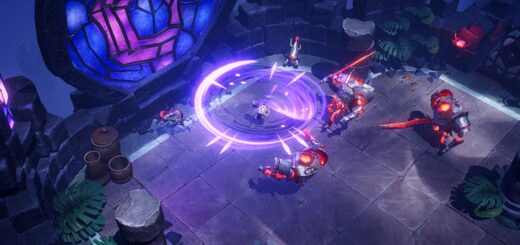
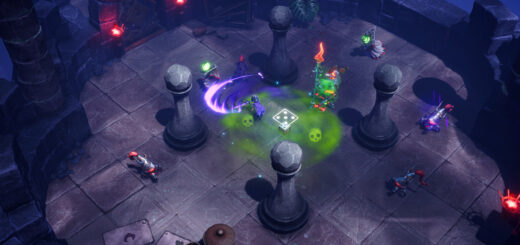
Gameplay has undergone a drastic shift this time around, with The Eternal Die being focused almost exclusively on fast-paced action combat. While combat in the previous game felt plodding at best, the designers have found ways to adapt it considerably to the new gameplay loop while leaving all its keystone elements largely untouched. Combat in The Eternal Die is fast and frantic, with controls that are responsive and smooth. Battling monsters still utilizes a mix of dice, cards, and actual melee combat, though this time everything has been adjusted with offense in mind. Aleksandra starts out with sword in hand and Fortune ready to be tossed into the fray. Previously, dice rolls were largely used to earn combat points that would in turn activate various ability cards; here, however, Fortune will deal damage directly in an area of impact when tossed amongst enemies, with an attack power determined by the number rolled. On the other hand, cards essentially function as magic spells, powered by energy dropped by enemies. Unlike before, Aleks is able to equip only one card at a time, and grabbing a new one will replace the previous card for good.

Cards and dice are woven into combat in a much more engaging way this time.
Between dice, cards, and handheld weapons, it’s easy to see how The Eternal Die greatly expands the previous entry’s combat options, giving players a lot of flexibility to experiment with different builds while always staying true to the thematic element of randomness. The key to this versatility is the upgrade grid, which fully resets with every new run. After each combat encounter, Aleksandra is offered a reward, which may include currency used to purchase permanent upgrades or the more immediately useful but temporary relics and pearls. Relics and pearls can be placed on a diamond-shaped upgrade grid, where matching three of the same color in a row will boost one of Aleks’s stats for the remainder of her run; for example, lining up three red relics will make her melee attacks more powerful. Additionally, relics each have passive abilities that will apply once they are placed on the grid, such as providing a minor damage shield or increasing the likelihood of the otherwise fairly rare health drops. The type of relics Aleks finds is yet another random element to the game, and it doesn’t take long before the upgrade board begins to fill up and players need to decide whether to replace an already placed relic with a new one they just discovered, causing character builds to be in a constant state of flux.
What really adds some depth to this system is the synergy between the relics players find and Aleks’s attack repertoire. Some relics will have no direct effect on Aleks herself but add an elemental modifier to either her dice or card attacks, like poisoning enemies in Fortune’s impact radius or sparking off a chain of lightning strikes between foes when a card attack is used. Still others may apply a circumstantial effect to Fortune, for example causing an effect only if a specific number is rolled, or reward skillful players by granting boons as long as Aleks avoids damage. In addition to all of this, it isn’t long before players earn the ability to expand Aleksandra’s weapon arsenal. Finding and restoring the robot Rack will open up his armory, where Rack will sell and upgrade melee weapons. Unlike relics found during runs, weapon upgrades are permanent, though players will have to choose which ones to make use of. Each weapon — sword, bow, spear, and mace — has four upgrade paths players can advance by collecting and spending Cinders, but only one weapon and one upgrade path can be active per run. It’s a system that offers lots of experimentation without overpowering Aleksandra, and weapon upgrades in turn also synergize with those provided by relics.

Combat is frantic, and every run leads to a unique build.
In order to find their way to Mare the Knight, Aleks and Fortune must proceed through four distinct levels of the Black Die, each representing an area of Random that Aleks has some history with. Each isometric level is made up of around twenty separate rooms, give or take, each bringing with it some sort of encounter. The majority of rooms are combat encounters, with doors that only unlock once all enemies have been dispatched. But there are also event rooms peppered in, like trap gauntlets where Aleks must reach the other side while traps trigger all around her. Each level also includes a vendor, a mini-boss, and a dedicated room where Aleksandra can try her hand in a game of chance to (potentially) win some prizes. There are even dedicated story-focused rooms, where Aleks will come across a scene or item that triggers a memory of her past. While all level layouts are completely random, these story rooms occur in sequence over numerous runs. The ultimate goal is to locate the staircase on each level that leads to the area’s boss, though there are obvious benefits to scouring each level and locating all possible power-ups and rewards before moving on.
It’s the area bosses where players may experience the first significant sense of repetition. As players sharpen their skills to match the challenges each area throws at them (and continue unlocking more and more permanent upgrades between runs), they will have to face the same bosses on each and every run, with Mare being the fourth and final one. To soften some of this sense of déjà vu, there is a decent amount of voiced dialog exchanges that precede each battle, but the fact remains that the bosses, while being well designed, eventually become an immutable part of the grindy nature of the game. Of course, bosses may require practice, adding more and more time onto each run as Aleks and Fortune are sent back to the very beginning again after dying. There are no permanent shortcuts that allow skipping any areas in the game, no matter how often players have gone through them.
Each time Aleks dies, she is tossed unceremoniously on top of the ingeniously named Discard Pile, ostensibly The Eternal Die‘s home base from where each run is started. While it is a rather barren place at first, it doesn’t take long for Aleks to meet a number of NPCs during her travels whom she sends back to the Discard Pile, where she can interact with them between runs. These range from the aforementioned Rack to the witch Aama, who sells permanent perks, as well as others who offer new cosmetics to change into or other sidequests that can be accomplished during Aleks’s outings into the Black Die. It’s always easy to spot new available interactions with an NPC due to large icons appearing over their heads, and completing all available sidequests is required to reach the game’s best ending (with even more difficulty modifiers available for post-credit runs), but several of the NPCs encountered here unfortunately feature very little dialog or characterization and are more one-and-done affairs instead.

When even Aleks’s friends look this fearsome, what does that say about her enemies?
The return to the world of Random brings back the same darkly imaginative art style as the previous game, though the move away from full 3D exploration means it’s mostly in the character designs that this is now evident. Whereas the previous game fully immersed players in the world of Random, with its crooked architecture and nightmare-fuel citizenry, the environments in the Black Die are tailored to act more as staging areas for combat encounters, and the randomized level layouts with each new run necessitate prioritizing function over form. Nonetheless, the character designs are outstanding, feeling like a cross between The Nightmare Before Christmas and American McGee’s Alice, with twisted yet lovely character portraits. It’s a macabre art style in which even the protagonists often look like wicked abominations, but it works marvelously to create a twisted fairy tale atmosphere. No slouch either are the well performed voiceover performances for the characters Aleks interacts with, imbuing the grotesque character designs with equally memorable characterizations.
Lost in Random: The Eternal Die is a very well executed roguelite action RPG that brings players back to the fascinating world of Random. While the foremost focus this time isn’t the narrative, the combat system has received such a shot of adrenaline that it more than makes up for it. Combat flows fast and frantic, with a wealth of offensive options mixing melee combat with dice- and card-based attacks. Though there is some necessary repetition that sets in due to the roguelike nature of the gameplay, the many synergies possible between various moving parts of the battle and upgrade systems make for a wealth of build flexibility. Anyone with any interest in roguelikes like Hades will want to give it a whirl, while the dark fairy tale atmosphere will be appealing to others. The game wants to present a polished, not revolutionary, experience and manages to deliver on this in spades.
Disclosure: This review is based on a free copy of the game provided by the publisher.


Fast and frantic combat that mixes melee, card, and dice attacks
Temporary and permanent upgrades make for a good amount of run flexibility
Outstanding character art and voiceovers bring the darkly macabre cast to life
Few bosses plus lack of shortcuts equals necessary repetition
World exploration and lore are far more sidelined this time around




Recent Comments