Flintlock: The Siege of Dawn Review
Attack and Dethrone God(s)
Ever since FromSoftware demonstrated its mastery, there have been plenty of others looking to show off their takes on the grim fantasy action RPG space. A44 Games takes a slightly different direction than most, aiming for a mixture of greater approachability with appropriate condensing of the experience in Flintlock: The Siege of Dawn. What results is an experience that works decently as a first entry to the Soulslike sub-genre, though it likely won’t do enough to convert those with misgivings.
Flintlock: The Siege of Dawn is set in a world that has been battling an onslaught of the Dead for the past decade. The game begins with Nor Vanek, a sapper in the Coalition army, embarking on a mission to destroy the apparent source of the Dead armies. However, this ends up being a mistake, as it fully unleashes the tyrannical gods of the Great Below upon the world. In the aftermath, Nor finds an ally in the feathered supernatural being Enki, who promises to help her fix this mistake, granting her the powers and assistance needed to kill the hostile deities.

Enki proves himself an invaluable ally in Nor’s quest to kill the gods.
Nor’s quest takes her across a couple of decently sized regions, where she needs to take on the Dead, bandits, and others who may have been seduced by the gods. During that time she finds an assortment of allies, sidequests, resources, and various towns and hamlets that she can liberate. There’s an appreciable amount to explore, and the resources, items, weapons, etc. gained from doing so make it worthwhile. It helps that the location designs incorporate verticality very nicely, which makes getting around a lot more interesting. The platforming works to the game’s benefit, even if the trigger for Nor grabbing onto ledges can be a touch inconsistent.
The sidequests provide enjoyable extra content and incorporate some of the game’s best storytelling, utilising its setting well to tell some brief stories that can be heartrending. The overall story is enjoyable enough and Nor herself is a strong protagonist, but the game is often lacking the necessary world-building to get players properly invested in the setting and what’s going on. Players are largely thrust into events and quests without really being given enough to establish how or why things are connected, while the mythology behind the gods is underdeveloped and left up to players to try and piece together. There’s easily enough to the story to keep players engaged, but plenty of areas where it could do more.
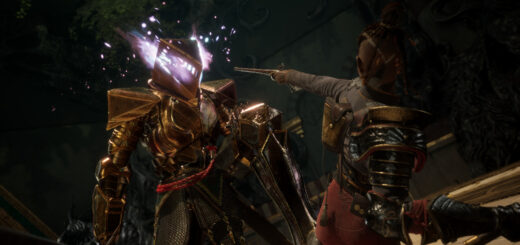
As its title suggests, Flintlock features 17th-century military technology combining melee weaponry and gunpowder firearms. Nor uses axes for her primary melee weapon, though she can also find a couple of hammers, and can also wield a primary and secondary firearms. The primary firearm, usually a pistol, can be brought out immediately and aims automatically, with additional shots recharged by using melee attacks, while the secondary weapon requires both aiming and reloading, and has a very limited total number of shots available. In addition, Nor has access to health potions and a small selection of grenades, while Enki can get involved and attack enemies or unleash a special attack upon command.

Combat works best against singular enemies, as it’s far too easy to lose track of others.
The combat system is solid but largely unspectacular, though the bosses provide some great and challenging encounters. It’s on the faster side, which allows for some appreciable flashiness. The game uses both dodging and defending/parrying, though getting parry timing right. Many enemies will be armoured and need to have that taken care of first, which is usually best done with a dedicated weapon or tactics. Fighting against single enemies is where the game works best, with the boss fights being highlights, while multiple enemies can be frustrating due to the inability to react to or often even see them. Three difficulty options can be changed between at will — although the story difficulty will disable achievements — so that those who do find avoiding attacks too tricky can get still get through the dozen-or-so-hour game.
Character upgrades are governed primarily by Reputation. Reputation is earned by defeating enemies, finding certain items, and participating in a coin-based mini-game. Reputation gained from foes makes use of an interesting bonus system, where it is not automatically gained until players cash it in. Before cashing it in with a button press, players can build up a bonus percentage through their battle action that is applied to the current collected Reputation; however, if the player takes any damage then the bonus is lost and Reputation is cashed in at face value. The penalty for dying is being moved back to the latest checkpoint at the loss of any held Reputation, but it can be retrieved if players simply get back to the place where they died without dying again.
It’s an interesting system that helps reward players, but this also gives the game plenty of opportunity to annoy players and further highlights the weakness of the combat system against multiple enemies, when it’s very easy to get sniped or hit by foes other than the one being focused on. Reputation is used to unlock abilities on the game’s skill tree as well as for purchasing outfits, and even upgrading the gear that Nor obtains throughout the game. These upgrades usually also require resources found through exploration. Gear is as close as it gets to creating a build style, but it’s nothing hugely game changing and, aside from the bonus system for generating repetuation, there’s little that stands out about the upgrade systems.

Some of the game’s visual design elements do make it stand out, even if there aren’t many memorable sights.
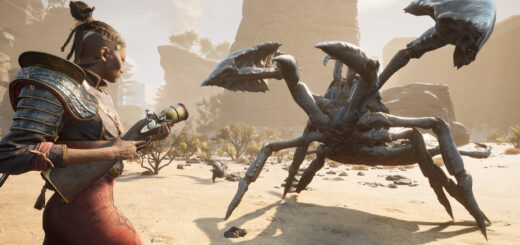
The game’s visual design works well and helps it stand out a little bit from the crowd, but there’s not much to write about the enemy designs, which are lacking in both interest and variety. Once players are able to find the appropriate graphical settings, the game performs generally well on Steam Deck. There were a few unexpected crashes in the review playthrough, but these all occurred right after an autosave point. Audibly, the game fares a bit better. The musical themes add some strong backing, coming to the fore on boss fights to lend them a sense of occasion, while the voice acting is strong throughout, led by a fine performance from Olive Gray as Nor.
Flintlock: The Siege of Dawn is an enjoyable experience, but may struggle to stick in the memory. There are some interesting ideas at play, but the execution just always leaves a little bit to be desired. While it never perhaps hits the same heights as other titles, it maintains a solid baseline that successfully holds interest for its playtime.
Disclosure: This review is based on a free copy of the game provided by the publisher.


Verticality adds to exploration
Good sidequest writing
Strong voice acting
Lacking a bit in world-building
Fighting multiple enemies can be annoying




Recent Comments