Esoteric Ebb Review
Fantasy Democracy
One can readily point to Disco Elysium as helping kickstart this decade’s cRPG revival, with its focus on character interactions inspiring a good number of titles in recent years. However, simply emulating a particular style is not in itself a recipe for success without also including strong design principles, able writing and quest design, and an engaging setting. Thankfully, Christoffer Bodegård’s Esoteric Ebb has all three, using its eccentric cast and world to great effect, fully bringing players into its thoroughly entertaining set of mysteries and ensuring they’ll have plenty of fun getting through the various obstacles it throws at them.
Esoteric Ebb puts players in the role of a cleric in the eclectic post-Arcanepunk fantasy city of Norvik. They have been tasked with investigating an explosion at a tea shop; however, they start out the game waking up in a morgue after being seemingly brought back from the brink of death. After creating an initial character build by assigning points to the usual attributes — Strength, Dexterity, Constitution, Intelligence, Wisdom, and Charisma — players set out to establish their current position and begin work on the quest they were assigned. Complicating the situation is that Norvik is due to hold its first-ever election in just five days, and players need to solve the mystery while navigating the city’s political factions before the voting takes place.
The game sees the player’s attributes act as characters in their own right, offering constant inner dialogue. Players frequently ask internal questions, and the attributes help to inform their reactions and feelings towards characters and situations they find themselves in, as well as providing all relevant historical or world details that the cleric would know. Though the cleric has their own set history, players are able to establish their personality by their choices and character build, with the game keeping track of whenever they express support for a particular party in the upcoming election or choose to refer to themselves as a cleric or something else.

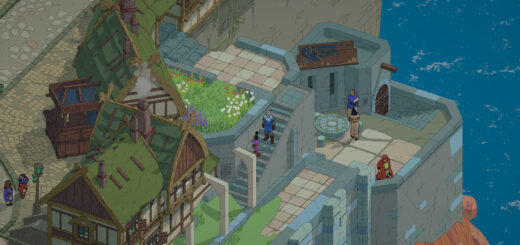
The city of Norvik is home to a wide variety of eccentric characters, the player included.
While the main quest involves solving the mystery of the tea shop, players have a large amount of freedom as to how they go about it, and can choose to pick up and focus on numerous side quests as well, many of which connect to the election or main quest in some way. Players are joined early on by a goblin companion named Snell, who proves to be a strong and entertaining sidekick, playing off well with the cleric, particularly during any odder moments. Quests involve a large selection of varied characters who are all entertaining to interact with in different ways, aided by the internal commentary of the cleric’s attributes. Many of the quests have multiple ways with which they can be solved or ended, helping give the game plenty of replay value.
With the five-day limit of the main quest, the game takes an interesting approach to advancing time. Time moves forward minute by minute as players advance events and conversations; taking longer to exhaust all avenues in a particular conversation uses up more time. Moving around does not advance the clock, giving players a bit more freedom and agency over how they spend their time. Many characters or locations are only available during certain times of day. Players will also need to find an appropriate time to sleep and take a long rest to restore spell slots and prevent exhaustion. Players may feel a bit rushed initially as they see the clock advance; however, the pressure it applies definitely works in the game’s favour. It succeeds in impressing upon players that they do need to prioritise their investigations and quests, but after getting used to how it works in practice, it doesn’t feel restrictive and still lets players follow the story threads they want to naturally. It helps encourage players to make plans and makes it very satisfying to follow through on them.
Esoteric Ebb can be a bit overwhelming at the start, as the game largely throws players into the situation and hands out a lot of information at once, without little guidance on what to do with it. However, everything soon starts to fit together, and it becomes clearer how the game’s systems and quest design work, even if the city remains a bit awkward to navigate. The writing gets long-winded at times, especially when it delves into factional politics and history, during which many players may glaze over a bit, but the conversations overall are thoroughly entertaining, aided by a strong underlying set of mysteries and highly enjoyable quest designs. Despite its bizarre foundations, the game’s setting has a ton of depth, and its eccentric cast ensures there’s always plenty of fun interactions to be had.

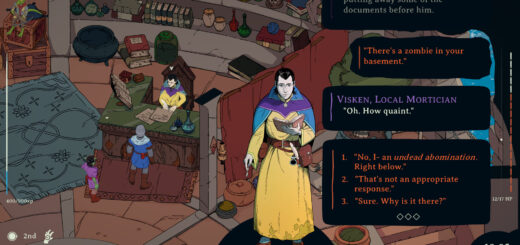
The cleric’s attributes offer plenty of advice on how to react or deal with characters.
Gameplay is built around both active and passive D&D-style skill checks. Passive checks that directly compare a number against the player’s attribute score are usually used in dialogue, primarily determining what advice and responses the player’s attributes offer. Meanwhile, active checks — where a d20 is rolled, and the player’s relevant attribute modifier is added to the result before being compared against the relevant Difficulty Check (DC) — come during events, encounters, and interaction with the world and characters. A number of dialogue options come with a skill check, which are frequently impacted by choices that alter the DC or grant Advantage/Disadvantage (where two dice are rolled instead, and it takes the higher or lower value, respectively). Natural ones and twenties are handled accordingly as guaranteed failures and successes.
Esoteric Ebb doesn’t contain combat per se, but certain high-danger encounters add a bit of combat flavouring, and the game keeps track of the cleric’s Hit Points. These turn-based events see the player and their opponent take turns performing actions, but rather than attacking, players must complete skill checks to get through the encounter. They offer the most direct threat to the cleric’s HP as they come under direct assault, though plenty of other events can also reduce their HP through poor choices and failed skill checks. Health can be restored using various consumable items or a healing spell, with numerous other spells also available for the cleric to use to their advantage, albeit with a limited number of spell slots available to use each day.
Should the cleric’s HP reach zero, the game will automatically run a series of death checks, where the player will need to roll a ten or higher to succeed. Three successes or a natural twenty will see them return with 1HP and a point of exhaustion, while three failures or a natural one means game over, though the game has an autosave and players can freely manually save outside of events and conversations. Aside from this, the game does a good job encouraging players to accept failed rolls in addition to basking in the joy of a lucky success. Trying to overcome a failure is often just as entertaining than smooth success, with there being other paths available to progress the game.

Players can equip or use various items to help them in their quests.
Players frequently earn small amounts of experience as they learn information and complete quests, which lets them level up, gaining points to upgrade attributes and unlocking additional spell slots. New spells can be found in a variety of ways, from completing quests to obtaining spell scrolls from numerous characters or locations. In addition, players able to pick up a wide variety of items that can be equipped into various slots. These items can alter attribute scores or provide bonuses in certain situations, such as giving advantage on conversational skill checks with bureaucrats or unlocking new event choices when a hammer could be of use. For further bonuses, completing quests allows players to unlock feats, with most quests providing providing multiple options, and to equip up to four at once.
Esoteric Ebb’s audiovisual elements do their job of supporting the strong gameplay and writing without ever standing out. The game’s art style works well with the setting, while the character designs are strong throughout and the different locations are decently distinguishable from one another. There is no voice acting, but it never feels like players are missing out with its absence, while the music and various sound effects add solid enough flavour to the visuals. The UI does a fine job, even if it takes a little bit of deciphering early on, and the game is great to play on Steam Deck with its built-in gamepad controls and adjustable text size working well.
While Esoteric Ebb certainly doesn’t try to avoid the direct comparisons to Disco Elysium’s style, it manages to stand out through its original setting and entertaining set of mysteries. The ingrained usage of skill checks to help guide conversations and what the game reveals to players helps keep them engaged, with plenty of highly enjoyable quests and interactions to be had all the way through. There’s lots to enjoy here, particularly for those who like seeing how their choices affect the presented mysteries and obstacles.
Disclosure: This review is based on a free copy of the game provided by the publisher.


Tabletop-style gameplay works incredibly well with quest design
Entertaining characters and setting
Highly enjoyable writing
Can be a bit overwhelming at first
City is sometimes annoying to navigate





Recent Comments