Inside BioWare’s Narrative Design: Interview with Sylvia Feketekuty
Writing for massive, choice-driven RPGs is a balancing act between dense lore and personal character arcs. For this interview, I was given the opportunity to talk with veteran writer and former BioWare narrative designer Sylvia Feketekuty to pull back the curtain on the “black box” of game development and writing. From keeping Commander Shepard’s dialogue punchy to navigating the technical constraints of branching paths and onboarding players into complex fantasy frameworks, Feketekuty shares invaluable insights into how some of gaming’s most iconic universes are built, one line of dialogue at a time.
Please note that this interview contains mild plot and character arc spoilers for Dragon Age: The Veilguard, specifically regarding Emmrich’s companion quests.
Austin Langer (RPGamer): When thinking about RPG dialogue across different eras, how do you approach balancing clarity and relatability with maintaining a distinct tone for the setting?
Sylvia Feketekuty: The two big settings I wrote for- Mass Effect and Dragon Age – were already fairly well established when I came along, so I never had to approach this from the ground up. But it was interesting to see the differences between each project.
On Mass Effect we aimed for what I’d call “timeless modern” dialogue. We wanted it to sound contemporary, like something a real person might say today. (With some exceptions, like your Elcors and your Reapers and so on.) We went light on modern swears and slang, because those date very quickly and call attention to themselves. Mass Effect does have its own in-universe slang, but the rule was to use it sparingly, and only when it felt unobtrusive. The idea was to make it easy to slip into the setting, so players could enjoy learning about it without getting hung up on the language. (Some sci-fi is all about future linguistic permutations, which is cool. But that wasn’t Mass Effect’s focus.)
Another guide, for me at least, was our main character. Shepard is a person of action! Always looking for a solution, moving ever forward. It’s because they’re the player character, but I think it set the tone for the rest of the game, especially during missions. Whenever it came to writing Shepard’s lines, I was always looking for a way to make them shorter or snappier. (And I believe their lines came in, on average, shorter per word than any other major character’s.)
Writing for Dragon Age was different. Since Mass Effect takes place in our own universe, you know how the laws of physics are supposed to work there. But each Dragon Age game had to reestablish its particular metaphysical framework of magic and spirits, their effects on different cultures, and the politics of dealing with them, on top of introducing new people and places. In my opinion, at least, there was a lot more to explain to players. Especially in the first few hours.
This is probably why, when I came on to Dragon Age: Inquisition, the narrative team already knew they wanted a diplomat character. Josephine helped to ground the big, political forces clashing around you. Whenever she briefed the Inquisitor, I had Josephine approach it like an executive summary. She knows the Inquisitor’s time is valuable. So, in tandem with your other advisors, she always gave players just enough information to make a decision, but never so much as to overwhelm them.
One of the other quirks I had in the back of my head is that Josephine isn’t quite as efficient in her speech as she thinks she is. The Lady Ambassador is never tiresome! But she’s so seeped in the grand politics of Thedas, she can’t help but try to round out all of the points, in the most diplomatic way possible. Paradoxically, I think it makes her exposition more interesting. That quirk is, I hope, part of Josephine’s charm.

On Mass Effect, the narrative team aimed for “timeless modern” dialogue that made it easy for players to slip into the sci-fi setting.
AL: I noticed your work includes onboarding tools like codex or glossary systems. When those are in place, does that change how much exposition needs to live directly in dialogue?
SF: I hope so! I did feel a bit more confident knowing that in Dragon Age: The Veilguard, players always had a place to look up basic concepts in the glossary. So I did go a little lighter on the “as you know…” exposition. But it’s a hard thing to measure, because you can’t know ahead of time how many people will actually open up a glossary and read it in full.
There’s things you can do to make it more inviting. When I was working on the Lore Glossary with editor Cameron Harris, we discussed with the rest of the narrative team how many terms we actually wanted to define. We limited it to a maximum of thirty. Throwing a bunch of new, setting-specific jargon at people can really overwhelm them. So thirty basic terms to define some of the most important parts of Dragon Age, with descriptions that never went over three sentences, seemed like a good limit.
It’s interesting to see how other games handle doling out lore. Final Fantasy XVI has a contextual codex system, where if you pause during a cutscene, any codex entries relevant to what’s going on are right there, in the pause menu, for you to read. And Owlcat’s Rogue Trader has a really slick hyperlink system. If you hover your mouse over any highlighted words of dialogue, up pops a short description, which you can expand into a slightly larger description, which links to the full glossary submenu. I liked this one a lot because the “lore words” don’t pop up so often that it gets distracting, and it also reminds you that the larger glossary is there as a resource.
So yeah, there’s lots of ways to do it.
(One thing I’d like to mention: there was a misconception going around at one point that I wrote all of the codex entries in Veilguard. This is not the case! They were split evenly among all of the writers.)
AL: When a character is responsible for delivering critical exposition, how do you prevent that functional role from flattening their unique voice? Have you encountered situations where exposition demands directly conflicted with character voice?
SF: It can be a struggle! I’ve absolutely hit times when a character who needed to be in a scene was not the best choice to explain what was going on. In that case, sometimes delaying part of your exposition is the best move. An NPC learning about what’s going on alongside the player always helps pace things out more naturally.
As for making sure exposition doesn’t flatten a character’s voice: one thing I like to do is give an NPC something to complain about, or worry over, or be excited for. It’s not necessary for very short scenes, of course. But if it’s a larger beat of exposition, try to dig deep for that hook. It helps with even the driest of information. If resources and time permit, bringing in a second NPC for the first NPC to argue with is even better. We always pay more attention when there’s friction.
When I was writing Emmrich’s personal quests in Veilguard, I tried to have a current of worry running underneath his explanatory dialogue. He’s the kind of person who’s always mulling things over in the back of his mind. “Should I tell Rook about lichdom? Can I successfully join their ranks? Will Manfred be all right if I do? Will Rook understand?”
And once Emmrich learns a former friend is behind the sinister events he’s investigating, his anxiety goes through the roof. It was really easy to write Emmrich’s plot exposition after that, because it was so charged with his personal anguish and fears.
Those moments weren’t perfect right off the bat though. I’d like to shout out the other writers, especially Trick and Brianne and Gabriel, who gave feedback that helped bring those emotions to the fore. Honestly, having someone you trust give you candid but useful story feedback is probably the fastest way to improve your exposition (and most other parts of your writing.)

The writers designed Josephine to act like an executive assistant, giving the Inquisitor just enough political context to make major decisions without getting overwhelmed.
AL: When you look at player comprehension, is there a point where simplifying dialogue starts to feel like you’re explaining too much? How do you identify that line in practice?
SF: By feel, mostly. At BioWare, we had narrative peer reviews with the writers, editors, and a few people from other departments. Those were round table critiques of the first draft of writing for every major mission and character arc. That was a great place to learn whether a concept was clear or not.
And many times, we’d get feedback on exactly where people felt lost. There’s so much going on with big, sprawling, action-RPGs that you need to remind your audience what’s happening more often than in a book or a movie. After all, the player might be coming back to a plot after doing anywhere between fifteen minutes to twenty hours of side content (or more!)
AL: In your experience at BioWare, have you seen moments where making dialogue more accessible actively weakened the tone of a scene? How do teams recognize when that tradeoff has gone too far?
SF: The feedback we got about that, both internally and externally, was mostly about the clarity of our exposition and where it was falling down. In terms of tone, you could recognize it wasn’t working if players felt overwhelmed or unengaged. And again, usually the solution was to break a chunk of information up, and deliver it over a longer stretch of time. It almost always made the dialogue sound more natural.
If breaking up a chunk of exposition was impossible, if a mission just didn’t have room, that was usually a sign the story was doing way too much at once. It meant the team needed to start simplifying what the player needed to know (go here, learn Y, defeat X with Z) so it didn’t interfere with the emotion of things.
AL: A lot of RPGs have characters with story arcs where they make a big, life-changing decision influenced by the player. When writing this kind of quest, how do you keep a character’s core beliefs and personality consistent? If the player has such agency over a character, how do you balance their ‘core profile’ so the character doesn’t sound like a totally new character if they do evolve through player choice?
SF: You definitely have to nail down a character’s core voice, their hopes and fears, before deciding how a big choice will change them. Or at least I do. The best thing you can do for yourself at this stage is to plant the seeds of this choice. Everyone has conflicting beliefs or multiple things they hold dear. Even if you don’t come up with the perfect life-changing decision right away, knowing those internal contradictions and yearnings will give a foundation to tinker with it until you get it right.
When planning out Emmrich in Veilguard, for example, I spent a lot of time noodling around with his background and his philosophical foundations before I felt I really got him. And in the first draft of his personal arc, the ending always led to him becoming a lich. The choice was more about how intelligent or not Manfred got. And it was okay, but it wasn’t gripping. It didn’t get at anything about Emmrich.
So I thought about it, and realized I wasn’t really pulling on some of the things I’d set up with his character. Emmrichs’ fear of death, contrasted with his reverence for it; his not-entirely-acknowledged paternal bond with Manfred; whether Emmrich could overcome his self-doubts for his deepest desires. So the choice became achieving lichdom or bringing back Manfred. And after he becomes a lich, Emmrich is even more rapturously absorbed in the spirit world than he was before. And if he decides to bring back Manfred, Emmrich finally takes conscious responsibility for what that little skeleton means to him.
So I would say Emmrich’s voice does evolve, depending on the player’s choice. But in both cases, it was along a journey he’d already begun to take, and rooted in who he always was.
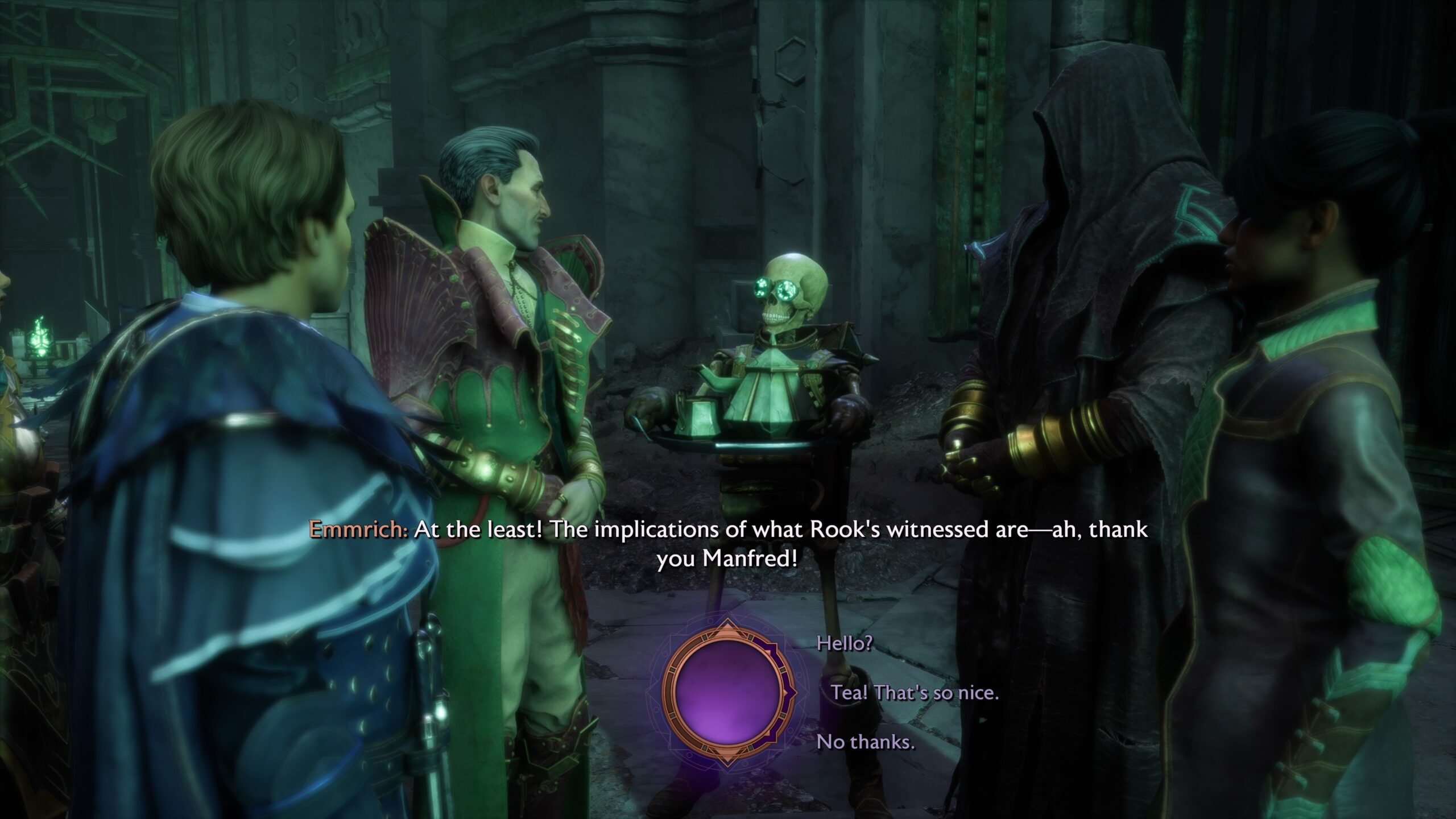
Emmrich’s personal questline in Veilguard is rooted in his underlying anxieties and fears, allowing his emotional arc to evolve naturally alongside player choice.
AL: How early in development do narrative constraints like branching scope or VO limits start shaping how dialogue is written?
SF: Right away. I think people would be surprised by how much even “small” branching dialogue-say a shopkeeper who has six different greetings and farewells-can make your word budget skyrocket when multiplied across an entire game. (Especially if your game is fully voiced, and you have to keep actor availability into consideration.)
One thing I wanted from the start of Veilguard was significant branching with Emmrich for players who took the Mourn Watch origin. Since it’s one of six origins, there was only, theoretically, a one in six chance players would ever see that dialogue. On paper that doesn’t seem like a good use of extra words. But I think that kind of branching is what players like the most.
It really pays off a choice you make, and lets you get deeper into role playing a specific fantasy, and changes a relationship with a character. That’s cool! It’s the kind of reactivity I like, at any rate. So if Rook’s a Mourn Watcher, players can complain with Emmrich that no one outside Nevarra really gets necromancy, or gossip about what’s happening back home, and so on. That was very fun for me. I think it was worth it.
AL: As player choice systems scale across multiple games, maintaining all those outcomes can become difficult. How do teams decide which past decisions remain meaningful and which ones are quietly deprioritized?
SF: The main concern isn’t just how many words you have to reference past decisions, but how much scope you have to build and test the content’s complexity. Once you have to factor in branching within branching decisions, it can rack up exponentially. Generally, whenever we didn’t feel we had enough resources to do a past choice justice, or it wasn’t easy to work into the new game’s story, we went with lighter references. Or let it lie, so that we didn’t violate anyone’s playthrough.
That isn’t always satisfying for players. I think that’s because some people believe if a choice from one game isn’t referenced in the next, we didn’t actually like that choice. If you’re outside the black box of development, I bet it can feel frustratingly personal. All I can do is promise that I’ve never seen that actually be true. No one who works years on a game likes the idea of a player feeling left behind. We want people to feel their decisions in past games were legit! It’s just almost always a matter of time and budget.
AL: You mentioned working on the Shattered Library in Dragon Age: Inquisition Trespasser DLC. What made that area particularly fun or challenging to write, especially in terms of delivering lore without overwhelming the player?
SF: It was exciting to finally start teasing deeper glimpses of the old elven empire. The rest of the writing team gave me feedback, so that we stayed within the boundaries of what felt right for Dragon Age. But I was given a lot of leeway to explore. I really wanted to show what it was like when magic hadn’t been stoppered up yet. A hint of decadent lushness, weird and fleeting scenes that felt like parts of larger stories. That’s one reason I made the Shattered Library’s codex entries read as if the player was experiencing them as sense-memories, instead of regular writing.
(The second reason is that, in-game, it might make no sense for the Inquisitor to flawlessly understand ancient elven depending on their past decisions. Constraints make interesting choices!)
In terms of keeping players from being bombarded by lore, it helped that the codices I’m talking about were side content. The main story of the Shattered Library was that it was part of an ancient disaster. We wanted players to really feel how cataclysmic it was for the elven people when the Veil came down. By making everything else optional, players weren’t overwhelmed because they could pick and choose how much they wanted to dive into the glory days of Elvhenan.
AL: Looking back on your work, are there any narrative decisions or approaches that changed significantly over the course of development? What drove those changes, and how did they affect the final player experience?
SF: That’s a great question, one I feel almost entirely unequipped to answer. It’s very hard to judge your own work. But I do feel I became more adept at balancing out the flow of information during my plots. I hope that translated into an even more fun time for players!
We hope you enjoyed learning about some of the narrative processes and thoughts that go into character writing. We would also like to extend our deepest thanks to Sylvia Feketekuty for taking the time to answer our questions.



Recent Comments