Crescent Tower Interview
Curry Croquette has been tapping into the NES-era nostalgia with Crescent Tower (demo available on Steam), by combining classic dungeon-crawler exploration within the heights of a mysterious tower with the turn-based roleplay reminiscent of 1980s JRPGs. Players get to build their team from three different races and nine different classes to explore and conquer a tower filled with traps and mysteries. Joining RPGamer today is the developer Curry Croquette to answer some questions about the game. This is the developer’s first title and is being created on days off from a job unrelated to video games.
Ryan Costa (RPGamer): With homages to both Final Fantasy and Wizardry in the gameplay, did either of these inspirations take center stage while planning out Crescent Tower?
Curry Croquette: Yes, Crescent Tower was influenced mainly by Wizardry in terms of its game system, and by Final Fantasy, mainly in terms of its UI.
We also took inspiration from many other JRPGs, such as The Legend of Zelda, Pokémon, and Dragon Quest.
For example, the dungeon mechanics were influenced by The Legend of Zelda. In Crescent Tower, items from The Legend of Zelda are replaced by each character’s skills.
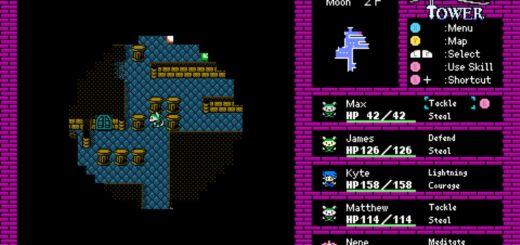
And the system that allows character skills to be used not only in battle but also for dungeon exploration is influenced by the Pokémon series. We wanted to recreate in Crescent Tower the fun of thinking about party composition while also considering Hidden moves such as “Cut” and “Strength” that can also be used to solve puzzles.
A protagonist who can use lightning spells and healing magic is a staple of the Dragon Quest series, and I think it will be familiar to fans of Japanese RPGs.
RPGamer: What is the most unexpected issue that has come up with respect to balancing the game between the Retro and Modern difficulties?
CC: The game’s balance adjustments were based on Retro. Modern is based on Retro, with adjustments that make leveling unnecessary, double the experience points gained, and halve the chance of encountering an encounter (of course, other small adjustments have also been made).
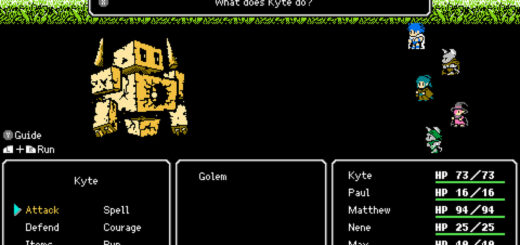
One surprising aspect of the balance adjustments was that the aspects that test players found difficult were completely different. In Crescent Tower, you start the game with just the protagonist, Kyte, and as the game progresses, more companions join the team and systems such as character creation and class changes are unlocked. Players who are accustomed to retro RPGs find the early stages, when the systems are not yet unlocked, difficult, while players who are not accustomed to retro RPGs find the mid-game difficult as they are unable to make good use of the unlocked systems.
I think one of the challenges this time was designing a system that even players unfamiliar with retro RPGs could become familiar with.
RPGamer: Will environmental obstacles evolve as the players ascend the tower? How many different types of traps will be encountered?
CC: There are 10 types of traps in total.
Floors 1 to 3 of the tower have a standard map layout, but from the fourth floor onwards each level has its own concept. We’ve tried to come up with a variety of ideas to keep players from getting bored, such as a level that makes use of a large number of teleporters, a level that uses ice gimmicks, and a level with a simple map but in which vicious monsters appear.

RPGamer: There’s a lengthy and enticing list of treasure for each creature. Is there a way to figure out a percentage table to see what can be obtained for players to decide if it is worth grinding for? Is this list the same for stealing and for after-battle treasure chests?
CC: The treasure list after battle and the list of treasure that can be stolen are the same.
The Seeker class uses a skill called Compass to look up a monster’s treasure list. Once you’ve looked up a treasure list, you can look it up again at any time.
While the Seeker isn’t very useful in battle, it is a class that can look up treasure lists, learn useful mapping skills, and support the party outside of combat.
RPGamer: The soundtrack is well composed, with many songs that evoke the feeling of classic titles, is there one in particular that resonates most with the staff as one that captures the essence of nostalgia best?
CC: The soundtrack is actually not original, but uses music distributed for free by a Japanese artist called Youfulca. The sound wasn’t created specifically for Crescent Tower, but it fits the atmosphere of the game perfectly, and I like it.
Personally, I find the background music on the third floor of the dungeon particularly nostalgic. As the game progresses, the party reaches the point where all five members are gathered, and I think the background music matches the atmosphere of “the real adventure is finally about to begin.”
https://youfulca.com/
RPGamer: Starting off utilizing a map scroll to fully plot out the dungeons is an interesting mechanic. Was it hard to program in something that is so finely player controlled?
CC: The programming was simple, with very little need to manage flags, so I didn’t have many difficulties there (although I did have many difficulties due to my poor programming skills…).
On the other hand, I struggled a lot with the level design and polishing the game system before programming, as I had to think about it while considering a variety of playstyles.
The game is designed with maniacal playstyles in mind, such as clearing the game with just the main character, Kyte, and without adding anyone to a party, or clearing it at level 1 without gaining any experience points.

RPGamer: Kyte’s class in the demo is Brave, how does his class differ later on from the nine other classes?
CC: When creating Crescent Tower, I first decided on the world view and story, then the people who live in that world. I then added a game system that would allow players to immerse themselves in that world.
Kyte is one of the characters living in this world, and his bravery and courage influence those around him, for better or worse.
I struggled a lot about how to summarize Crescent Tower as a work, but I decided to make Kyte’s class Brave, and tell the story from Kyte’s perspective. The Brave class represents Kyte’s humanity and personality.
Meanwhile, in terms of the game system, Brave has similar abilities to the Hero in the Dragon Quest series. The Hero in the Dragon Quest series is called ” Yuusha (meaning brave in Japanese)” in the Japanese version, which was a perfect fit for Kyte’s image.
RPGamer: With the Creeping Coin enemy from Wizardry lore making an appearance as Dancing Coin, will there be other direct Easter Eggs to the titles that inspired Crescent Tower, and if so, are there any you could share?
CC: In addition to the Creeping Coin, a monster based on Murphy’s Ghost from the Wizardry series also appears in Crescent Tower. There’s also a monster based on the Stray Metal from the Dragon Quest series. They run away easily, but if you can defeat them, you’ll get a huge amount of experience points.
RPGamer: Will there be a full party or more characters who can be met in the tower, or will there always be created characters in the party as well?
CC: Inside the tower, you’ll meet Max the Beastman and Nene the Elf, who will join you on your adventures. You’ll need to create your own characters for all party members except for Kyte, Max, and Nene.
Just like characters you create yourself, you can freely change the class of Max and Nene or remove them from your party.

RPGamer: Meditate is a wonderful ability; using a turn to increase MP is so much easier than travelling back and forth to town. What other modern amenities were you most excited about adding in to make this 1980s-inspired title feel at home in the 2020s?
CC: Crescent Tower is based on the Wizardry game system, but we have revised systems that we felt were too inconvenient. “Meditate” is one example of this, but we have done away with complicated systems such as character loss, age, and inns (of course, those complicated systems were part of the charm of Wizardry…).
We have also incorporated many other ideas to make operation more comfortable, such as shortcut keys that allow you to use mapping and torches with one touch, and the battle speed can be adjusted in great detail to make leveling up more comfortable.
RPGamer: Will there be any side adventures related to expanding the story for the characters that are met in the tower?
CC: There are no side adventures related to the story. However, as I mentioned in the previous question, Crescent Tower is created in such a way that the story and characters are developed first and then the game system is applied.
Characters like Kyte, Max, and Nene have well-defined backgrounds, and it’s clear where they were born, what kind of lives they lead, and what their thoughts are when they take on dungeons. We didn’t delve deeply into these stories in the game, but there are hints throughout that will help you learn more about their stories. I hope you enjoy these aspects as well.
RPGamer: What is something that you would love to share about the game not discussed above?
CC: I created Crescent Tower to be enjoyable not only for fans of retro RPGs, but also for people who have never played an RPG from that era. I hope that players will immerse themselves in the game’s world and adventure, just like when they first played a video game as a child.
RPGamer would like to thank Curry Croquette for their time in answering these questions about Crescent Tower as well as Sarah Blackwell and Stride PR for making it possible. The 8-bit retro dungeon crawler RPG is aiming to release later in 2025 on Steam.




Recent Comments