Persona 5: The Phantom X Impression
It’s clear that it has many of the trappings of Persona 5; however, its gacha nature and structural changes undermine the cohesiveness of the experience.
Developed by Perfect World’s Black Wings Game Studio under the supervision of Atlus, Persona 5: The Phantom X was created to give the very successful Persona 5 a presence in China and Korea, where mobile gaming is much more prevalent. Atlus has now given international players the chance to experience its take on the Phantom Thieves, while also bringing it to PC. After putting around ten hours into the game, it’s clear that it has many of the trappings of Persona 5; however, its gacha nature and structural changes undermine the cohesiveness of the experience.
Although the game is nebulous about it, it seems to take place in an alternate, somewhat distorted world to Persona 5′s. It begins with a version of Persona 5′s intro, up until the new player-named protagonist interrupts proceedings and then suddenly wakes from their dream. At this point things fully diverge. The Phantom X’s protagonist — soon codenamed Wonder — comes from a completely different background to Joker, living in a fairly large house on their own and seeming to be an unremarkable student at Kokatsu Academy.

Familiar locations but new faces.
The game’s introduction is primarily about them noticing that something is wrong with their world; it appears that hopes and desires have been largely stolen from the populace, meaning that little to no effort is put into solving problems or helping others in need. This discovery puts them on the radar of Lufel, a mysterious talking owl, as well as giving them an invitation to the Velvet Room, where the enigmatic Igor offers his assistance in unlocking the protagonist’s potential. Soon they are introduced to the Metaverse, and the hostile Shadows that appear within it.
Persona 5: The Phantom X is at its best when it’s emulating Persona 5. It’s in a bit more of a rush to give players things to do and the story isn’t quite as impactful, with certain story beats within its first Palace clearly drawn from Persona 5, but the sequences where the game can focus on the story and developing its characters work very well. Lufel is an interesting contrast to Morgana, and in fact works much better at introducing players and the protagonist to the Metaverse and what their role as Phantom Thieves is, being much more respectful and invested from the outset. The other cast members also do a good job of standing out and complementing the story with their own goals and personalities.
That being said, it’s hard to escape the differences, particularly the lack of a calendar system. This means that once they’ve gone through the extensive set of tutorials and unlocking of its various systems, it’s largely up to players to figure out what to do. This ultimately ensures that The Phantom X loses the tight structure and direction of Persona 5. It’s also hard to hide from the fact that the game is a gacha, and this is made abundantly clear by both the number of menus that the player has to deal with and the sheer mass of different currencies or resources they get saddled with. The game gives players a steady stream of unlocks and a lot of ways to interact with them, but it’s never very clear quite how useful each part is among the full mass of them. Quantity of systems is very much a driving force, and dealing with the sheer volume of icons highlighting that something has been unlocked or is new gets tiring quite quickly. There’s an obvious reason for it, but ultimately, this gets in the way of being able to enjoy the experience.

Palace Infiltrations? We got those too.
The dungeon-crawling and battles are found in different content. Unsurprisingly to Persona 5 fans, the meatiest of these consists of Palace Infiltrations, where players work through large dungeons complete with puzzles, obstacles, and mini-bosses to overcome. Similar to when it focuses on the story, these are the high moments of the game where it is generally successful at emulating the original. There is also The Phantom X’s iteration of Mementos, the multi-floored dungeon that effectively covers the subconscious of Tokyo as a whole, and offers plenty of ways for players to build up their power and resources. However, it’s nature is diluted by being surrounded by the game’s menus, events, and party building elements. There are various challenges and training battles, alongside the launch collaboration event with Persona 5, which consists of a bunch of short, largely uninspiring vignettes that contain small amounts of story, combat, and exploration.
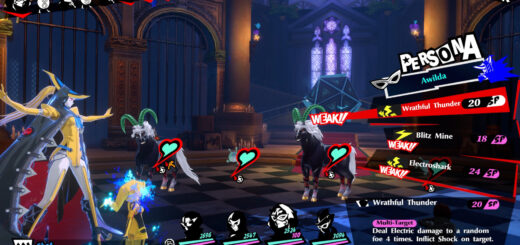
Combat largely follows the system of Persona 5, though some small tweaks add up to give it a different feel. The party and their foes still gain an extra turn for attacking weaknesses, and players can do an all-out attack if they knock down all their foes by hitting said weaknesses, with some other special abilities also available. However, characters appear to have a more limited moveset, and it seems much more focused on those individual characters synergising their own abilities rather than truly attacking together. It’s all perfectly functional, but the way the system works makes it a bit harder to be really strategic about things; it feels like party setup is much more important than thinking on the fly and therefore it’s much simpler and quicker to just let the auto-battle system take over for most of the time.

More limited movesets mean combat feels more about party compsition rather that tactical thinking in the moment.
In addition to the story characters, players are able to summon “Phantom Idols” for their party. These are cognitive manifestations of others that the protagonist knows or has seen in passing, many of whom get their own separate side stories, and each comes with their own Persona. Collecting both Phantom Idols and Personas for the protagonist for use is the biggest gacha element, though there are others such as the weapon system. The resources that players pick up are also necessary for growing the strength of the party members, who are stuck under various different caps until the requisite currencies or items are found. Much like the lack of the calendar system diluting the essence of the series, the relegation of Personas into the gacha system removes much of the appeal and enjoyment of them, and the systems that replace the original game’s simply aren’t engaging.
The game’s presentation comes right from Persona 5. On a general graphics level, things are largely indistinguishable, although the UI elements are much busier, which slightly undercuts its style. The character and Persona designs fit in well and there’s a decent mixture of new locations, such as the protagonist’s home and school, and familiar places like Shibuya, with the map indicating a lot more places becoming available down the line. Most of the music is simply lifted straight out of Persona 5, while the Japanese voice acting, added in the international release, is solid even if small quirks like full names being said the other way around to the subtitles are noticeable.
Persona 5: The Phantom X should be treated as its own thing rather than any sort of extension of Persona 5. The structural changes needed to fit in with its original platform expectations and monetisation make it a completely interactive process. It has some readily identifiable strengths, and those who do enjoy mobile service titles will likely find lots to enjoy here, but those hoping that it provides a new Persona-like experience will find that the gacha nature is ultimately overpowering.
Disclaimer: Early access to a build was provided by the publisher, though this article is primarily based on the public live version.






Recent Comments