Beyond Galaxyland Impression
The 2.5D graphics work very nicely in providing interesting places to explore with good variation between areas, and the music provides an excellent and highly engaging backing that works really well with the sci-fi setting.
Developer and composer Sam Enright returns with a second title following the footsteps of 2018’s The Greater Good. Beyond Galaxyland, planned to be released on PC and consoles later this year with publisher United Label, offers an enhanced scope as it takes to the stars while looking to expand its 2.5D side-scrolling exploration and strategic turn-based combat. RPGamer was given the opportunity to check out a new demo build covering the first two-to-three hours of the game.
After a brief intro scene where the mysterious Malefactor conducts a raid of a giant facility in space, the game switches perspective to regular Earthling protagonist Doug. After returning home one day, he — accompanied by his pet guinea pig Boom Boom — is suddenly attacked by a mysterious being, chasing him into a cave where they encounter a strange portal. After entering the portal, Doug wakes up in a sci-fi facility where a pair of robots inform him that life on Earth is doomed due to the invasion of an entity called the End. However, the intergalactic corporate empire DreamCorp has spent time rescuing a selection of humans and placing the survivors on a planet within the realm of Galaxyland.
Doug is given little time to grieve the supposed deaths of his loved ones, as he is quickly shipped off the planet of Erros, where human survivors have been placed, although access to technology has been greatly restricted. He is accompanied by the imminently retiring MartyBot, while also being reunited with Boom Boom, who has been upgraded to be much larger, fully intelligent, and able to wield a gun. However, while most of the inhabitants in his new home seem happy with their lot in life, Doug seeks to return to Earth to find out the truth. His initial adventure sees him seeking allies and undertaking some requests as he seeks to find a ship that can first get him off this particular planet.

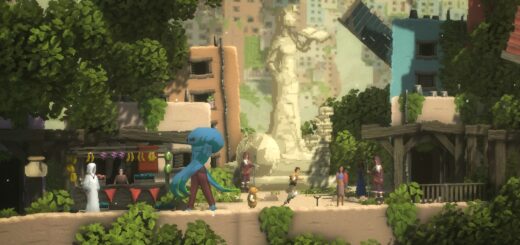
Earth-like, but definitely not Earth.
The opening few hours do a good job of setting the scene and raising a myriad of questions about Doug’s situation, the fate of Earth, and what exactly is going on with DreamCorp and Galaxyland. It’s clear there’s a lot to be revealed and uncovered down the line. Although it certainly deals with darker matters and events, the writing and side quests inject enough levity to keep the experience nicely balanced and help those times when things do get serious have more impact. The characters don’t get too much time in the opening stages to stand out, other than perhaps MartyBot, but there is still plenty of time for them to develop.
Exploration is primarily in 2D, but players can move between different tracks at certain points, which allows them to go behind or in front of the main plane to get around obstacles, complete puzzles, and go forth. There is an element of side-scrolling to exploration, as players will need to time jumps (and double-jumps) to get to certain areas, while players might also need to use individual character actions to get past obstacles, such as Boom Boom shooting a chain to cause a bridge to lower. The opening few hours have a few interesting puzzles, some of which involve manipulation of the game’s physics system, but the game also offers the option for players to skip a puzzle if they get stuck on it. The early exploration and puzzles show strong promise for the game and ensure players are kept engaged.
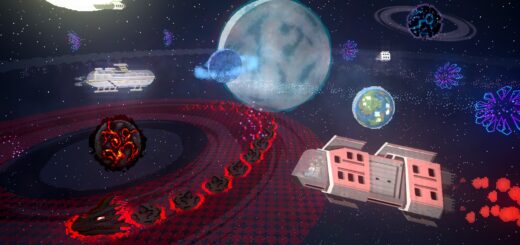
While the vast majority of the demo is located in the Erros town of Arcadia, once players do get access to a ship and head off into space, they can travel between different planets, some of which offer additional side content with bonuses and rewards that will help for the main quest. One of the side planets demonstrated how the physics can change between planets, with its higher gravity meaning that Doug’s jumping distance is significantly reduced.

Maintaining Ability Points is an important part of combat.
Combat is initiated by coming into contact with enemies, though players can make an initial strike to cause a bit of damage before the fight starts. The battle system is turn-based and uses an active-time system for determining turn-order. In addition to HP, each character has a number of Summon Points (SP), while Ability Points (AP) are shared between the party. AP are gained by hitting enemies with regular attacks, but rather than a singular attack, the option grants multiple strikes. Players can elect to use all their strikes, or stop early, which results in all remaining strikes being converted to AP. The reason to do this is that any attack that misses reduces the party’s AP, which is used for each character’s unique special abilities, including attacks and healing. AP also features in defending, as whenever an enemy does a regular attack, players can press A to defend for a brief period. If they time it correctly, the damage is reduced, but if they miss the opportunity then AP is reduced.
Meanwhile, Summon Points make use of captured enemies. One of Doug’s special abilities allows him to attempt to capture a foe, which is more likely to succeed the lower the enemy’s HP. Once an enemy is captured, they can then be equipped on party members, granting them access to that enemy’s abilities. Summons gain experience and level up while equipped, granting access to additional abilities. The combat system offers a good amount of strategy, with maintaining sufficient AP quickly becoming a key consideration, that encourages players to consider whether to go all out or keep things in reserve. The game consists solely of a manual save system, but in the first few hours save points, which double as restoration points, are more than plentiful.

We don’t yet know whether it is corrupted by capitalism.
A photo-collecting side quest gels well with the game’s combat system, giving players reason to check out their surroundings for rewards and to view enemy HP bars in combat. There is also a straightforward crafting system where players can create useful battle items and a few slots for character equipment, such as an early gun that causes Boom Boom to strike all enemies with reduced individual damage.
While the demo is only a brief window into the game, there’s a lot to like from Beyond Galaxyland. The 2.5D graphics work very nicely in providing interesting places to explore with good variation between areas, and the music provides an excellent and highly engaging backing that works really well with the sci-fi setting. The combat and puzzles offer a strong mixture of gameplay elements and engagement, while the story offers plenty of intrigue and scope for exploration. It just remains to be seen if the full game can carry its initial launch to escape velocity.
Disclosure: This article is based on a build of the game provided by the publisher.




Recent Comments