Varlet Review
Back to the Future School
FuRyu returns to a familiar setting in Varlet. Developed by Aquria and following in the footsteps of The Caligula Effect and Monark, it marks the publisher’s latest attempt in utilising a near-future high school setting and supernatural powers. Unfortunately, some interesting story ideas and decent music are thoroughly let down by a self-destructive gameplay loop, incredibly shallow systems, and a horrendously broken battle system.
The game puts players in the role of a new transfer student at Kousei Academy, which is fully integrated into an augmented reality/social network called Johari. Accompanied by their AI companion MENA, they are soon roped into joining the Student Support Services by their cousin, the head of the SSS. At the start, it gives players an interesting multiple choice quiz that assigns points into six personality attributes: morality, sympathy, altruism, Machiavellianism, psychopathy, and narcissism. Unfortunately, this is basically as interesting as it gets. These points do ultimately end up providing some different combat bonuses based on which attributes get high scores, though as players soon find out, it might as well do nothing. The actual story itself revolves around Glitches, which send people into an alternative world, and Desires, beings that inhabit the Glitches and turn out to be responsible for a number of incidents at the school. Players find themselves granted a special power that transforms them and lets them fight back against the Desires and close the Glitches, solving the incidents while usually gaining new allies in the process.

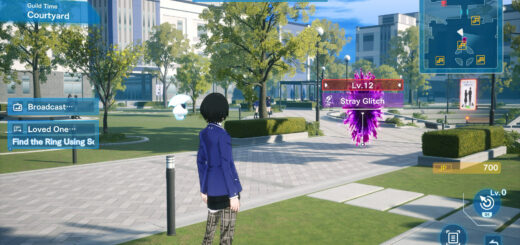
Varlet’s Glitches don’t take much effort to find.
The game is divided into chapters, each of which takes place across eight days. Those eight days are covered through a repeated cycle of a new personality quiz, some story events, a dungeon, more story events, another dungeon with a boss battle, and some final story events. In between each of these is the opportunity for players to engage in some optional content. Alas, Varlet’s optional content is completely pointless and serves zero tangible benefit on the game other than to pad hours; it ultimately raises the question of whether the game would’ve been better served had it simply not existed.
In between story events, players are given the opportunity to fulfill SSS requests. These generic requests are pulled from a small repetitive list, and fulfilled by wandering the same small location while constantly triggering a scanner — which gives off the cry of “Sonar” every time it’s used — to find items to pick up or stray Glitches that can be entered for a few battles and/or combat items. There is some flavour text for unremarkable NPCs that give them some throwaway stories, but otherwise they can be readily ignored. Due to the broken battle system, the item, money, and experience rewards are unneeded, and the actual process of undertaking the quests quickly becomes mind-numbing. At best, these sections simply let the controller act as a fidget toy.
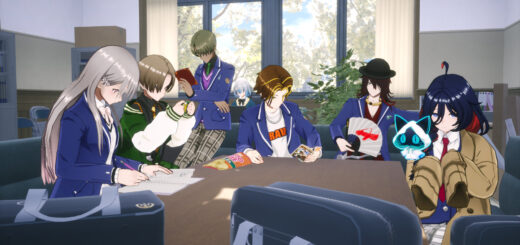
Certain breaks allows for the player to spend time with one of their SSS allies and learn more about them while becoming closer. However, this is simply a matter of witnessing events and sometimes choosing places to go to hang out. This acts as the method of earning points to spend upgrading their skills, and given players only have enough time to complete their relationship story with at most half of their allies, there’s little point in doing anything other than picking their usual battle party members.

Players can build relationships with fellow SSS members.
The gameplay loop simply serves to hinder what is a fairly interesting story with a decent cast of characters. The individual chapter arcs work fairly nicely, each usually focusing on a particular character and generally wrap up that particular thread nicely while still advancing the overall story. The main cast is quite endearing, providing entertaining interactions. Although it has good moments, the game’s finale is fairly predictable and doesn’t quite pack the punch it hoped for, but is still decently satisfactory. The world building is distinctly lacking, with the game confined to the tiny school grounds and the Glitch dungeons, as well as including a grand total of one adult (who plays a bit part) in the entire game, but the overall story is enjoyable.
The base template of Varlet’s turn-based combat is perfectly serviceable. Players control a three-person party, taking on up to three enemies at once. Each turn, players give each party member a command, with the time it takes to use determined by the particular skill or action. How long the turn lasts, and whether enemies get any actions turning it is based on when those actions occur in the timeline. Positioning on the timeline become crucial as many abilities can break the opponent, preventing them from using their action if it goes after. In addition, each enemy has a stun meter that when emptied allows them to unleash a special combo attack. There are also a number of character-specific mechanics, though players ultimately don’t need to pay that much attention to them.
The problem with the combat is that the balance is completely broken very early on. A character who joins in the early stages starts with the ability to heal a party member for 40% health, which can very quickly be upgraded to covering the full party, and this ability has quick timing. None of the skills have any MP or similar cost associated with them, other than if players wish for a character to act immediately, though even that cost if recharged jokingly easily. Even without this character, the combat becomes a cakewalk when one figures out how easy the break and stun systems are to manipulate. There are effectively two slightly different strategies needed to cover the whole game, which can be used ad nauseam.

Combat has a serviceable base template, but is just completely broken.
Varlet includes a standard experience-based level-up system. In addition, each character has a skill tree, which upgrades attributes and skills using points obtained by spending time with them as mentioned earlier, but there are no equipment, loadout, or other options to customise the party, not that players would have anything to gain from being able to, given how broken the combat balancing is. The main character does get a secondary form with a set of other skills in the back half of the game, but there’s zero need to use it outside of the story battle it first appears in, nor is there ever a need to rotate party members.
Presentationally, the music is one of Varlet’s strongest points, and while not especially memorable, the game is enjoyable to listen to. It continues the theme from The Caligula Effect of using various guest composers to produce a decently varied selection of tracks, including its vocal boss themes. The Japanese voice acting is also solid, though the script and lacklustre visual presentation doesn’t really afford a whole lot of opportunity to show off their acting chops. While the main characters have good memorable designs, the enemies are boringly repetitive and the environment designs are lacking at best. The school itself is incredibly uninteresting, and while the Glitch dungeons have distinct themes, they still look much like one another. The dungeon designs are okay, but not particularly interesting. There are some light puzzles involving switches, but it all quickly becomes rote, especially with the problems of the battle system.
Varlet has a few interesting elements. The story is enjoyable enough to experience, with a welcome cast, and it’s quite enjoyable to listen to. However, the gameplay is ultimately little short of a disaster. While Varlet does a lot wrong, players can still readily get through it. However, the worst failing the game has is that it feels a significant improvement could simply come from excising much of its gameplay.
Disclosure: This review is based on a free copy of the game provided by the publisher.


Interesting enough story and enjoyable cast
Solid music
Completely irrelevant gameplay
Broken battle system




Recent Comments