Traysia Review
I Asked for a Boat and All I Got Was This Lousy Raft!
While the Sega Genesis is not known for being an RPG powerhouse, it did have a few successful franchises with the Shining series and Phantasy Star. It also had a bunch of other one-offs that never made big names for themselves. Telenet’s Traysia was released in 1992 and received tons of unfavourable reviews upon release due to its cumbersome controls, repetitive gameplay, and boring quests. In 2026, Ratalaika Games and Shinyuden decided to revive the questionable classic for modern consoles and PC. While gaming preservation is a wonderful and noble gesture, there are games meant to be lost to time, and, sadly, Traysia is one of them.
In the port town of Johanna, the game’s protagonist Roy dreams of adventure. Before Roy goes, he is given a special pendant from his sweetheart, Traysia, whom he is leaving behind. Roy travels to the Kingdom of Salon to begin his adventures, only to learn that travelers are being attacked in the Northern Forests. Roy joins a party consisting of three individuals: Banegie, Magellan, and Floyd. Unfortunately, during their expedition, Floyd betrays the party for his own nefarious reasons, and Roy and his companions soon learn that there is more going on in the kingdom than at first glance. Upon returning to Salon, the party meets a young mage named Bellenue, who explains that Floyd has a history of manipulating rulers and causing chaos. Roy and the party vow to bring peace to all of the Kingdoms and exact revenge on Floyd.

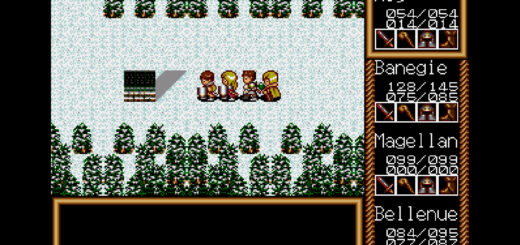
Did you know that defend and move are the same button? I didn’t either!
Traysia‘s narrative is very basic and uninspired. Although the game is broken into five chapters, nothing about the story feels engaging or exciting, and in fact, at times, it’s quite messy. A lot of the chapters don’t connect well, and some of the character reveals were likely revolutionary for their time, but now feel dated in 2026. There is also the problematic element of players spending a great deal of time with one female character who clearly loves the protagonist, only to see her rejected for a character who has exactly five minutes of screen time. But since the game is named after her, apparently, she gets a pass. It’s so hard to care about these characters and their world when everything feels either convenient or not thought out. There is just so much disjointedness in the characters that, other than the connections with Floyd, they don’t feel like they work well together, leaving the player to question what the point of the story was in the end. While the dialogue is hilariously bad and kind of camp, Traysia‘s overall narrative lacks excitement, making whatever bits of story one gets a slog to get through.
Speaking of slog, Traysia‘s got even more problems beyond its dull narrative. The game features messy UI, wherein players will spend too much time guessing what each icon means and what it does. Players can move inventory around and pass it to other party members, but there are no indicators to check one’s gear to find out if it’s better than what is equipped. It’s so hard to know what the player is clicking on because the icon is faded as well. Present throughout the game is a large text box that takes up too much space on screen, even when there is no dialogue presently happening. It’s also hard to navigate menus once in them, as there is also no way to sort items or know what the item’s carrying capacity even is. There’s also no way to figure out which characters can equip which weapons without fumbling through multiple screens, only to be told the character cannot equip it, and then continue the guessing game of who the item is for. It’s so poorly designed, terribly explained, and offers no assistance to the player beyond having to fiddle around with it and hope something makes sense.

At least the still art is nice.
Even worse than the menus is the game’s idea of turn-based combat. Player characters will start at the bottom of the screen and will march towards the enemy. However, in true Traysia fashion, players will have to highlight the enemy they wish to attack, in hopes that the characters will even approach the right one. Characters like Bellenue can only attack in the four cardinal directions, meaning that unless the enemy is directly in front of her, she can’t hit anything with her attacks or magic. In fact, magic is just useless in this game simply because the player can’t actually target the enemy, and often ends up hitting the player characters. One’s probably thinking that moving would be the obvious solution to that problem, but Traysia doesn’t explain to the player that defend and move are the same button. Once the player figures that out after numerous tries of accidental defending, it’s still not useful, as the player can select where they want the character to go, but the pathfinding will still make other decisions. In multiple instances, characters will all be lined up in a row, and no matter how many times this reviewer attempted to move them off of each other, the pathfinding insisted that everyone being on top of each other clearly made the most sense.
It gets to the point where using the new cheats provided in this edition becomes much more appealing. Players can turn on cheats on the main menu, which include giving all the characters infinite health and mana, and up to 9999 gold. However, there’s even an issue with this element: if the player turns on the 9999 gold cheat, it means they cannot gain any more money throughout the game, and there are weapons and items that exceed that amount. How stupid is that? It’s a cheat that can be turned on but also negated at the same time. How is that a cheat? While the infinite health and mana are great, the additional money cheat doesn’t work, and players are better off Googling the classic infinite money cheat that exists in Traysia‘s original release.

The inn music makes me want to claw my eyes out.
The graphics are also bland and lacking in any personality. A lot of the game is brown upon brown, upon a bit of green and red, but mostly brown. The dungeons and overworld are empty, with so little to explore. Thankfully, this version has a rewind (which, why would one use) and a turbo speed option (which should definitely be used). Given how boring everything is in this game, having the option to at least speed up the pain has many benefits. The soundtrack is also painful to listen to, but thankfully, turbo mode also removes the music while in use. The town and store themes in particular are gratingly cheerful, just adding to the torture of how bad this game is, and the battle theme is so hyped up for such a crappy combat system. Even the sound effects are terrible, as going into any building sounds like the player is walking down a flight of stairs. Why is that even necessary?
If there is any positive in Traysia, it’s that the game is mercifully short, clocking in at around ten hours to complete, and for those playing on PlayStation, completing the game will also give a Platinum trophy for one’s troubles. The game also has lovely cutscene art that is reused so often that it loses all meaning after having to see Roy dream of Traysia every chapter. This version also allows players to enjoy the game in Japanese as well, though the biggest question is why one would play Traysia at all, given what a mess it is. Traysia is a relic with nothing to offer anyone, as it struggles to have an identity beyond being a piece of lost history brought back for preservation. In reality, it should have stayed lost forever.
Disclosure: This review is based on a free copy of the game provided by the publisher.


Most cheats are rad
Still art for cutscenes is nice
Hilarious dialogue
Cumbersome controls
Terrible combat
Sound mixing and tracks are awful




Recent Comments