The Blood of Dawnwalker Review
Somewhere Between Golden Hours
As time goes on, it becomes easier to grasp just how little there is of it. To-do lists pile up, the body gets older, and stuff that used to come easy gets more difficult to do. It then comes across as a little strange how little the passage of time plays into RPGs. There are standout examples, like the year-long calendar in modern Persona titles or some of the Atelier games, but largely many games in the genre seem content to give players as much time as possible to complete as much as they’d like. For its first game, The Blood of Dawnwalker, developer Rebel Wolves is clearly thinking about how time limits can shed a new light on a standard formula. While it never quite soars, Dawnwalker punches above its weight where it matters, and its numerous shortcomings feel far more like a lack of budget than a lack of ambition.
Set during the height of a plague in the fictional valley of Vale Sangora, The Blood of Dawnwalker follows a young man named Coen who has had to take primary responsibility for his family in the wake of his mother’s mental illness and father’s despondency. While seeking aid for his plague-stricken sister, a quartet of vampires, led by a man named Brencis, arrive in the valley, overthrowing the cruel Prince and curing the populace of the plague with their blood. However, the peace is relatively short-lived as the vampires quickly establish a weekly “blood tithe”, wherein every town must offer up some blood to the vampires, and an increasingly hostile police state. Coen’s father joins a group attempting to revolt against the vampires, but they are betrayed. In the ensuing violence they attempt to turn Coen into one of them as leverage against his father. However, the transformation does not quite work as planned and Coen is knocked out and left for dead. In actuality, he has become a Dawnwalker, a creature who is a vampire by night and human by day. Waking up to discover that his family has been kidnapped to be a sacrifice for Brencis’ coronation as Prince, Coen has thirty days to stop him or else lose his family.
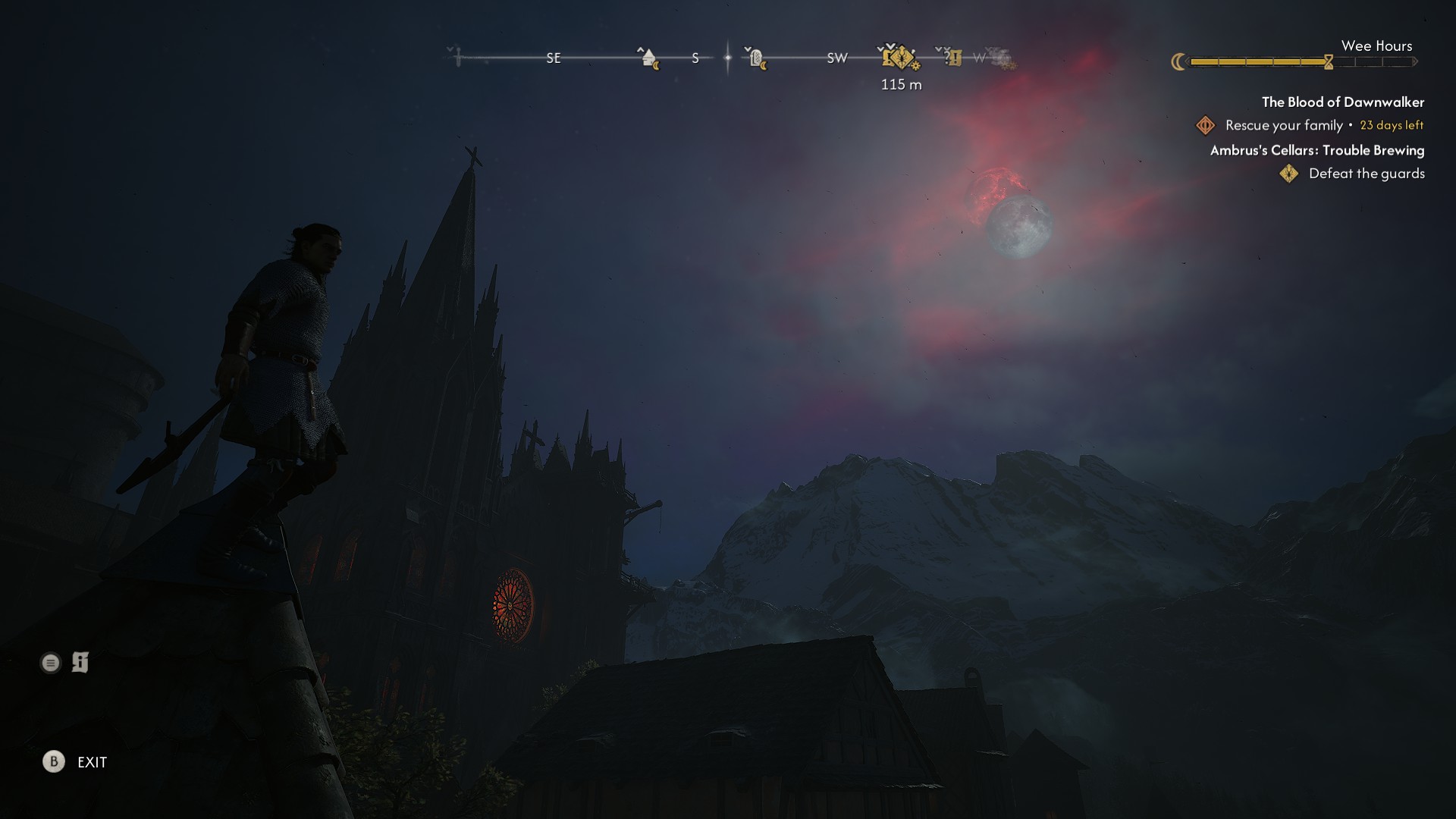
Welcome to nighttime sky of Vale Sangora.
This sets up The Blood of Dawnwalker‘s central conceit: time is against the player and most actions must be considered. Rather than having a clock ticking down in the corner of the screen the whole time, Dawnwalker opts to break time down in structured segments. Days are divided into day and night and each half contains eight units of time. Time never passes on its own; players choose to spend time on most of the game’s meaningful interactions, namely quests, spending skill points, and choosing certain dialogue options. There is a potent psychological effect that helps to imbue player decisions with a lot more meaning than is actually present but works nevertheless. It’s hard to think of a game that does a better job disincentivizing rote completion of open-world chaff when the choice is between another anonymous bandit camp, the next character-driven side quest, or spending skill points. This doesn’t mean that there is no reason to do the standard open-world side activities, since most are tied to vampiric control of the realm, and disrupting that is one of the primary ways of drawing out Brencis and his lords. But the passive effect of having a cost to these activities pushes players to be more considerate of how they spend their time. The only reason this isn’t a slam dunk is that by the end of the game the time limit isn’t as restrictive as it should be and the final boss will likely be engaged with a surplus of time. Still, the foundation of this system is rock-solid, and hopefully future iterations can really make it shine.
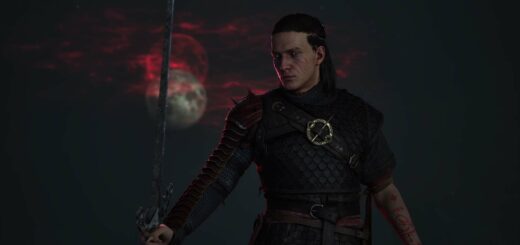
The other operative twist that the day/night cycle provides is that, as a half-vampire, Coen spends his nights as an empowered blood-drinker which comes with its own strengths and drawbacks. By day, Coen comes equipped with a sword and has access to witchcraft, taught to him early in the game by the local witch of his hometown. Shops are open and Coen’s appearance is normal, allowing him to mingle with the populace. By night, Coen assumes a vampiric form that keeps the sword and gains access to a different suite of abilities that reflect his new nature. Primarily, he gains a new traversal power that functionally allows him to teleport across short distances, plus powerful claws that regularly surpass the sword in damage. The first main drawback is that, due to accelerated healing, he cannot carve witchcraft symbols into his skin, making witchcraft unavailable at night. The second is that Coen’s blood hunger comes into play, and if he enters a conversation while at low health he will lose control and kill and drink the blood of the person he is talking to. The latter is a great idea that could add additional stakes to the outcome of combat encounters but is undercut by the game’s difficulty. The former highlights how, despite a few neat ideas, Dawnwalker‘s combat never really grows beyond functional.
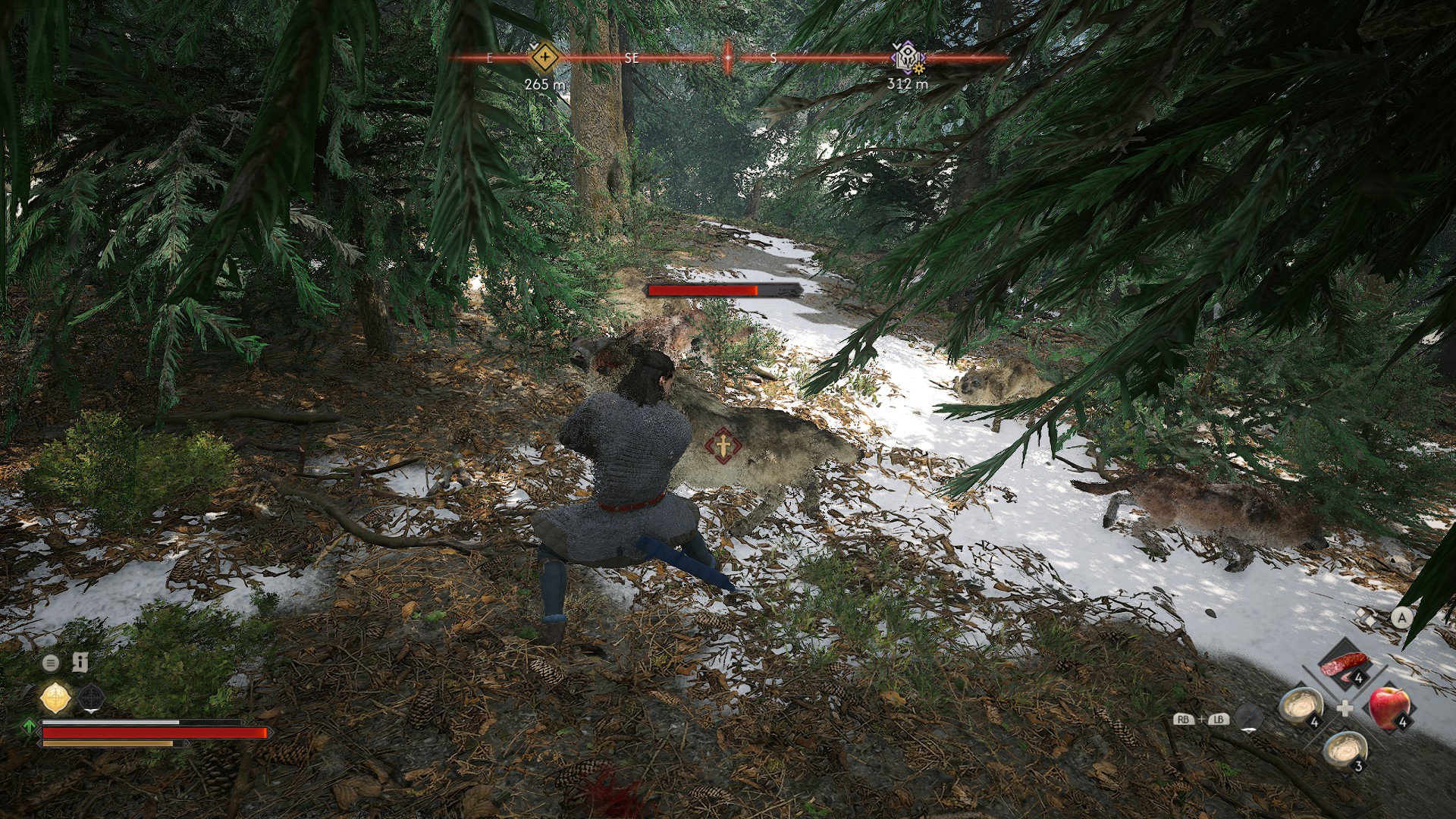
Vale Sangora’s forests contain legions of wolves, scores of boars, and some worms, for some reason.
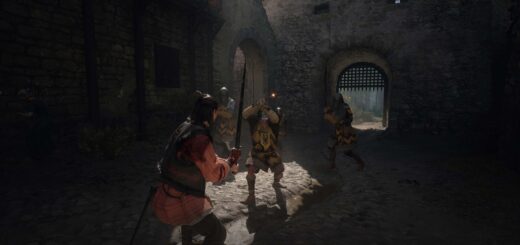
As an action RPG, Dawnwalker plays close to its Witcher 3 roots with a few modern tweaks. Combat is primarily melee-focused, with Coen’s weapon of choice being a sword that can be used day and night. While Coen can dodge, certain attacks even require it, blocking is the main defensive action. Blocking is split into Omniblock and Directional Block. Omniblock functions as a more traditional block where damage is prevented at the cost of stamina. Directional block is a parry, requiring specific timing and a proper directional input to execute but with less stamina cost on defense. Further perks along the Swordmastery tree unlock critical hits as follow-ups to successful parries along with other passive benefits. Meanwhile, Omniblock never surpasses the directional method and just has less skill support from the game in general. A similar issue arises when comparing Vampirism and Witchcraft. While it’s nice to give the player options, the game offers little reason to invest in certain play styles, as generous parry windows and a special ability economy sped up by whacking enemies with basic attacks anyway push players to that far more efficient path.
This split between two skill sets seems like it could create an interesting idea space, with players having to consider how they want to approach combat and character builds to excel at different times of day. The problem is that the game supports being a vampire far more than not. Witchcraft, Swordmastery, and Vampirism are the three skill trees available, and while there are unique abilities and skills in each, synergies exist between Swordmastery and Vampirism that Witchcraft cannot compete with. Many of the Swordmastery passive skills also apply to the Coen’s claws at night, functionally making them the most powerful tools in the game. Witchcraft’s skill tree, by comparison, is half dedicated to gathering items and crafting, leaving its combat potential feeling less explored than the other two trees. It never feels more than a complement to directly attacking opponents, especially considering how all abilities in the game cost Activation Charges that slowly refill over time, though with certain perks attacking and perfect blocking can speed up this process. Adding to this imbalance, many of the game’s bosses can only be fought at night, shutting off Witchcraft during some of the game’s harder fights.
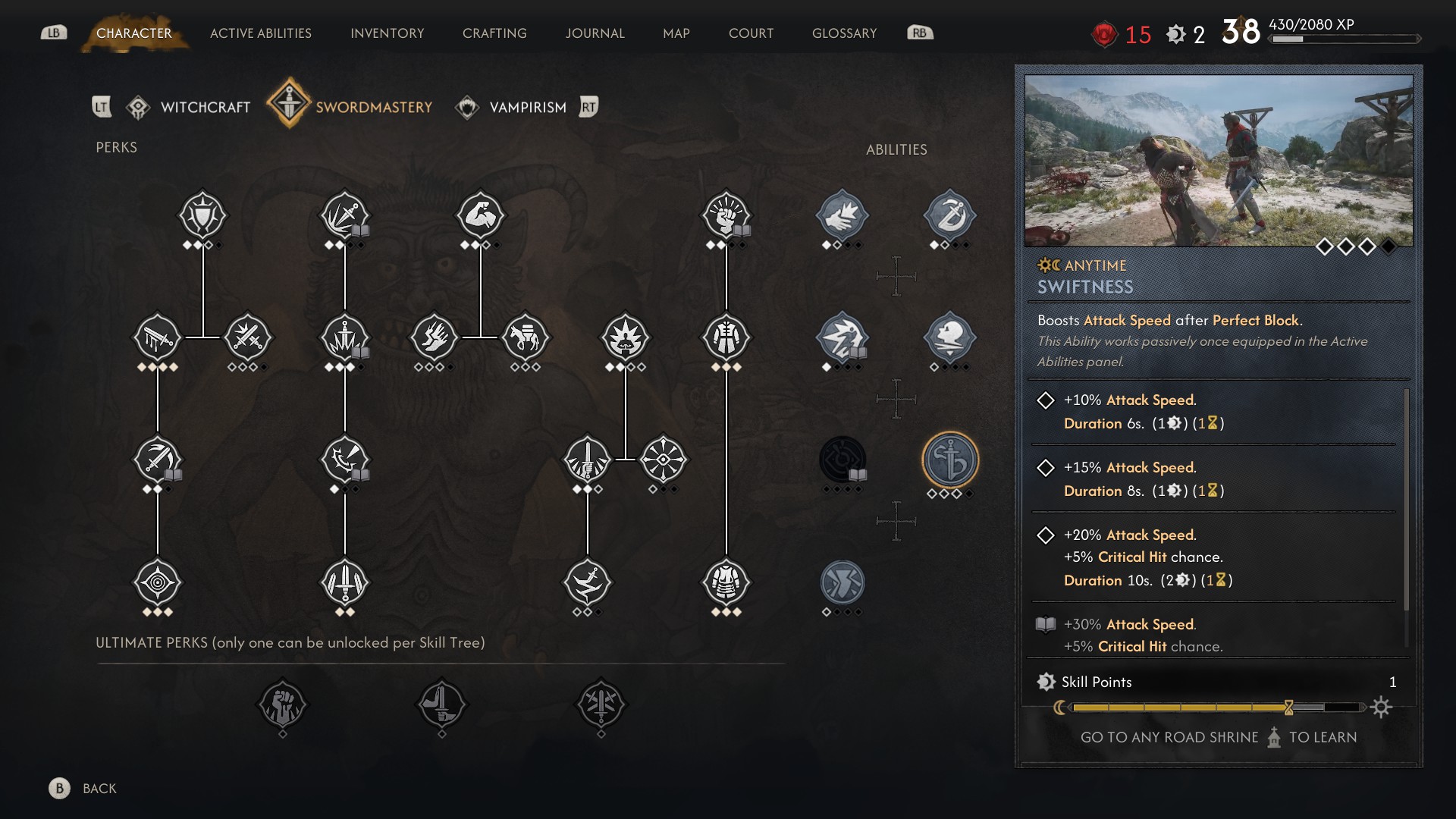
Requiring time to level up does put the player in the mindset to consider just what kind of content is important to them in a game.
I say “should be” because The Blood of Dawnwalker is so easy it’s hard to see any build faltering too much. By the midway point of the game Coen becomes a nearly unstoppable force if players only land half the perfect blocks. Bumping the difficulty up did little to alleviate this, and while the final difficulty makes the meaningful change of removing directional indicators for enemy attacks, this comes with the problem of being more difficult to gauge when an enemy attacks from off-screen. So by the game’s end, combat becomes perfunctory and easily managed. Its frequency also highlights how much seems to have been cut from the final game. The variety of enemies is lacking and entire gameplay systems seem half-baked or missing. Large, clustered groups of enemies make stealth impossible even when the level design and Coen’s vampiric abilities scream that it should be a viable option. Increased infamy, the primary goal of disrupting the vampire lords logistically, does little more than place additional soldiers sporadically throughout the map, easily circumvented. Even walking around as a vampire at night rarely makes anyone turn their heads despite Coen’s glowing eyes and paler complexion. It is clear that encounters were designed to be approached in numerous ways, but that the scope of the game had to be reduced. Ideally, a sequel would see many of these ideas come to fruition.
Mechanically, the rest of The Blood of Dawnwalker is a much more traditional open-world affair. As Rebel Wolves is made up of former CD Projekt Red employees, The Witcher 3 is the obvious template the studio is working from. Vale Sangora feels like a smaller map in The Witcher 3 that’s entirely enclosed from the rest of a much larger game. This more concentrated open world does wonders for pacing and traversal, but there are few environments to explore beyond forests, swamps, and the rocky cliffs enclosing the valley. Various activities dot the map and are revealed by way of towers that must be climbed to get a lay of the land. Scattered shrines serve as both fast-travel points and the locations where skill points can be spent. Anyone familiar with an open-world game made in the last twenty years can see how it all fits together: unexciting yet functionally satisfying.
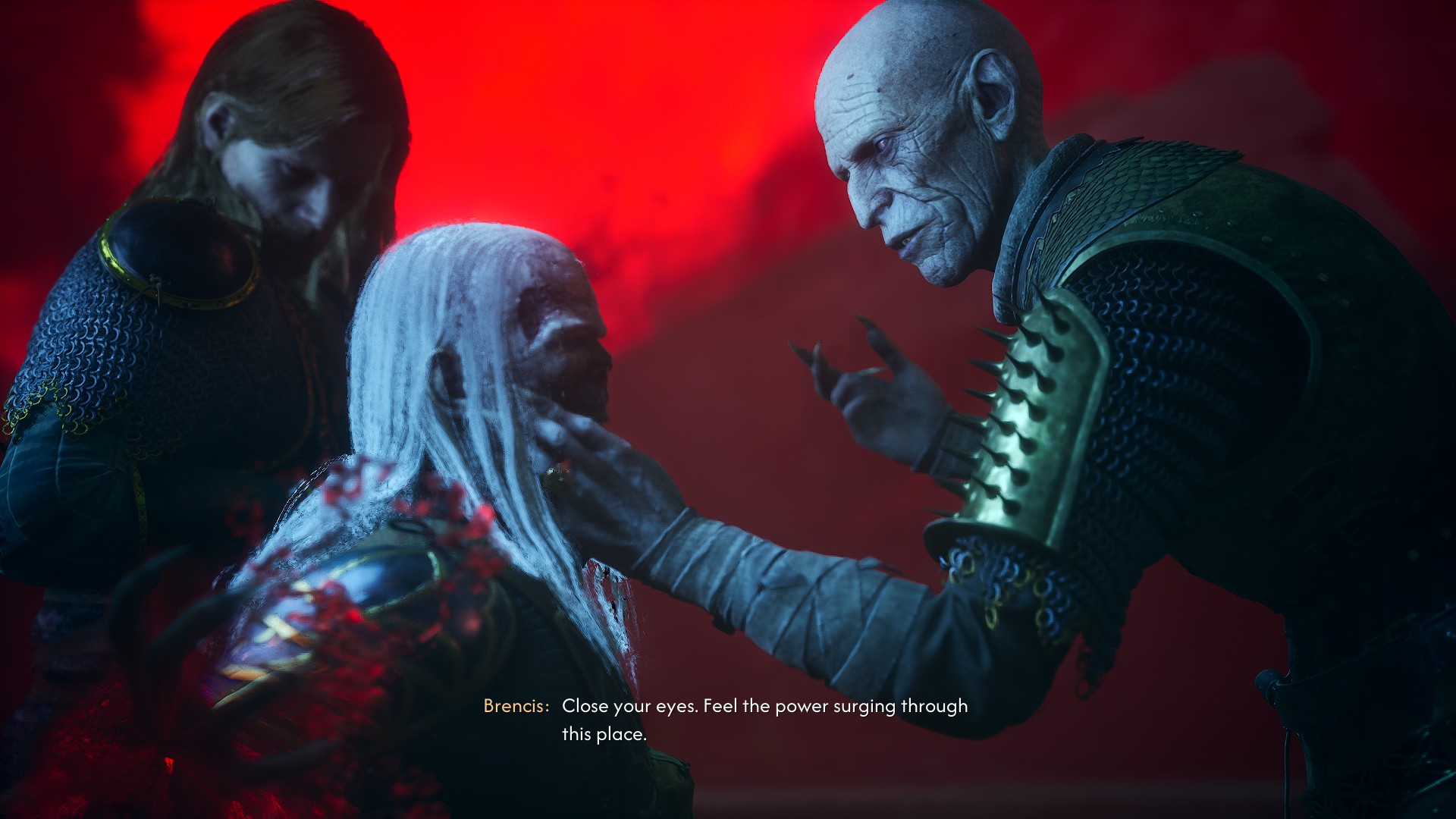
Despite limited screen time, the vampire lords of Vale Sangora are effective villains.
What does stand out is some excellent writing and character work. While Coen is played pretty straight and a little boring, there is a lot of great world-building that not only fleshes out the setting but gives some pathos to keep Coen grounded in his family expectations, how those expectations have ruled his life, and how he sees his responsibilities in light of his newfound immortality. The supporting cast also cast a wide net of opinions in regards to their unusual situation. Coen will run into peasants who think the blood tithe is a small price to pay for stability and immunity to the plague, while others resent being treated like little more than cattle, and others still will warp their religious beliefs to fit their new vampire lords into their worldview. Then excellent vocal performances tie all of it together. The only misstep is that while Coen thinks of himself in a monstrous light, the gameplay never quite ties that into what the player is doing. Visually and musically, the continued influence of The Witcher 3 can be felt. Far from an ugly game, Dawnwalker can look good on occasion and has plenty of great skyboxes to show off; it is hard to ignore how similar it looks to the decade-old Witcher 3. The music works out the same way, where it doesn’t manage to stand out besides capturing some general vibes.
In spite of the discrepancies between what the developers appeared to want this game to be and what actually made it to store shelves, The Blood of Dawnwalker is a pretty good time. The vision is present throughout the game and the obvious shortcomings often feel far more like a material consideration than outright mistakes. In a game fascinated with the concept of time and what it means to use the little we have, it’s nice to say that The Blood of Dawnwalker is a worthy exploration of that, one that makes it easier to be excited for a future title that has more of its systems intact, RPG mechanics tightened up, and combat expanded to be a bit more open-ended than what’s there. And if the repetitive portions of the game can be tolerated, then there’s an enjoyable game underneath, too.
Disclosure: This review is based on a free copy of the game provided by the publisher.

A surprisingly engaging world and narrative, writing and performances included
Smaller scale and structure keeps pacing brisk
Time limit pushes the player to consider their actions...
...but isn't quite as restrictive as it needs to be
Combat never quite evolves past the opening hours
Repetitive enemies and combat encounters



Recent Comments