The 7th Saga Retroview
Seven Levels of Pain
The 7th Saga was a game I found at a local rental shop near my house. The box said RPG, and perhaps I had seen it mentioned in a Nintendo Power magazine, but it did not have much fanfare supporting it. Regardless of what drew me in, what I found when playing this game was a reality check: it was hard. I thought I knew what difficult SNES RPGs were, but this game was on a different, unforgiving level. Unbeknownst to my younger self, this game was made harder for American players. Still, there was something that kept drawing me back to this game, no matter how many times I suffered defeat. The 7th Saga has a certain charm that makes you want to persevere past areas you have stumbled in previously.
The game begins with an elderly gentleman inviting seven travelers to his domain. This man, King Lemele, explains that in this world exist seven Runes imbued with tremendous power, and he wants one of his new apprentices to go out and collect all seven for him. The player then gets to choose any of the seven apprentices to play as, and their journey begins with very minimal instructions. Luckily, the NPCs populating towns will provide hints for players needing some direction. This game also has a decent amount of secrets scattered around every location.
The seven apprentices have different playstyles as each one mimics a common RPG class, like Warrior or Priest, and as such, some characters have a harder time starting off. Picking the right apprentice to start off with will be an important decision. Players new to the game might want to pick Wilme, the alien, to get their feet wet. He has high Strength, Speed, and Hit Points and does not need to purchase equipment. Those looking for more of a challenge can start out with Lejes, or one of the other two magic-oriented characters. They are more frail and have a harder time starting their journey. Leveling up and equipping the best gear available is essential for survival in this game.

The seven heroes all have their strengths and weaknesses.
Two things players will notice when walking out of the first town in The 7th Saga are the crystal ball and how hard even the very first enemies are. The crystal ball is unique for this game and its sequel, but it functions like a radar for the player. It will point out towns, enemies, and dungeons, and will also mark where runes are hidden with a flashing red indicator. Enemies crawl around the world map and will move towards the player, even if the character is not moving. This also allows players to navigate and dodge enemies if they are swift enough, due to being able to see them moving inside the crystal ball. This tool is going to be the player’s best friend, especially after long bouts of walking aimlessly in the wilderness, low on heals, and noticing a new location appearing from within its magical confines.
Knowing where enemies are on the battlefield or in dungeons is important in this game, as battles can be very harsh. Right from the start, a fight with multiple enemies can turn into a deadly encounter. When an enemy touches your icon in the crystal ball, the turn-based battle initiates. Enemies hit hard, and it is recommended to level up a few times before venturing too far from the starting area. Luckily, there are no game overs in this game, as the character is rushed back to town, with a loss of money being the initial punishment. Beyond hitting like trucks, some monsters have instant death spells, and the heroes have no real defense for these spells, other than them having low hit rates and characters’ Speed stat allowing them to dodge the spell outright.
The original Japanese version of this game is actually a much easier and more forgiving experience. The heightened difficulty is actually due to an accidental code change in the US release. Enemies were given higher stats, and the player character’s stats were reduced when the game was translated and brought overseas. This makes The 7th Saga one of the few games that got harder, not easier, when American players got to play this.

The crystal ball is a very important tool.
The story in The 7th Saga is all about collecting the seven runes, with local, contained incidents taking a backseat to that central plotline. These rare artifacts have numerous powers that help players in and out of battles. Seeing a flashing red dot pop up in the crystal ball means a new rune is within reach. Most locations have an issue that needs solving before the players can advance, and there are a few side quests that are only available for specific characters. An early subplot deals with a fallen pet haunting a nearby castle, and the player is tasked with going to the monster-infested site to slay the beast. If the player reaches the boss and loses, they can ask the locals around town to learn more about the monster and how it came to be, which leads to them acquiring an item that helps the player end the monster’s suffering. While these sub-stories are not deep or complex, there are enough sprinkled around the world to add depth and layers to the game.
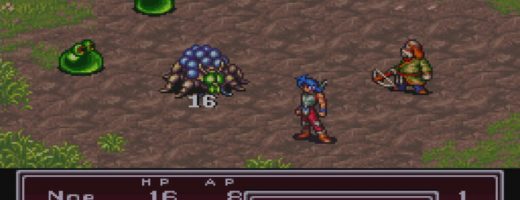
Another thing that is distinct about this game is the graphics. Character sprites are less detailed on the world map, but once battles start, the camera zooms behind the player, and the battle begins. The sprites in fights are more defined and look dark and edgy for characters and enemies alike. There are a lot of unsettling enemy designs found in this game. All the different apprentices look great from behind, but coincidentally, they look really menacing when players have to face them and get to see how their sprites look from the front.
After running around alone for the first section of the game, the player will come across the other apprentices scattered around the world. If their beliefs align, the player can persuade one of the others to join their journey. It is a good idea to pair the main protagonist with an apprentice who covers their weaknesses. Having a second party member is a lifesaver in a game this punishing. Though sometimes, the apprentices will actually challenge and ambush the player depending on the circumstances. Fighting apprentices is one of the hardest fights in this game due to their levels scaling with the player’s and their stats not being altered from that unintentional code change. There are at least two instances where the player will have to face an apprentice in a one-on-one duel, and these can be huge difficulty spikes that RPGamers struggle to move past.

This fight is not going to end well!
There are a few tricks that can help struggling players with these fights, like learning that defending for a turn doubles the attack power of that character on their next turn, or using a particular revive gimmick can help turn the tide in battle. Also, losing to an apprentice while in possession of any of the runes will cause that character to steal all the collected runes, which they can then use against the player in subsequent fights. This event can severely cripple progression, so it is recommended to always save before engaging with a rival, as sometimes a quick reset might prevent prolonged frustration.
The music in this game is fantastic. The tracks stand out from other games on the system, with The 7th Saga heavily utilizing flute and reed organ sounds. The overworld theme changes throughout the journey, and all locations have vivid and memorable tunes that add to the atmosphere. The town songs are peaceful and welcoming, whereas the overworld music denotes exploration and unknown adventuring, and players will know they have reached a dangerous location when the music changes to something more ominous. From start to finish, these melodies are unique and memorable, and among the best on the SNES.
This is a hard game surrounded by RPGs that are a breeze to complete in comparison, and for that, The 7th Saga stands out on the SNES for its heightened difficulty and relentless gameplay. It has a distinct look and sound that make it one of the more unique games on the system. Granted, there’s an insane amount of grinding and luck required to be successful. The story takes a backseat, but there is enough lore and content to make avid RPGamers enjoy the ride until the credits roll. This is a staple game I can always return to, as the many combinations of teams make subsequent playthroughs a refreshing experience of struggle, strife, and satisfaction.
Disclosure: This review is purely comparing this game to other SNES RPGs. Nintendo Power issue 52 has an article for this game.

Harder than your average SNES game
Characters are unique
Music is fabulous
Collecting runes is fun and rewarding
The grind is not for everyone
Story is basic
Apprentices have little to no character development





After the DQ series, this is THE number one game of the 1990s for me. Awesome memories of this!
Yeah, I spent a lot of hours grinding in this game. Gotta go hunt brains out in the open world for big XP rewards!