Onimusha: Way of the Sword Review
A Triumphant Return
The Onimusha series has been missing in action for quite some time, with the last mainline title, Onimusha: Dawn of Dreams, being released all the way back in 2006 for the PlayStation 2. While the first two games in the series have since received remasters, Onimusha has been dormant for just over two decades, until now. Onimusha: Way of the Sword is one hell of a strong comeback, featuring exciting and challenging combat, great presentation, a gripping story full of likable characters, and an authentic, mostly well-designed world.
Taking place in Kyoto during the Edo period of Japan, Way of the Sword sees Miyamoto Musashi, an up-and-coming samurai, trying to battle his way to notoriety by challenging local clans. After successfully winning a duel against a clan’s leader, he’s chased down by dozens of pissed-off underlings, barely escaping in chaotic fashion. Right after fleeing, Musashi’s long-haired and flamboyant rival, Sasaki Ganryu, comes to taunt and challenge him; however, he is suddenly killed by demonic monsters known as Genma, with Musashi being accosted, overwhelmed, and murdered by them shortly thereafter. Musashi then wakes up in Hell, with a mysterious, malicious Man in White forcibly fitting him with an Oni Gauntlet, which resurrects Musashi and brings him back to life and allows him to kill Genma.
Upon waking, Musashi must come to grips with several realities. First, the gauntlet keeps him alive, but he must absorb Genma’s souls to sustain himself. Second, his rival, Ganryu, has also been given a gauntlet, and his obsession with defeating Musashi has driven him mad to the point of killing and consuming human souls, which is encouraged by the Man in White. Lastly, the gauntlet contains a sentient woman named Shizuka. Trying to figure out his plight, Musashi journeys to a shrine in Eastern Kyoto, where he meets Ono no Takamura, a mighty Onimusha warrior who explains that Musashi, now also an Onimusha, must help fight the Genma to prevent them from escaping Hell and breaching the Oni Gate – a responsibility Takamura has shouldered for seven hundred years. Izumo no Okuni, a young and plucky kabuki dancer, is also at the shrine, with Takamura watching over and protecting her, and together with Musashi and Shizuka, they all must navigate a wide variety of demonic threats and conspiracies.
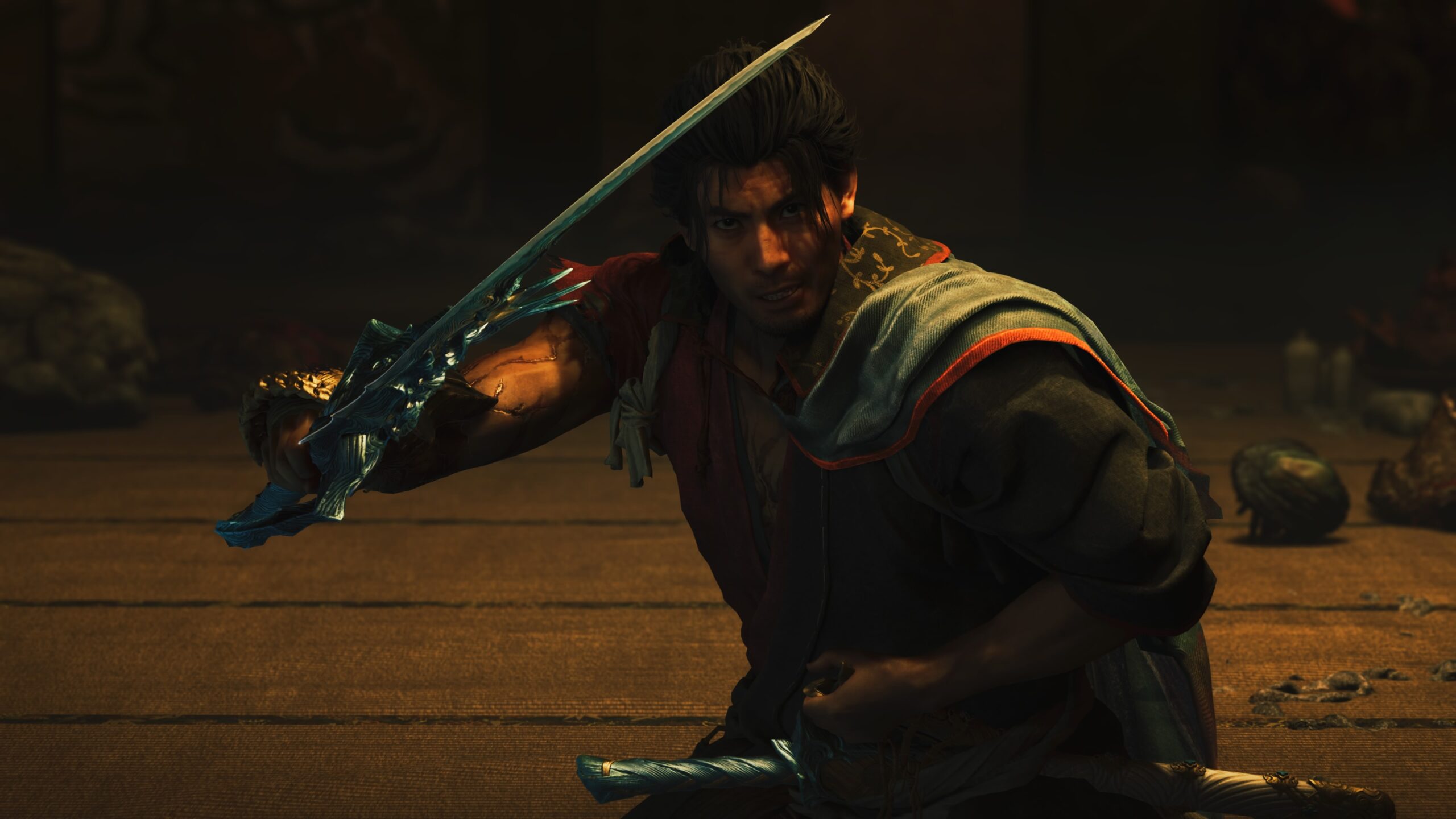
Musashi squares up, ready to slash through any Genma in sight.
Way of the Sword’s plot is excellent and engaging, largely due to its endearing characters and imposing, well-written villains. Musashi himself is a standout, with an affably boneheaded personality that clashes with the level-headed, serious Shizuka and the more playful, teasing Okuni, making for entertaining banter throughout. The Man in White’s repeated appearances always impart ominous intrigue, and Ganryu’s descent into madness and obsessive rivalry with Musashi make for some entertaining and chaotic scenes. Another of the game’s villains, Dokyo, a mask-wearing female Genma who conducts horrible biological experiments in an underground laboratory, is infuriatingly antagonistic in the best way. The consequences of her amorality result in some truly heart-wrenching, visceral scenes that are Way of the Sword’s best, and it’s supernatural villainy like hers that keeps Musashi’s war against the Genma justified and motivating.
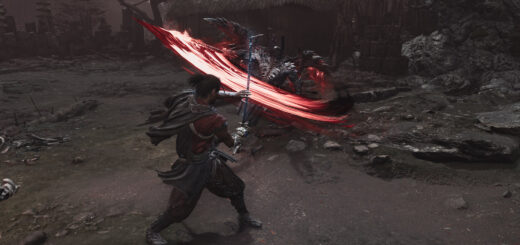
On the topic of fighting, Musashi will be doing a lot of it, and combat is where Way of the Sword burns brightest. Wielding a sword as his primary method of offense, he can use both light and heavy strikes, parry or deflect enemy attacks, or simply put up his guard for an omnidirectional block. Parrying and deflecting reduce enemy stamina, and when their stamina is completely drained, Musashi can perform a Break Issen, a visceral strike that does incredible damage, usually outright killing weaker enemies. If players are skilled enough, an Issen can be performed against any attack, although the window for doing so is significantly smaller than for a parry or deflection.
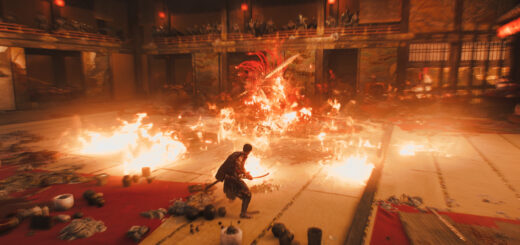
Defeating enemies will result in souls of three different colors dropping: red souls, which serve as a form of currency to further empower Musashi; yellow souls, which function as health and drop more often when Musashi is low on health; and blue souls, which fuel the Oni Armament gauge. Aside from the sword, players will also gain access to various Oni Armaments, special weapons that can be used once a gauge is filled up. These can serve any number of purposes, with the Earth-Shakers breaking shields, armor, and heavily damaging stamina, while the Wind-Whipper naginata summons a cyclone effective at crowd control. Furthermore, Musashi can use environmental objects to stun or damage enemies and an Oni Bow to shoot ranged enemies and, with a charged shot, inflict them with a status that prevents them from regaining stamina.
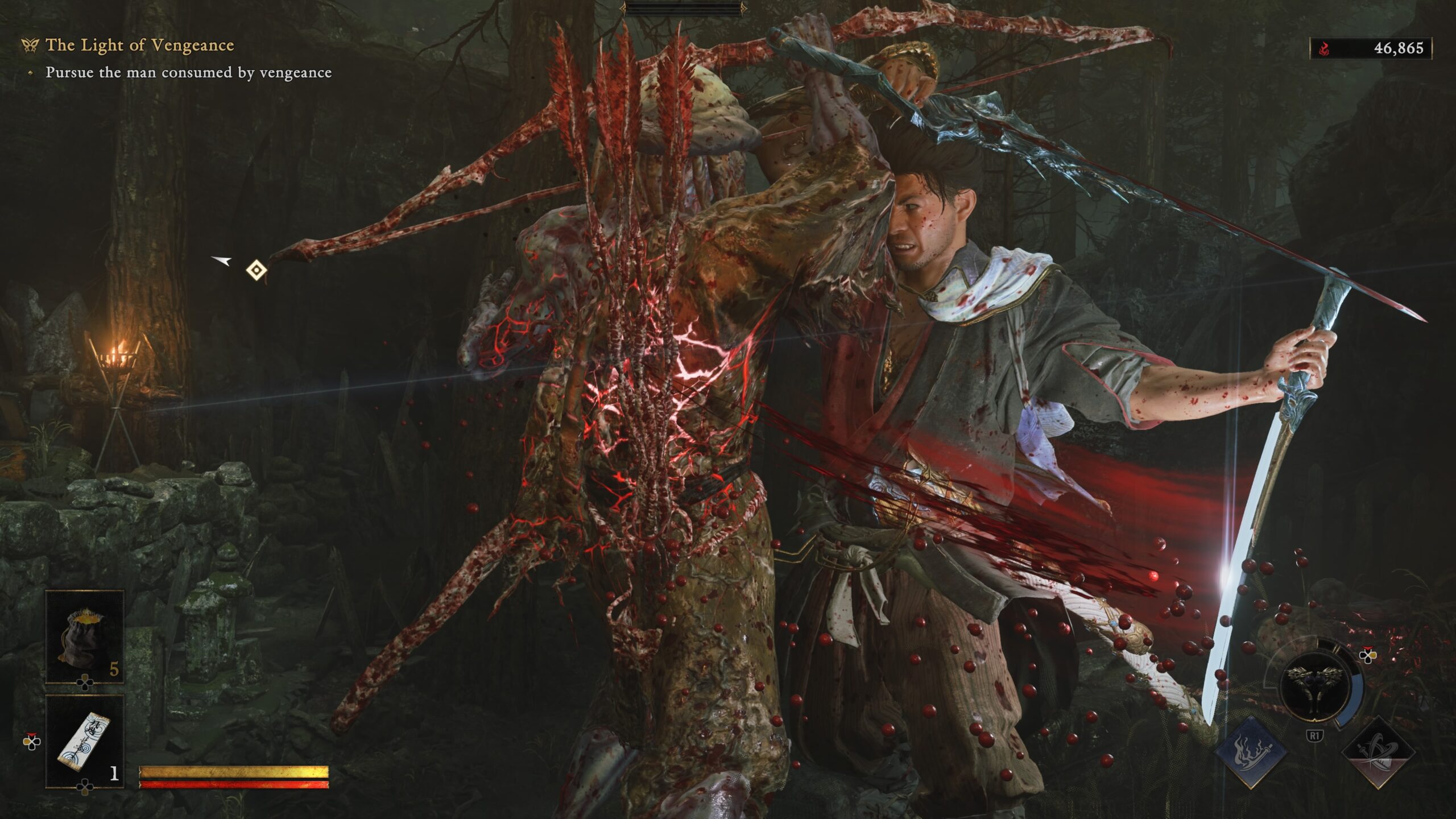
Musashi pulls out his wakizashi to perform a Break Issen.
What makes Way of the Sword’s combat so effective is how deliberate it is, how it flows so smoothly, and the way it flawlessly incorporates all of its mechanics together into one cohesive whole, especially in boss battles. Onimusha consistently incentivizes observant, patient players by encouraging them to analyze movement and react accordingly. Repeating timely dodges, known as Reflex Dodges, allows Musashi to retaliate with a devastating Reflex Combo, whereas successful parries put Musashi in the Blazing State, increasing his damage and the drop rate of blue souls. Grabs, indicated by a body part glowing blue, cannot be blocked or parried and require a timely counter, whereas unblockable, must-parry strikes glow pink. When more souls drop, however, Musashi must absorb them quickly, as enemy Genma can also absorb them, allowing them to enter a dangerous empowered state of their own. The combat asks quite a lot of players, with increasingly tough but rewarding fights that always demand multiple avenues of awareness, especially when assailed by multiple enemies at once.
Players will find themselves consistently growing stronger, and Way of the Sword feels just as satisfying and intentional when steadily increasing Musashi’s power, if not a duller experience in how this is achieved. Featuring a medium-sized open world, Eastern Kyoto serves as the hub in contrast to the largely linear story levels. Musashi can engage in several sidequests and activities, which mostly revolve around fighting Genma, and may also explore the city. In return, he receives offerings, which can be given at a shrine with red souls to empower equippable charms that increase stats, or materials that can be used to fortify his clothing, sword, gauntlet, abilities, and skills.
The actual process of engaging in these sidequests quickly becomes rote, mostly because players repeatedly face the same lowly mobs with very little variety. While the game is wanting for a bit more enemy variety, it’s far less apparent when beelining through the main story than it is if players choose to do sidequests. That said, what the quests lack in gameplay substance, they make up for in rewards and especially lore. Mysteries of Kyoto and Curious Cases both reward short stories that detail real-world locations and Japanese mythology, making for some interesting reading. That said, the open-world design still feels like unnecessary bloat, with NPCs nowhere near as compelling as the main story, and with Curious Cases lacking voice acting, some of the better stories miss out on the ability to fully register emotionally.
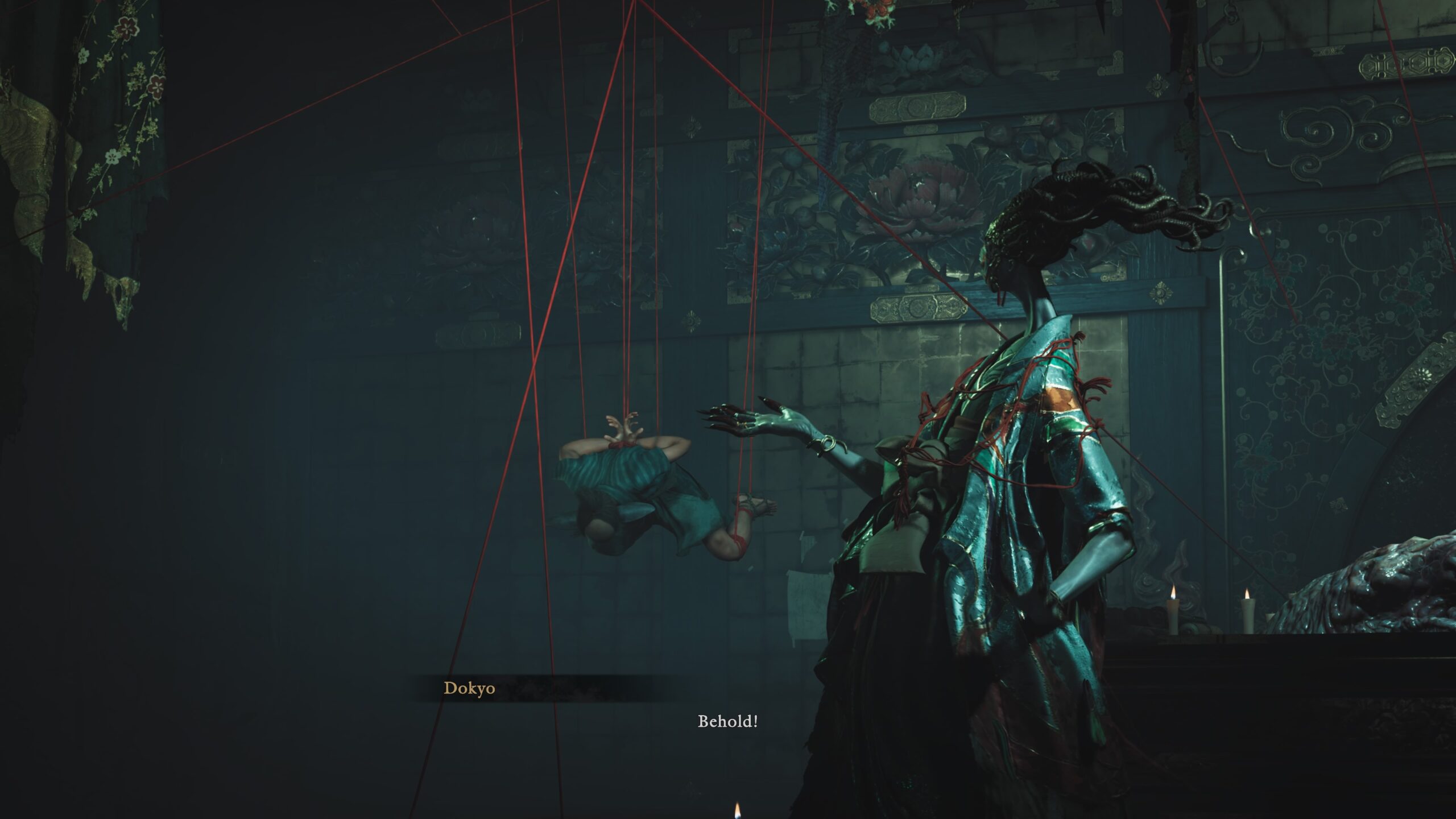
The wicked Dokyo tortures one of her victims for her wicked experiments.
Soundwise, Way of the Sword’s English voice acting for the main cast stands out as quite remarkable. Kenichiro Thomson does a great job of making Musashi come across as likable and badass, but special attention must be given to Clare Corbett as Dokyo, whose masterful shrieky, cantillated, and dramatic cadence fully sells just how psychotic and twisted the character is. The soundtrack is also quite strong, making great use of a wide array of traditional Japanese instruments to set the dark fantasy tone. Even if most of the tracks aren’t especially melodic or individually memorable, they all do a fantastic job and are pleasant to listen to.
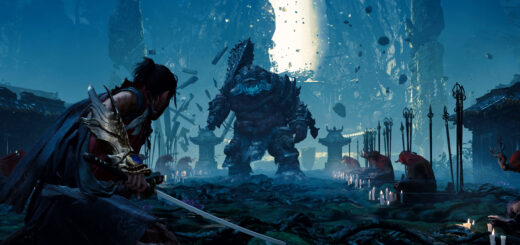
In illustrating its dark fantasy world, Way of the Sword’s art direction is quite effective, and supported by strong visual presentation. In areas controlled by Genma, the world is blanketed in Malice, resulting in a blood-red mist and the emergence of demonic, warped stone structures with screaming faces, twisted limbs, and jagged rock. Most of the game uses a muted color palette of grays and browns, but there are plenty of splashes of contrasting color, especially in the story levels, that help keep the game visually stunning and interesting, even outside Eastern Kyoto, which is comparatively duller. That said, all of the environments feature incredible attention to detail, and it’s obvious that great care was taken to make historic locations feel accurate and immersive. Also importantly, the demanding graphics and generally high fidelity never detract from performance. Way of the Sword runs at a consistently high frame rate on a base PlayStation 5, keeping its animations smooth and cinematic fights engaging.
When it’s all put together, Onimusha: Way of the Sword is a glorious comeback for a series that has been latent for far too long. Musashi has a nice, distinctive sense of humor and personality that is always entertaining, whether bantering with allies or feuding with demonic, manipulative villains. While its open-world structure in Kyoto is a bit bloated and somewhat detracts from an otherwise fantastic linear experience, the side content adequately supports an authentic, interesting setting. But the biggest takeaway is the game’s riveting, intense, and masterful combat design, which ultimately defines the game and, to summarize what Takamura says to Musashi regarding part of his reasons for fighting: “it’s just damn fun.”

Deliberate and exciting combat system
Great English voice cast
Authentic and detailed Japanese setting
Engaging story and characters
Game's latter half could use more standard enemy variety
Open-world structure is a bit bloated and dull




Recent Comments