Hades II Review
Forever In Hell
Serving as the sequel to the much-lauded roguelike Hades, Hades II finally arrives on PlayStation 5 and Xbox Series X|S, bringing the action roguelike to all modern consoles. This time around, players control Princess of the Underworld, Melinoë, daughter of Persephone and the titular Hades. Hades II sports some riveting and heart-pounding action combat, although the gameplay suffers quite a bit due to the balance of available Boons. That said, the presentation benefits from vibrant graphics and some fantastic music. Further, the game features an amiable cast of characters, with a rich story deeply rooted in Greek mythos.
From the outset, Hades II drops players right into the fray in Erebus, the waiting area at the edge of the Underworld, with Melinoë swearing vengeance against Chronos for kidnapping her family. When players inevitably die on their first run out, they’re returned to The Crossroads, Hades II’s hub area. Here, they will meet Melinoë’s mentor and the Titan Goddess of Witchcraft, Hecate. She leads the Underworld’s resistance against Chronos alongside numerous undead shades and various allies, including Nemesis, the personification of retribution, and master strategist Odysseus. The ramshackle nature of the Crossroads and its varied inhabitants does a great job of making the overall struggle against Chronos feel personal and dire, with a strong sense of camaraderie amongst its residents and visitors.
Hades II’s plot effectively uses and twists around elements of Greek mythology, and all the characters feel compelling and well-written. This is especially true for Melinoë, who is constantly riddled with self-doubt and an inferiority complex, particularly toward Nemesis. All the while, she’s steadfastly devoted to her mission and the gods, willing to endure maddening trials no matter how many times it takes. There’s no shortage of appealing characters, and players are given a lot of leeway in who they choose to interact with and learn more about. While the roguelike structure of the game can make the pacing a little hit-or-miss at times, there’s a wide abundance of dialogue to ensure that players are always receiving new information or interactions. The high-quality writing is sure to keep players entertained for long stretches, as most characters feature plenty of highly situational voice lines that depend heavily on the player’s choices. This attention to detail is noticeable throughout the experience, and incorporating it keeps the plot captivating despite the roguelike structure.

Melinoë, being a witch, casts a spell to accept Apollo’s Boon.
As an action roguelike dungeon crawler, Hades II centers around becoming gradually stronger across runs, and attempting to get closer to Chronos each time while learning enemy behavior and boss patterns along the way. In combat, Melinoë has access to six different weapon types, most of which feature a short-range attack and a longer-range Special. She can also utilize a dash for extra mobility. In addition, she has a magic Cast, which allows her to freeze enemies in place, which, in addition to Omega (Ω) attacks, makes use of a Magick Bar. During every run, as players progress from room to room, they’ll receive Boons from the Olympian gods, with each Boon allowing the player to choose from one of three boosts that take effect for the remainder of the run and empower their various abilities, be it through adding status effects or increasing damage. Additionally, most of the time, Melinoë can also obtain a lunar-based Hex from Selene, the incarnation of the Moon, which is upgraded through a skill tree during runs.
Unlike the first game, the sequel offers two different dungeon paths, each split into four distinct dungeons. The initial branch features the Underworld, consisting of Erebus, Oceanus, the Mourning Fields, and Tartarus. Later, players may also reach the surface world, also featuring four dungeons, though it is toxic to Melinoë due to her bloodline, and cannot be traversed without a special spell. Each area within both branches features a boss Guardian, and all four must be defeated within a single night. Die, and players must start all over the next night. Both areas are thematically and visually opposed, providing the game with appreciable variety and a way to mix up their playthrough if one path becomes too difficult. Hades II’s combat is quite engaging, with responsive controls, a good variety of enemies in each area, and exciting bosses that feature challenging, interesting patterns to dodge. Bosses like Scylla in Oceanus are especially exciting, as fast-paced attack patterns and chaotic action dominate. The sheer number of options available to players, be it through Boons, weapons, or random events, helps keep combat feeling fresh and different across runs, while also helping manage the game’s adequate and strong level of challenge.
However, what prevents Hades II from fully excelling is the imbalance of Boons, which is a fundamental problem. Not all gods are created equal, and Hestia’s fire Boon and its associated Scorch status are significantly and noticeably more powerful than the others, while Hephaestus and his forge Boons offer static damage options and defensive abilities that also clear the competition. It’s a bit disappointing and a little frustrating when coming across Zeus or Poseidon, whose Boons just can’t mathematically stack up against the damage output of Scorch. This results in runs sometimes feeling artificially inflated in runtime due to the sheer grit of continued survival while attempting what feels like a distinct hard mode, depending on which Greek god appears randomly. While it’s still possible to make other Boons work with proper dodging and good play, Hades II could truly excel if Boons were balanced better and all of them felt as viable as fire.
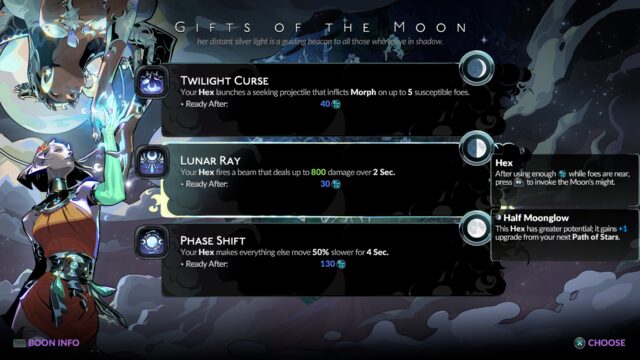
Melinoë communes with Selene and is offered three different Hex options.
The Crossroads offers many options for Melinoë to improve her abilities and chances of success across runs. Primarily, there’s a whole host of Arcana Cards that give dungeon-based abilities or improve stats, but there’s also a magic cauldron overseen by Hecate that allows players to brew collected ingredients into magic spells. These spells alter dungeons, allowing players to alter aspects of a boss or add benefits to dungeons like shops and improved healing pools, or unlock areas of The Crossroads, including a bar and the hot springs. There’s an area to grow crops, a merchant, and various spots where guests occasionally show up. Players can progress character dialogue trees and relationships by providing them with nectar, or, for denizens of The Crossroads, communally bathing in the hot springs. These provide interactive scenes that offer more story and reward players with various items, including equippable Keepsakes that further empower Melinoë. However, like combat, the roguelike nature of progression can sometimes make character questlines or interactions feel artificially elongated or poorly paced, especially if players are compelled to focus on those who appear less often due to RNG. That said, Hades II consistently strengthens players through interactions with all members of the cast and elements of The Crossroads, creating an ever-so-slightly frustrating but overall accessible and addicting roguelike experience.
Hades II sports a vibrant, colorful look, with plenty of exuberance, life, and detail throughout its world. This is especially evident in its character portraits, with all the major NPCs having distinct, memorable looks. Melinoë’s heterochromia, outfit, and transparent green arm displaying her bones are quite striking, as are her various night-aligned kin, including Nyx, Selene, Hecate, Eris, and Artemis. The strong character designs absolutely ooze personality, and characters like Dora the Listless Shade and Arachne the Silk Weaver all benefit greatly from their portraits’ expressiveness. Environments are littered with plenty of details, making the world feel immersive and animated, and this is further boosted by field animations and spell effects. These aspects go a long way towards making combat feel fluid and the world organically alive.

After getting beaten down several times, Scylla gets mad. Real mad.
Hades II‘s soundtrack excels, utilizing a wide variety of Greek instruments from the earliest moments of Erebus. This sets up the atmosphere, setting, and tone before quickly mixing in plenty of modern sounds, including metal guitars and synthesizers, to keep the music fresh and varied. The dark, witchy atmosphere of The Crossroads owes much to its music, which conveys an underlying sense of conspiracy and magic. There’s also a noticeable and dizzying variety of tracks, helping keep the game’s sound varied across repeated runs. Oceanus’s second boss, Scylla and the Sirens, have several different songs they can play during the boss encounter, including the hilarious, well-composed, and catchy rock n’ roll diss track titled “I Am Gonna Claw (Out Your Eyes then Drown You to Death).” Boss encounters are the most memorable in this regard, but the level music also boosts the atmosphere considerably. Voice acting is excellent across the board, with Judy Alice Lee as Melinoë turning in an extraordinary performance, although plenty of side characters — namely Erin Yvette as both Dora and Scylla — also feature some fantastic and animated voicework.
On the whole, Hades II delivers a truly great action roguelike experience, buoyed by strong, exciting combat. It remains addictive across multiple runs, even with poor Boon balance, keeping combat artificially elongated. This is achieved through engaging combat and a compelling story that motivates players to learn more about the characters and world. Its outstanding visuals and fun, immersive audio also make it a treat for the eyes and ears. Trudging through the depths of hell has never been more exciting, and as someone fairly new to roguelikes, I found myself pleasantly surprised at just how engaging Hades II can be.
Disclosure: This article is based on a free copy of the game provided by the publisher.

Fast-paced, heart-pounding combat
Fantastic character designs and visuals
Abundance of excellent dialogue
Awesome music everywhere
Boons are poorly balanced
Story or quests can sometimes feel roughly paced





Recent Comments