Final Fantasy Mystic Quest Retroview
A Mediocre Fantasy
It eventually happened. During my retro streams, I finally beat a game I had played before. Considering I never owned the game, Final Fantasy Mystic Quest is a game I played a decent amount. Many consider this “baby’s first RPG”, and Square released it as such. Believing that an assumed difficulty of console RPGs was hindering their appeal in North America, Mystic Quest was created as a dumbed-down version intended to act as an introduction to the genre. While Final Fantasy Mystic Quest has its flaws, it is a completely welcoming RPG, even if it holds the player’s hand.
Calling Final Fantasy Mystic Quest’s plot basic would be generous. The game begins by introducing players to Benjamin, the destined hero who will save the world. Ben needs to collect four crystals that have been scattered around the world. That’s it. Beyond Ben’s shrug emotion, the character is bland and unremarkable as far as character development goes. He is joined by a few different characters, and while each character is colorful and has decent sprite work, no one really stands out other than maybe Tristam, who loves adventure, treasure, and eventually gives the player a neat grapple-claw tool. The game limits the party to two members, with the current companion usually leaving Ben shortly before the next one joins. The new characters join at a higher level than Ben, who needs to grind in dungeons or on the overworld monster panels in order to catch up to his new comrade. The companion characters cannot level up themselves, effectively joining at the strength they need to be to complete the objective at hand.
Mystic Quest opts to forgo a fully explorable RPG overworld map for something akin to Super Mario World, where Ben can move around to access towns, dungeons, and monster panels. Monster panels are ten-fight gauntlets that sometimes reward players with interesting items, but usually only offer money, which isn’t that useful in the game, in addition to experience. Most consumables can be found in brown boxes that reset every time players enter a location, so there is not a pressing need to purchase items. Actual red treasure chests are what players want to actively hunt for, as they contain equipment and spells.

I’m melting! Melting!
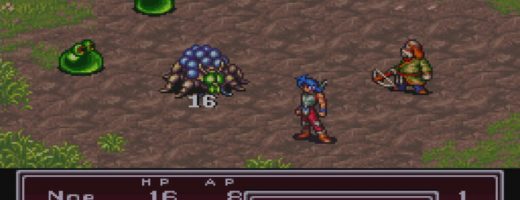
Battles are turn-based and simplistic in nature, but the game makes them more interesting by giving every monster in this game a gradually-evolving sprite that shows how badly they are roughed up. Some bosses have multiple renditions showing how thrashed they are, which is an innovative way to demonstrate to players they are dealing damage and inching closer to victory. Otherwise, the combat has little to write about, with enemies rarely providing an active threat. Most of the challenge appears to come from the player’s lack of accuracy, with attacks frequently missing. If a player does get beaten by an enemy, they can instantly start the fight over, which immediately nullifies the challenge if there is no punishment for losing fights.
There are a few different weapons and armor pieces to stockpile in the game, and each one is better overall than the previous. Some monsters are weak to certain weapons, so there is at least some strategy involved with what weapon to use in battles. Luckily, players can swap between the strongest versions of each weapon type mid-battle without penalty. The different weapons also perform unique field actions in the game. Swords can trigger switches, axes can cut down trees, bombs can open up passages, and claws can cling onto walls. Ben can also jump, which adds a tiny amount of platforming to dungeons. The armor in the game also improves as new pieces are acquired. Not only do they provide better defense against attacks, but they also add slight elemental and status prevention with each upgrade.

Ah. The Dark Lord’s only weakness.
The magic system uses the same implementation as the original Final Fantasy. Gone are magic points, and instead, each type of magic has a certain number of uses until players rests to restore them. As Ben levels up, he gains the ability to sling more spells. Certain spells can make others redundant, such as Life offering revival and full hit point restoration, whether the characters are alive or not. Also, whether it was intentional or an unintended bug, the final boss can be killed by casting Cure on it.
The best part of Mystic Quest is the music. Each melody is charming in its own way. The town themes are warm and cozy, whereas the battle and dungeon beats are more upbeat and energetic. There are tons of tracks that will stick with players long after finishing the game.
Ultimately, Final Fantasy Mystic Quest does not do a good job of distinguishing itself from the rest of the RPGs on the SNES. Replaying the game had me remembering my younger years for sure, as my brother and I would rent and play this game during our weekend romps. Still, fun music aside, there is not a lot going for this game. If I had no nostalgic feelings for Mystic Quest, it would not be worth replaying. Still, it is short and easy enough to complete, so it is at least not a hassle to play through. RPG enthusiasts might find Final Fantasy Mystic Quest fascinating to examine, but compared to the great RPGs on the system, it is lacking.
Disclosure: This review is purely comparing this game to other SNES RPGs. Nintendo Power issue 42 has an article for this game.


The music is nice
Watching enemies deteriorate during battles is fun
This game was created because Japan thought Americans were simple
The story is non-existent






Recent Comments