Echo Generation 2 Review
B-Sides Mixtape
Getting a sequel to 2021’s nostalgia trip Echo Generation likely wasn’t on anyone’s BINGO card for this year, but that is exactly what happened. What’s more, developer Cococucumber wasn’t content to simply reiterate the first game’s mechanics while continuing its story, so Echo Generation 2 has several surprises up its sleeve. While it looks and sounds just about identical to its predecessor, it takes a few steps away from the standard turn-based combat system, instead presenting players with a deck-building card battler of sorts. It’s also more of a prequel, taking place years before the first installment and eventually dovetailing into previously established events, while eschewing any and all emphasis on the ’80s nostalgia that made the last one such a product of its time. Despite tweaks to the established formula, the two games complement each other nicely and make for a decent package that’s best enjoyed as a whole, with the initial outing just slightly outpacing its successor in terms of enjoyment.
The connective narrative tissue between the two games is readily apparent, even from the game’s outset. No longer do players control Dylan and Lily of the previous game (though they do make cameo appearances). Instead, the game is broken into chapters that split the focus between four playable protagonists. Sister M is a young girl who was raised in the secret research facility players visited in the last outing, who must now use her special mental abilities to escape, while Jack’s chapters show us how he came to mysteriously disappear all those years ago. There are also Annata Z, a zombie wandering a blasted hellscape searching for her child, and Noliva, an interstellar bounty hunter who is about to make a life-altering discovery. While the majority of these protagonists seem to have nothing to do with each other, their storylines (as visible on the chapter select screen) do eventually converge, and while players are able to use this screen to jump between the storylines at will, certain chapters (that all take around an hour or so to complete) must be seen through before others become accessible.
In a vacuum, each of the four disparate protagonists are quite interesting, and their unique settings continuously provide the game with breaths of fresh air. It’s easy to see that there was a lot of storytelling ambition on the part of the developer, and all four storylines manage to hold the player’s attention well. The trouble is that they do feel so different from each other, and the ultimate merging of the paths feels rather sudden and unearned, with little consequence moving forward to boot, giving one the impression that these were perhaps originally ideas for completely separate games that, due to either time or money constraints (or, worse yet, to pad the game) were mashed together haphazardly into Echo Generation 2. Jack clearly seems to be the game’s key protagonist — he’s got the most obvious connection to the first game’s plot, his storyline has multiple chapters, and the game’s climax occurs on his watch. As neat as the remaining cast members are, they do ultimately seem to be delegated to window dressing.

We’re not in Kansas anymore…or Earth…or the ’80s!
Pacing is a bit of an issue as well. Jack is the only protagonist whose narrative path takes up multiple chapters, while each of the other three receives far less screentime with only one dedicated chapter apiece before reappearing in the game’s shared climax. But the worst offense here is towards the game’s villains, a trio of extra-dimensional mega baddies who are introduced early on in spectacular fashion before then being completely forgotten about until the final boss rush, where each gets one battle with no further fleshing-out of their character or motivation. In fact, the whole final chapter is a disappointing mess, throwing all protagonists together simply because the plot demands it, only for them to have nothing to do with one another beyond fighting through the final six-round boss rush. To make matters worse, these final confrontations also represent a sudden, unwelcome difficulty spike in that all six rounds must be restarted if players fail at any point.
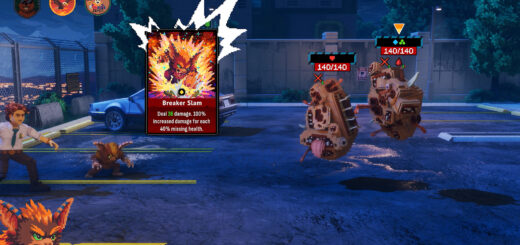
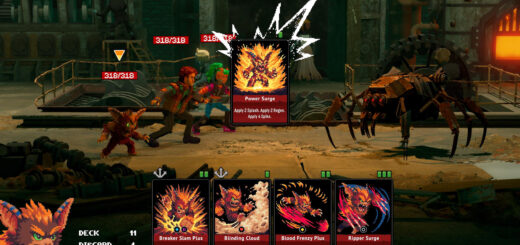
The game’s combat system is as much to blame for this light late-game frustration as anything else, though not due to any inherent shortcoming of its own. In fact, its conceit is actually rather interesting. Combat proceeds by playing cards, with each character having a unique deck of twelve cards of which five are randomly available each turn. Some cards provide offensive abilities while others bolster defense or heal, some target one character while others affect a whole group, some are usable only a limited amount of times per battle whereas others have no such restriction. Players and enemies take turns playing cards, with only one enemy or ally able to act per turn, with control automatically moving to the next character in line on the next turn. For example, it takes three full turns for each enemy in a group of three to act once. The same is true for the player’s party. This really negates any advantages or drawbacks that come from outnumbering the enemy or being outnumbered oneself, other than the battle lasting longer, since there’s only one incoming and outgoing attack per turn either way.

Not only do abilities have fun, unique animations, but the cards themselves are fully animated as well!
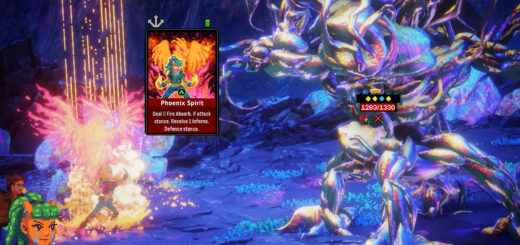
The complexity of the combat system derives from the variety of abilities and synergies that exist between cards. Each of the four protagonists utilizes a different form of damage-dealing. Annata Z, for instance, being a zombie, utilizes viruses and poisons to bolster her physical attacks and deal damage to her foes. Elsewhere, the futuristic bounty hunter Noliva infuses fire-based elemental damage with her attacks, as well as switching between two different stances, further boosting certain cards in specific situations. Her canine sidekick Strix, meanwhile, relies on the interplay between lightning and ice-based elemental attacks, while also being a defensive-minded character able to protect others.
It’s a lot to take in, and the fact that each chapter can be completed in around one to two hours means there’s little time to learn, let alone master, a particular style. Players are bombarded with terms and abilities right out of the gate (stack, pierce, bleed, scar, conduction, burn, chaos, combustion, shield, protect, and many more, with an equal number of status icons making the on-screen UI look rather busy) and just when one becomes used to the combat synergies of the current character, the chapter ends and new tactics are introduced. All of this gets turned on its head in the finale, when players must quickly relearn strategies from earlier in the game, now in tandem with other characters they weren’t developed to support in the first place. It’s not impossible to manage, but there’s so much in such little time that it does miss the mark on potentially being a more satisfying combat system.
While complex in features, the game does feel overall pretty fair, provided one takes advantage of equipping badges that provide helpful bonus boosts in battle, and makes sure not to leave earned skill points unused (for example, one of the first abilities each character can unlock is to be able to play two cards per round, and battles are heavily geared toward that being the case). It takes no time at all to build up a sizeable arsenal of combat cards, so frequent trips into the menu to swap out and update the 12-card hand are vital. There are a few additional wrinkles to the combat system, like stance-breaking if cards of particular colors are played against enemies, or a timing-based parry system that lessens incoming damage with well-timed button presses, but these are far more intuitive and don’t require as much tracking of icons and terminology.

That’s a big boy!
The most significant way in which Echo Generation 2 unmistakably harkens back to its predecessor is in its visual identity. The game uses the same arresting graphical design, combining voxel-based, highly detailed character models with striking environments and hand-painted backdrops. While this may sound like a clash of styles, it actually leads to some stunning vistas, ranging from a picturesque cabin on the lake in the middle of a serene sunset to a rain-drenched sci-fi neon concrete jungle filled with skyscrapers and flying cars. While there isn’t as much of a focus on large-scale bosses as last time, there are still plenty of times when the designers opt to go big or bizarre with their enemy designs, and these are not only fun to behold but also (still) impressively detailed.
Musically, the game retains the same synth-heavy soundtrack that marked the last game as a love letter to the rise of ’80s nostalgia. Here, keeping that same soundscape does tie the two games together thematically, even if the devs have this time taken the foot off the retro pedal; apart from maintaining a consistent sonic identity, the music still greatly suits the game’s air of mystery, as well as being a great fit for the sci-fi and research lab settings.
Despite several years lying between the two games’ release dates, Echo Generation 2 manages to tie in really well with its predecessor, creating a one-two punch of indie games that can be perfectly experienced together without too much of a time investment. That said, the game is far from a rehash of the same ideas presented last time around. First and foremost, the developers have opted for some pretty significant changes to the simple turn-based combat of the last game, resulting in card-based combat that’s still paced to flow a lot like a turn-based system. But the choice to insert multiple standalone protagonists, with wildly different settings and nuances to the card-based combat, doesn’t pay off in a satisfying way, and in fact introduces just a little bit of frustration near the end and information overload at the beginning. These changes mean that some will undoubtedly prefer the first game in the series, but the difficulty curve is gentle enough and there’s enough overlap between the games to make it absolutely worthwhile to still give this one a go.
Disclosure: This review is based on a free copy of the game provided by the publisher.

Like the last game, the combination of visual styles and elements looks great
Ambitious 4-pronged storytelling approach
Plenty of nuance baked into the card-based combat system...
...that muddles up any attempt to truly master it
Finale feels like a rushed way to tie up the game quickly
Drops off the '80s nostalgia train in favor of expanding the existing lore




Recent Comments