All in Abyss: Judge the Fake Review
Ante Down
Last year, a certain poker-centered indie roguelike made quite a few waves, so it’s not wildly surprising to see other games take a stab at integrating various gameplay styles with poker elements. Though it doesn’t share that game’s core DNA, All in Abyss: Judge the Fake also utilizes a poker game mechanic but bolts it onto a mediocre visual novel with some fanservice sprinkled over top. While on paper everything functions as it should, the game suffers from a rather dull and repetitive gameplay loop, which is then irredeemably shot in the face by a series of repulsive, downright stomach-turning punishment scenes between its cast of magical girls that are meant to titillate but only nauseate.
The game centers on Asuha Senahara, a life-long gambler who has just arrived in the Designated Gambling District in order to make her fortune by gambling her way to the top of the food chain and living like a queen. However, the DGD is lorded over by what’s known as the five Witches of the Pentagram — five notoriously talented gamblers who live, eat, and breathe gambling and have never lost a match. Challenging each witch in turn and taking them down by playing by Abyss Rules, basically a life-or-death rule stipulation, becomes the goal over the game’s five chapters. With the clueless and naive Mina Nosaka by her side, Asuha must gamble her way past each Witch’s loyal goons and earn the right to challenge her to a duel, not to mention work out each Witch’s ace up her sleeve and how to circumvent it when the time comes.
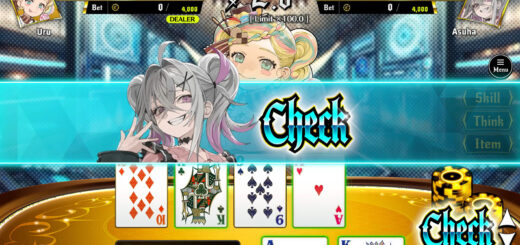
The method by which all of this is achieved is, as already mentioned, by challenging foes to games of poker, specifically Texas Hold’em. Those looking for other styles or even just the traditional Five-Card Draw won’t find those here. In essence, poker is All in Abyss‘s ersatz battle system, where damage is determined by the strength of the winning hand multiplied by a damage multiplier that goes up each time one of the two players raises the bet. Rather than traditional “damage”, a winning hand eats into the losing player’s remaining amount of cash. Once that cash reaches zero, the match is over. It’s necessary to defeat foes and earn money this way as certain conditions must be met in order to challenge the Witches of the Pentagram, such as having a minimum amount of money in the bank or using said money to buy items required to beat the Witch at her own game. However, the game will not allow players to get into an unwinnable situation by challenging a Witch before acquiring everything needed to beat her.

The sooner it starts, the sooner it can end.
Sadly, challenging foes to games of poker quickly turns tedious. Matches, particularly toward the latter chapters, can be quite lengthy, with foes having unreasonable amounts of money that must be chewed through. The mechanic mainly functions as a way to artificially stretch out the game’s runtime, and it inadvertently encourages the propensity to save scum by saving the game just before challenging an opponent, then going all in with maximum bets and simply restoring the game if the tides of fortune turn the wrong way. Bosses, in particular, are set up with ridiculous amounts of money, and defeating them by playing it safe is an unrealistic endeavor. It all culminates with a final boss that’s laughably unfair and loaded with cash, making it a potential rage quit moment for any who have made it that far.
However, it’s likely plenty of players will cash out their chips well before making it to the final boss. With so little gameplay to hang its hat on, the game compensates by including its weirdly kinky, tasteless, and even outright disgusting torture scenes in an effort to spice things up. For all but the most niche audiences, this tactic is likely a misfire. Watching anime girls be cruel to each other is one thing, but watching these girls be executed via fetishized kinks won’t sit well with some and be a complete turn-off to many. Whether it’s food torture described in nauseating detail or a perverse mommy fetish (that runs the length of a full chapter rather than just the crowning torture scene), it all leaves a bad taste in one’s mouth, to put it very mildly. It’s not just the Witches that get the torture treatment, either; losing a final match will “reward” players with a torture scene in which Asuha herself is forced to endure a similar punishment. To the game’s credit, the torture scenes become less malicious as the game wears on, but by then it’s probably a case of “too little, too late”.

It seems like a winning hand, but the Witches of the Pentagram have special tricks up their sleeves.
It doesn’t help that Asuha herself is also an unappealing protagonist. She’s conceited and self-centered, with no regard for the consequences her actions may have. As she states repeatedly, her only aim is to gamble, and she’s so confident of her luck that she throws all caution to the wind. Victory doesn’t satiate her, making the efforts of Mina, who tries to act as a sort of conscience and protect her, fall on deaf ears. Instead, she treats Mina like dirt, uses her for money or a place to stay, and is generally cruel to her despite having no other friends at all. There are no redeeming qualities to make one root for her, and this doesn’t change even as the game carries on. In a game where characters already treat each other in inhumane ways, a mean-spirited protagonist with zero character growth creates a miserable feedback loop of negativity.
It might have been possible for the game’s visual novel sections to hold some redeeming qualities. The prose is acceptable, with a minimum of noticeable errors and exposition that flows decently. But the way characters deal with each other often becomes over-the-top crass. Asuha, especially, has a potty mouth on her, which at least does match her DGAF mentality. Apart from this though, there’s not much joy to be found in the visual novel aspects, either. For the most part, each chapter follows the same formula: choose from a list of five or six locations in a menu, follow some exposition, return to the menu, and do it again with the next location. The story is generally a non-factor, just tabbing down to exhaust a list of menu choices in order to dig up dirt on the current Witch and eventually proceed to the chapter’s gambling showdown. There’s always a location one can travel to participate in some random poker matches to make money, a vendor to purchase items from, and a cabaret club where spending money grants Asuha certain buffs. Experience gained by winning matches can also be used to purchase upgrades that grant boons like more damage dealt with specific poker hands or abilities that can turn the tide in Asuha’s favor during a match.

The character art looks good. It’s the game’s one redeeming quality.
Each Witch introduces one unique gameplay element that must be dealt with in order to defeat her. There’s a reason why these ladies have gone unbeaten for as long as they have; one may have a supernatural talent for predicting Asuha’s cards, while another seems to always get exactly the card she needs to clinch a hand. This is where visiting and revisiting each location in a chapter becomes important, because it is only through the research conducted thusly that Asuha will eventually figure out the secret behind each Witch’s success and find a way to break her “spell” during their match. While a lot of this is pretty straightforward and more or less occurs automatically, the final boss holds a unique place in that they have an extremely tricky puzzle to figure out. For once it’s up to the player to unravel it rather than the game handling it on auto-pilot, and it’s just a shame that there wasn’t more of this type of interactivity to pique interest a bit more.
The thing that will likely draw the lion’s share of players to the game are its character designs, namely Asuha, Mina, and the Witches of the Pentagram. It’s no shock that the girls all feature cute anime designs, with some slight fanservice thrown in for good measure. All in Abyss doesn’t go overboard with sexualized content, instead focusing its gratuitous content on the perverse torture scenes previously mentioned. Some girls do sport voluptuous proportions, but there’s no nudity or even revealing shots to speak of. The remainder of the game’s presentation feels like pretty standard visual novel fare, with location backgrounds that look nice but are few in number and have been confirmed by the developer to incorporate some AI content. There is also a very limited musical selection that plays on constant, noticeable repeat. Torture scenes are simply still images with text superimposed while a grimy heavy metal track makes them more stomach-churning than they already are, and voiceovers are limited to characters shouting out their moves and hands during poker matches.
All in Abyss might be that title that caters to the most specific of niches of what is already a subset of gamers. The narrative lacks any redeeming characters, the poker gameplay tends to get old fast, and the gameplay is reductive. Most offensive, however, are the perverse torture scenes that are treated as collectible trophies but will turn the stomachs of many. The gratuitous cruelty simply isn’t enough to sustain a worthwhile game experience, and it quickly plummets from “going overboard” to “growing overly bored”. Those who feel intrigued by this concept may still find a good time here, but all others would do well to steer clear.
Disclosure: This review is based on a free copy of the game provided by the publisher.


Well-drawn designs for the game's ladies, to lure in as many players as possible
Texas Hold'em rules only, and matches can draw on for a long time
Visual novel elements feel undercooked and tacked-on
Collectible punishment scenes are tasteless, stomach-turning, and torture the player the most





Recent Comments