Onimusha: Way of the Sword: SGF Play Days Impression
Onimusha: Way of the Sword has great promise: an immersive, authentic world, a gorgeous setting, interesting lore and character interactions, and some outstanding bosses.
The Onimusha series has a storied history, being one of Capcom’s premier franchises during the PS2 era for much of the early 2000’s, with the first game, Onimusha: Warlords, being the first PS2 title to surpass one million sales. However, the series fell by the wayside once seventh-generation consoles hit the market, and it has been radio silent for two decades, until now. Onimusha: Way of the Sword is part of Capcom’s wider attempt to revive some of its dormant franchises, and at this year’s Summer Game Fest Play Days, Capcom showed off both a theater presentation and demo featuring some later-game content. RPGamer was able to go hands-on, exploring a new level and taking on a never-before-seen boss.
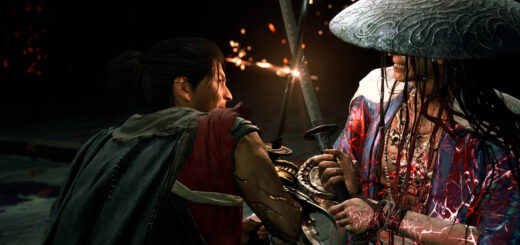
The demo began with the protagonist, Miyamoto Musashi, meeting a blind woman in an abandoned, ransacked village. She alludes to Musashi being bound to a terrible fate, mentioning the sentient gauntlet affixed to his arm (which has an entity named Shizuka within), and promises that the nearby Yasui Konpiragu Shrine can solve his problem. She adds that many of the village’s residents have found a remedy there, and so off to the shrine Musashi goes. There, he meets an old man whose leg has been amputated at the knee, and, upon speaking with him, he finds that the old man experienced terrible pain in his knee for over a decade, but that he is now free from this pain due to the shrine god’s assistance: no knee, no pain. Exploring the shrine reveals a common theme: stark, severe, and unsettling remedies for all sorts of ailments that the village residents seem uncannily happy about.

The shrine’s meadow stuns with its array of colorful flowers.
This initial setup did a fantastic job at establishing an unsettling atmosphere, effectively building intrigue and a sense of unease about the world. Speaking with other village residents reveals more disturbing “solutions” to their problems, and several encounters here help flesh out Way of the Sword‘s authentic setting, which is one of its strongest elements. All of the buildings, architecture, and even the flora are crafted with detail and beauty. The shrine area and its flower meadow stood out as particularly gorgeous, partly because of their sudden appearance within the shrine’s walls once Musashi crossed an invisible barrier, but also because of the contrast against the dilapidated, muted colors of the surrounding village. The environmental spectacle was also evident in the theater presentation earlier in the day, where the presenter elucidated the real-world locations depicted in Way of the Sword, which are crafted with impressive accuracy and attention to detail. The end of the theater presentation featured a dance on a kabuki stage, and between that and the demo’s meadow, it feels like the game’s more vivid flashes of color and lively moments are fighting against the browns and grays of the dark, malice-filled world, to great effect.
Once Musashi goes further into the level, he meets the Eight Stout Pillars, a collection of statues who promise to endow him with power should he find three of their missing brethren. Their dialogue, as well as Musashi’s, offers some fun back-and-forth banter, with Musashi’s boneheaded personality delivering entertaining moments. This is especially true when interacting with Shizuka, and was also evident in the theater presentation, where Musashi’s inability to row a boat properly drew a good collection of laughs from the audience.

Rasho-gan tempts Musashi.
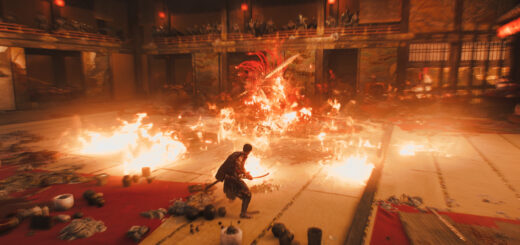
As Musashi attempts to track down the statues, he fights enemies throughout the level. Featuring an action-based combat system, Musashi can parry, block, use heavy and light strikes, and wield some special and powerful Gauntlet Weapons. These weapons charge based on filling a gauge by collecting blue-colored souls that drop from enemies. Way of the Sword‘s combat foundation is quite solid, feeling responsive and satisfying to execute, while also featuring some truly impressive cinematic attacks and flourishes. That said, there’s one crucial flaw in the combat design, one that’s also present in the publicly released early-game demo: regular enemies are just too easy due to a lack of group aggression. When facing a group of enemies, they just sort of stand around and take turns hitting Musashi. While an enemy or two will occasionally muster the courage to lunge at Musashi, it’s far too easy to deal with large groups of enemies due to their tendency to engage one-on-one. This appeared to be the case in the theater presentation as well, albeit to a slightly lesser extent. This is somewhat disappointing, as the levels generally offer interesting opportunities for interaction, be it by using a rolling cart as a weapon or a large wooden board as a shield and crowd-control measure.
Way of the Sword‘s combat shines much brighter in its boss fights, where the foundational elements are executed significantly better and feel more satisfying. There’s an enjoyable, deliberate pace to boss encounters, and an appreciable variety of attack forces Musashi to counter them utilizing his bow and Gauntlet Weapons. Animations are smooth and well telegraphed, and the fight cinematics elevate the experience to a new level. While the demo’s boss offered a fulfilling challenge, the boss featured in the theater presentation seemed even more intriguing, largely due to Musashi’s wider array of Gauntlet Weapons. Smart use of these weapons and their abilities appeared to turn the tide in a tough fight, and it seems to be where most of the promise and combat divergence is.
On the whole, Onimusha: Way of the Sword has great promise: an immersive, authentic world, a gorgeous setting, interesting lore and character interactions, and some outstanding bosses. While the element of challenge is somewhat lacking against regular enemies, Way of the Sword appears to be a strong return to form for a long-dormant series.





Recent Comments