Towa and the Guardians of the Sacred Tree Impression
While the game’s visual aspects certainly help it stand out, there’s strong gameplay to back it up.
Brownies Inc. has a good developing lineage. The studio’s founder is Shinichi Kameoka, who is known for his work with the Mana series before founding Brownie Brown (now 1-Up Studio), which worked on Sword of Mana and Mother 3 among others. After previously working on Egglia, the studio has teamed up with Bandai Namco for isometric action roguelite Towa and the Guardians of the Sacred Tree. Sporting a beautiful visual style and interesting two-character combat system, RPGamer was able to check out its early sections during a four-hour preview event.
Towa and the Guardians of the Sacred Tree is set around the blessed village of Shinju, which is looked after by Towa, the ageless child of the gods. However, in the outside world, the god Magatsu has risen and aims to consume the world in dark miasma with his monster minions known as the Magaori. After the Magaori invade the village, Towa is tasked with gathering eight companions — known as the Prayer Children — who can wield the sacred sword and staff bestowed on her and who are unshackled from the flow of time. This allows Towa to turn back time should anything befall the Prayer Children.
The game’s story takes place after much adventuring has already taken place. It begins as Towa and the Prayer Children reach Magatsu before he is fully summoned. However, there is no longer enough mana left — it having been spread across multiple futures Towa has created with her time-travelling abilities — and Magatsu sends the Prayer Children to the end of time. Fortunately, Towa’s abilities allow her to reunite with the Prayer Children and embark on a new quest to obtain mana by defeating the Magaori and Magatsu’s more powerful subordinates, the Magatsu-Hi. In order to do this, two guardians can be sent out at a time, one acting as the sword-wielding Tsurugi and the other as the staff-wielding Kagura.

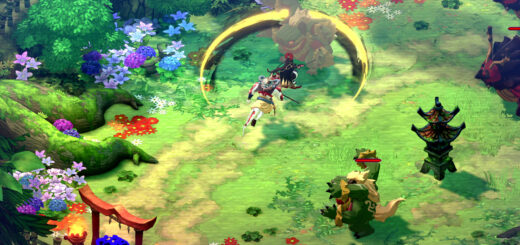
The game sees players controlling two guardians as they advance through rooms of foes.
Towa and the Guardians of the Sacred Tree is quite interesting in its approach to the narrative. Outside of the introduction scenes, the game is actually quite light in terms of major plot events. Instead, it focuses on relationships between characters, with many scenes calling back to past events and actions they have undertaken. However, that doesn’t mean the game is lacking in emotional punches. One of its key elements is that in order to restore the mana after defeating each Magatsu-Hi, the Kagura must offer themselves as a sacrifice. While the guardians are unwavering their duty and readily accept the necessity of their sacrifice, it certainly hits hard. In addition, many of the events in town offer an interesting mixture of heartfelt and humourous interactions between Towa and the villagers. It works decently well, and ensures there’s an underlying sense of mystery to the main story while still offering plenty of opportunities for characters to interact.
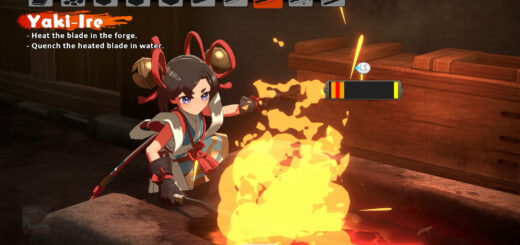
As the game progresses, players gain access more facilities at the village where they can obtain permament progress and unlocks, with the village also featuring other interesting aspects that this preview is not at liberty to divulge. The most involved facility is sword forge, which gives players a multi-phase mini-game where they can create and customise new swords. There are also options to improve the guardians or change their loadouts, such as unlocking other spells or equipping them with different swords, as well as the likelihood of certain upgrades appearing during runs. Witnessing conversation events at the village will also award players ore that be used for upgrades.
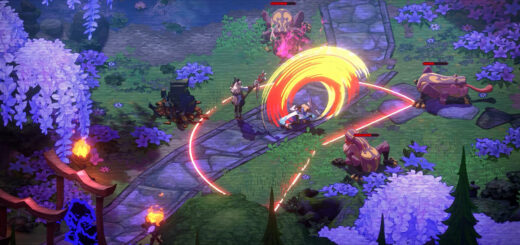
Combat in Towa and the Guardians of the Sacred Tree sees players directly controlling the Tsurugi, with the Kagura automatically following them, though players can also directly move the Kagura separately if they wish. The Tsurugi is armed with two swords that must be swapped between frequently, usually every few seconds of use depending on the sword’s durability rating. Each sword is equipped with its own attack that uses up durability. Once its durability hits zero, that sword no longer does full damage and needs to be sheathed before it can do full damage again. Meanwhile, the Kagura is able to provide two magic spells that can be freely used following their respective cooldown periods. Players can also dodge or use a special ability that utilises mana stacks filled through regular fighting. In the few hours spent with it, the game successfully gives players a good selection of actions without overcomplicating the controls.

Rest points offer the opportunity to enjoy charming conversations between guardians.
Each run sees players try and advance through a series of rooms while obtaining temporary upgrades called Graces. There is a good amount of variety to the Graces available, and the upgrades provide good impetus for synergising or adapting one’s play style to make the most of them. Each room usually houses a few waves of monsters, though certain rooms can provide rest points (where players can also witness conversations between the two selected Prayer Children) or a store to purchase additional upgrades. After doing what they need to in the hub, players can start their current “route” to try to progress the game, with each route having its own design and bosses. After completing a room, players sometimes get a choice of doors, which leads to a type of reward or room indicated at the exit chosen, giving a bit of strategy and risk-versus-reward pull.
The two-character system allows for some interesting mechanics. One of these is how the game handles health. There is a single shared health bar, but both characters contribute towards it and only lose health when that character is hit. Even if one character is reduced to zero HP, they can still act and there is no game over until both have been eliminated. In addition, the sacrifice system encourages some strategic thought from players as well as ensuring that they can’t just find a partnership they like and stick with it. There is a decent amount of difference between the characters, though it doesn’t feel so much that players need to drastically change their style between them.

The sword forging mini-game is decently involved.
Regular enemies come in a decent enough variety and don’t take very long to beat. Boss fights provide an exciting challenge and their own mechanics for players to deal with, making the individual encounters sufficiently memorable and offering decently differing threats. The game indicates when enemies are going to attack, as well as the danger area, to give players a heads up and help them learn where they need to be stationed to deal with each attack. The early runs move along at a good pace as well. A successful run on the first route took around twenty minutes, with the second taking a bit longer and having extra rooms and an additional mini-boss. In addition to the regular difficulty, the game includes a story mode that lowers the challenge and provides a boost with each failed run to help players get over the current hump.
Towa and the Guardians of the Sacred Tree doesn’t skimp on the visual beauty. The environments are gorgeous, and the eclectic character designs look fantastic as well, with traditional Japanese art styles used to fine effect in certain scenes. Combat looks great, and the UI does an impressive job of looking flashy while giving players all of the information they need to succeed. The game’s audio is another strong point, with engaging music, good sound effects, and excellent voice acting from an experienced cast.
After spending a few hours with Towa and the Guardians of the Sacred Tree, there’s a lot to like. While the game’s visual aspects certainly help it stand out, there’s strong gameplay to back it up. Whether the game can maintain enough variety and ensure its narrative elements fully pay off remains to be seen, but what is there currently shows plenty of promise. Towa and the Guardians of the Sacred Tree releases for PC, PlayStation 5, Xbox Series X|S, and Nintendo Switch on September 18, 2025.
Disclosure: This article is based on a build of the game provided by the publisher.




Recent Comments