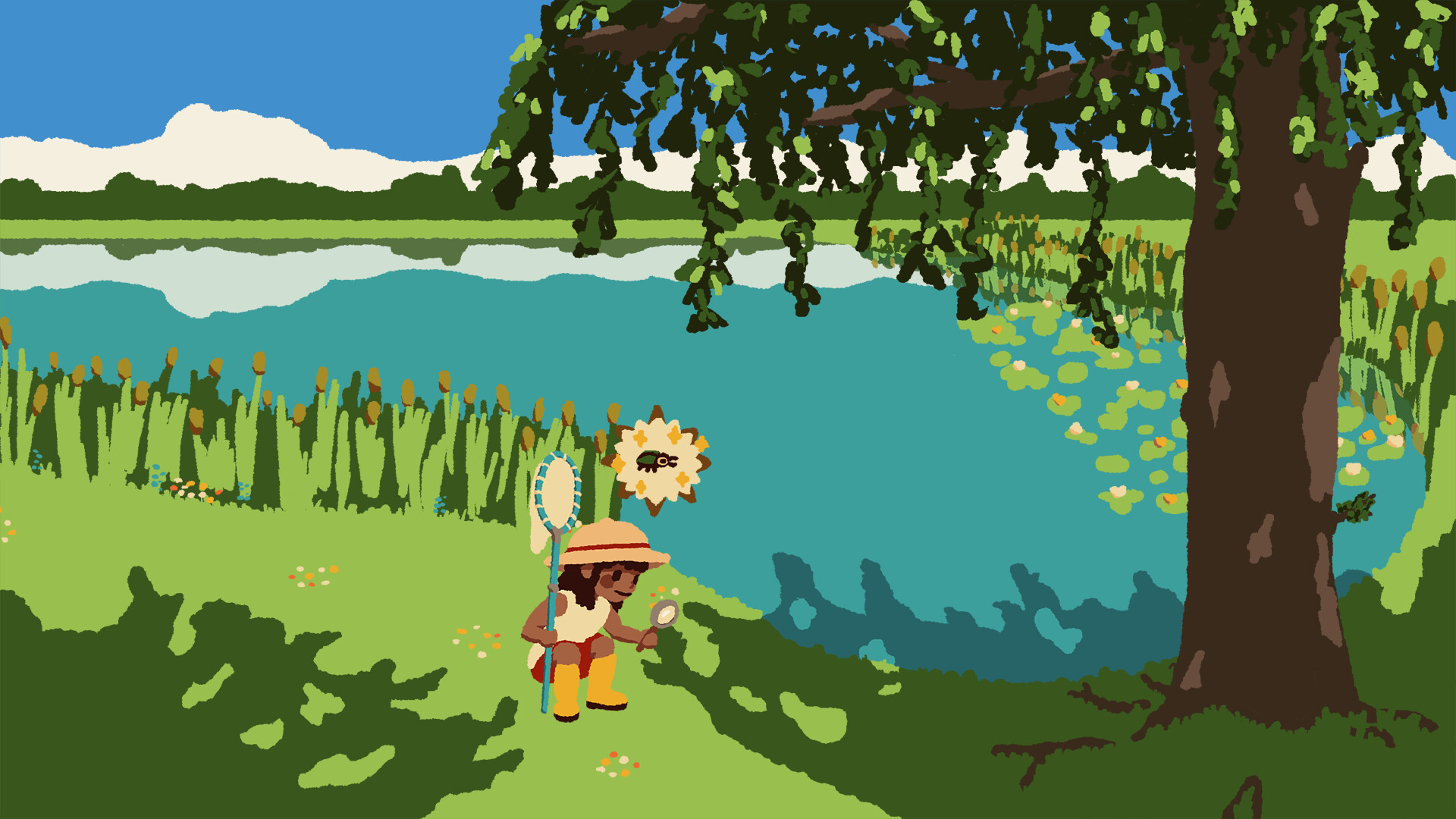
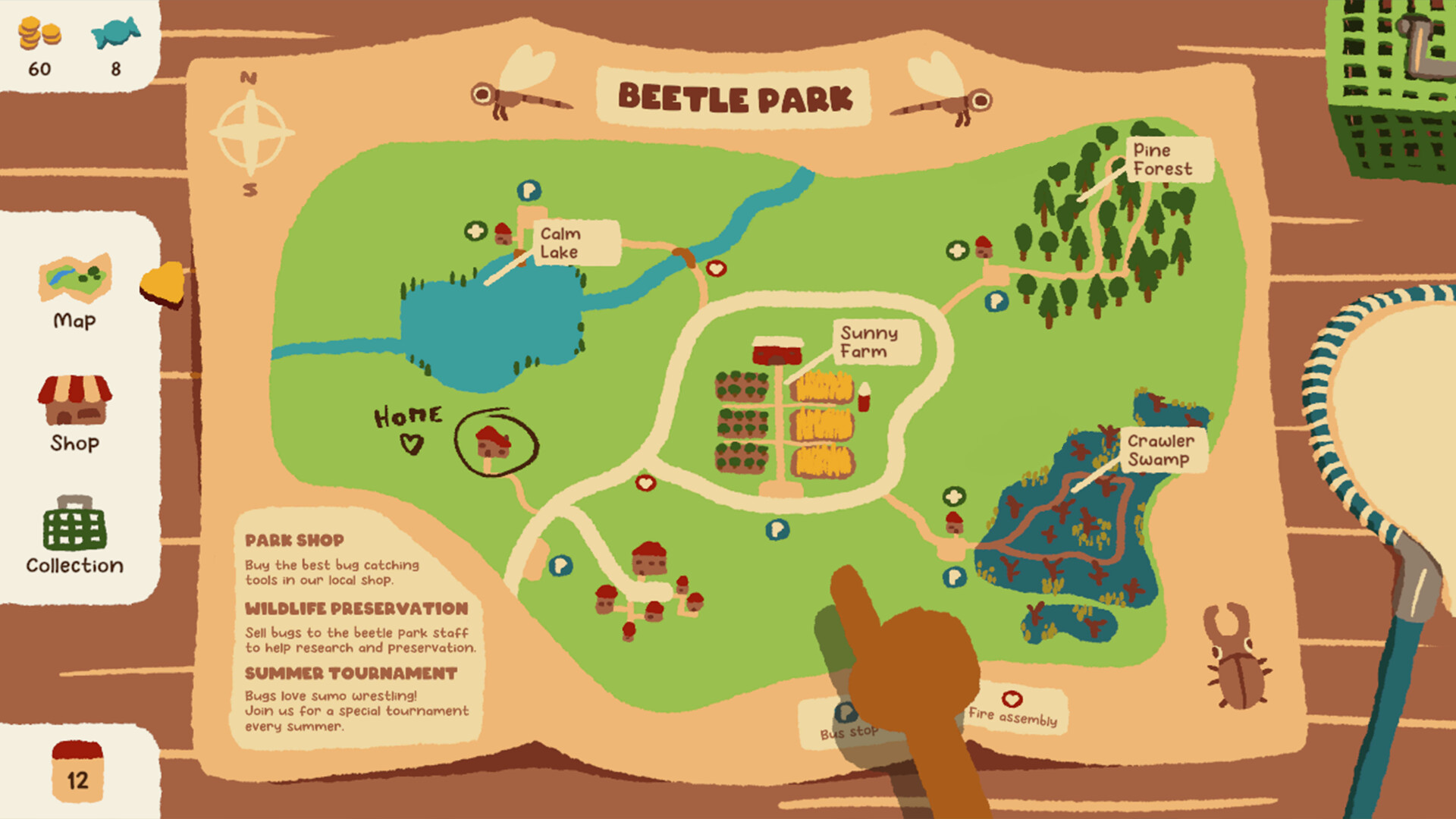
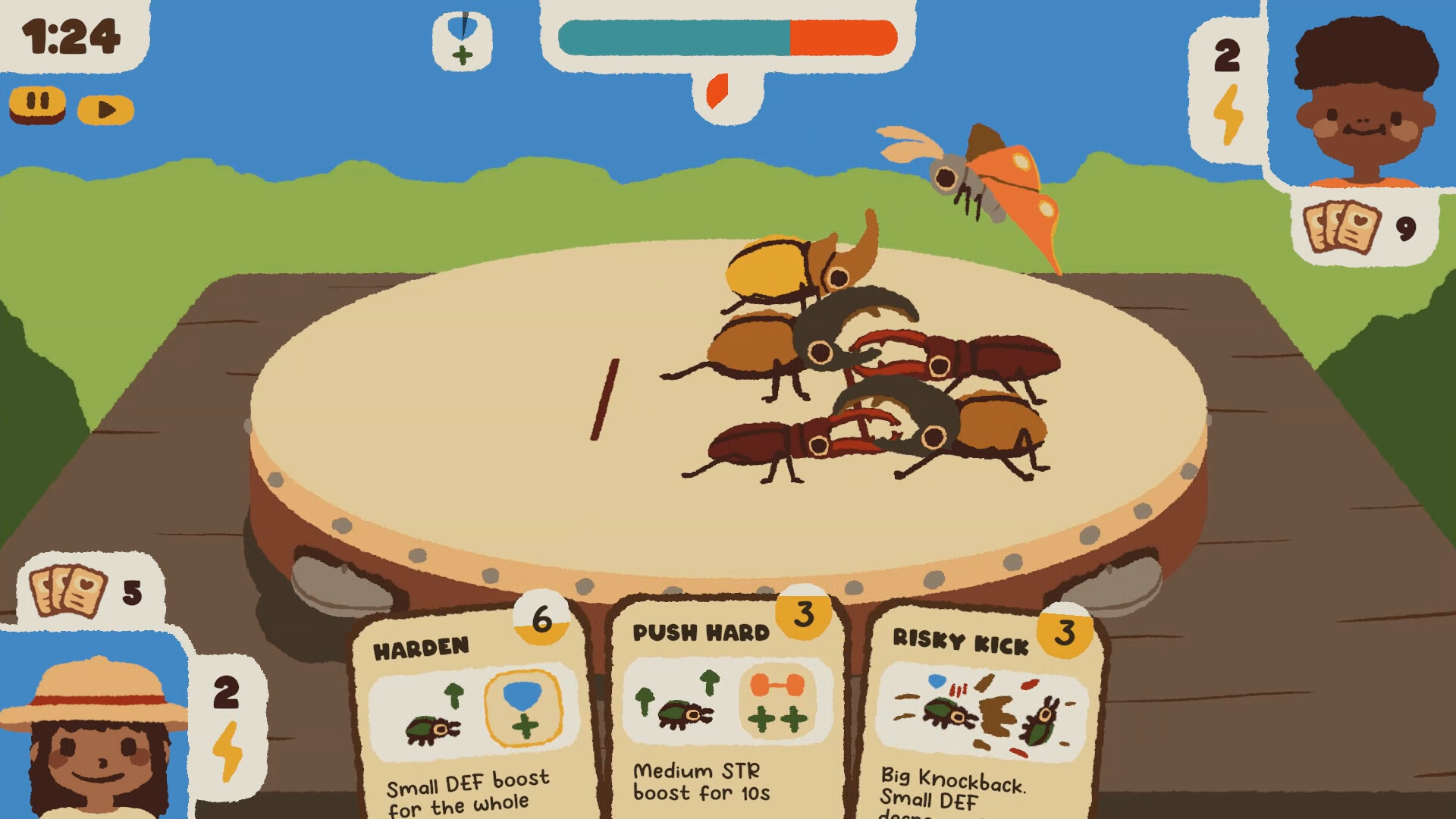
Doot Tiny Games’s Kabuto Park is a charming short bug collecting and battling game that aims to showcase the joy of spending summer in nature and discover the impressive array of small critters that live in it. Released just a couple of months ago on Steam and Itch.io, it offers an excellent balance of bug collecting and battling in a tight, simple package. RPGamer was given the opportunity to put some questions to developer Doot about the game and its inspirations.
Sam Wachter (RPGamer): Where did the inspiration come from when creating Kabuto Park?
Doot (Doot Tiny Games): The starting point was that I wanted to do another small game, different enough from Minami Lane and more personal. I wanted to do the visuals on this one so it needed to be extra simple.
After a little market research looking up things like what small games worked or what Steam Festivals are coming, I thought it would be fun to try to do a creature collector game.
I’m a huge fan of birds, so the first idea was a game where you catch birds and then try to defend a big castle that is also a bird feeder.
However, the fantasy felt unintuitive and not catchy enough. Catching and fighting are not verbs that fit well with birds, but you know what they fit well with? Beetles!
I recently played Natsu-Mon, am a big fan of bugs and beetles, and thought this could lead to a really interesting game.
Of course this is a very summarized version, it took several weeks to get there, but the general idea is that it was a mix of setting up clear objectives, thinking about cool things I like, doing market research, and iterating until I found a catchy simple pitch with a strong fantasy.
RPGamer: Is the battle system’s Push and Hold mechanics based off of anything specific?
Doot: It’s based on a game jam we did with Blibloop some years ago! The jam was Ludum Dare 50, the theme was “delay the inevitable”, and we made a game where you try to delay a conversation with your partner with a Street Fighter meets Scott Pilgrim aesthetic. I always loved the gameplay we had there and it stayed in the back of my mind for years before I had this perfect opportunity to use it.
The deckbuilding based on your team of critters is directly inspired by Ooblets! I really thought it was a very good way to introduce deckbuilding to all kinds of players when I played that game.
The push / hold phases, stat system, and card effects went through a lot of iteration during the game’s development to get to something that feels both exciting yet not overwhelming. I also wanted players who enjoy that to be able to craft cool strategies and feel smart while others could just run over the game by just having bigger beetles with big stats. Playtests helped a lot to get there!
It might not be perfect, but I really like the balance we have there, especially since I managed to keep it very accessible to players who are there only for the cute bugs and summer vibes.
RPGamer: How did the development process for Kabuto Park differ from your first game, Minami Lane?
The biggest difference compared to Minami Lane is actually that I wanted the game to be very different so that I could not make comparisons in terms of expectations and results. Minami Lane did incredibly well, and I don’t want to set that level of success as a goal. My goal is to make cute little games and have fun making them, and it should just stay that way! It’s easy to say but kind of hard in practice, when starting the work on Kabuto Park it was really hard to tell myself “that’s ok if this one is not as good as the previous one”.
Another big change is that while on Minami Lane, Blibloop and I both worked full time on the project, this time I was the only one! This means I had to make all the art and this was very scary to me as my comfort zones are project management, game design and programming, not art. Blibloop and I loved working as a couple on Minami Lane but we knew from the get go that we did not want to work together on all projects to make sure we keep our couple safe from the issues that could arise by doing everything together all of the time!
Finally, I felt like overall development went a bit smoother? I guess it’s down to experience, but I’m starting to have more trust in the way I do things. I also started to feel the results of building a community for two years, marketing is slowly starting to get a bit easier.
RPGamer: What is your favourite bug, and why is it (or isn’t it) the Goliath Beetle?
Doot: I’m glad you love the Goliath Beetle, it’s such a cool one!
I’d go with Greater Stag Beetle or Hummingbird Hawk-Moth.
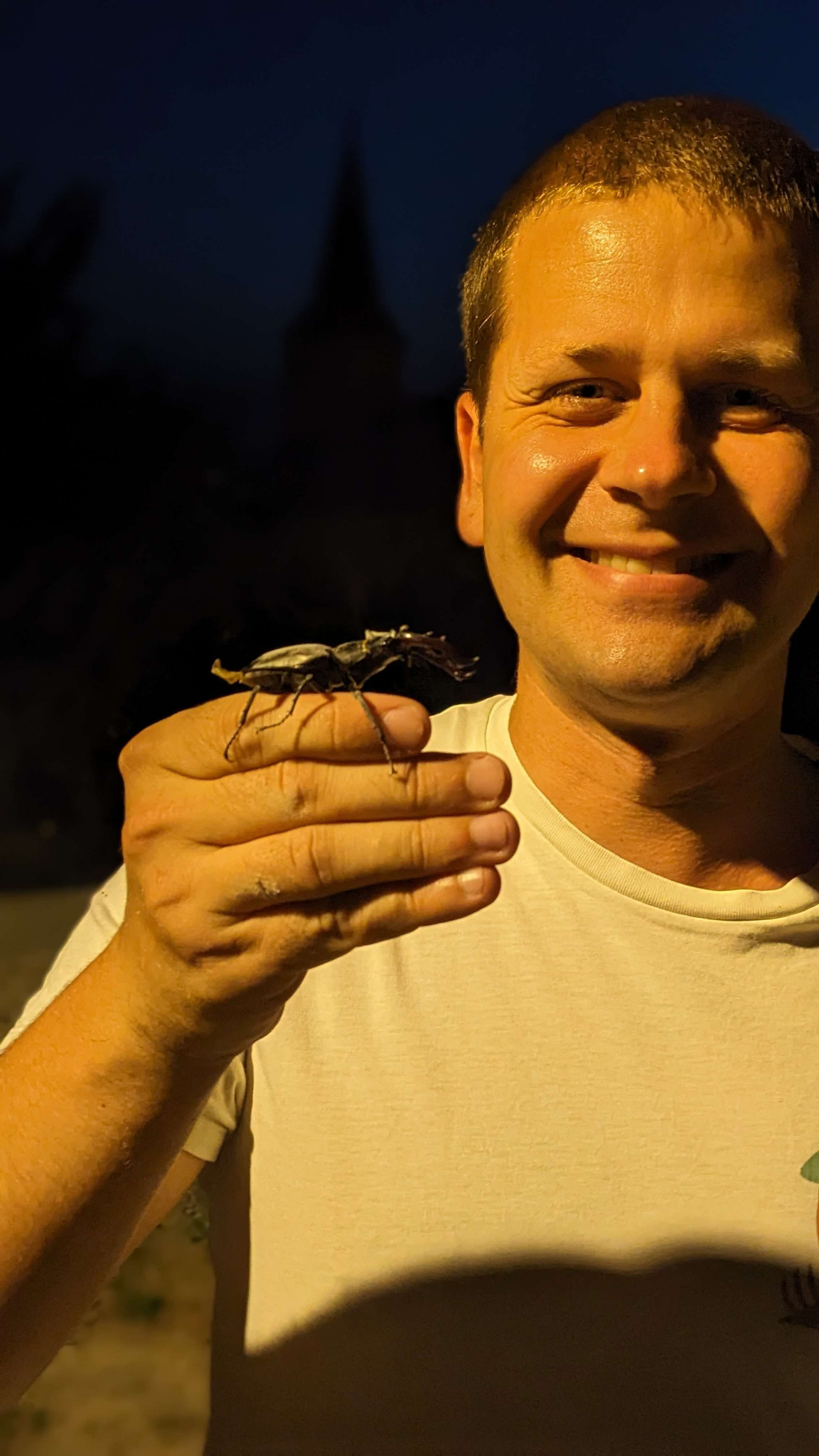
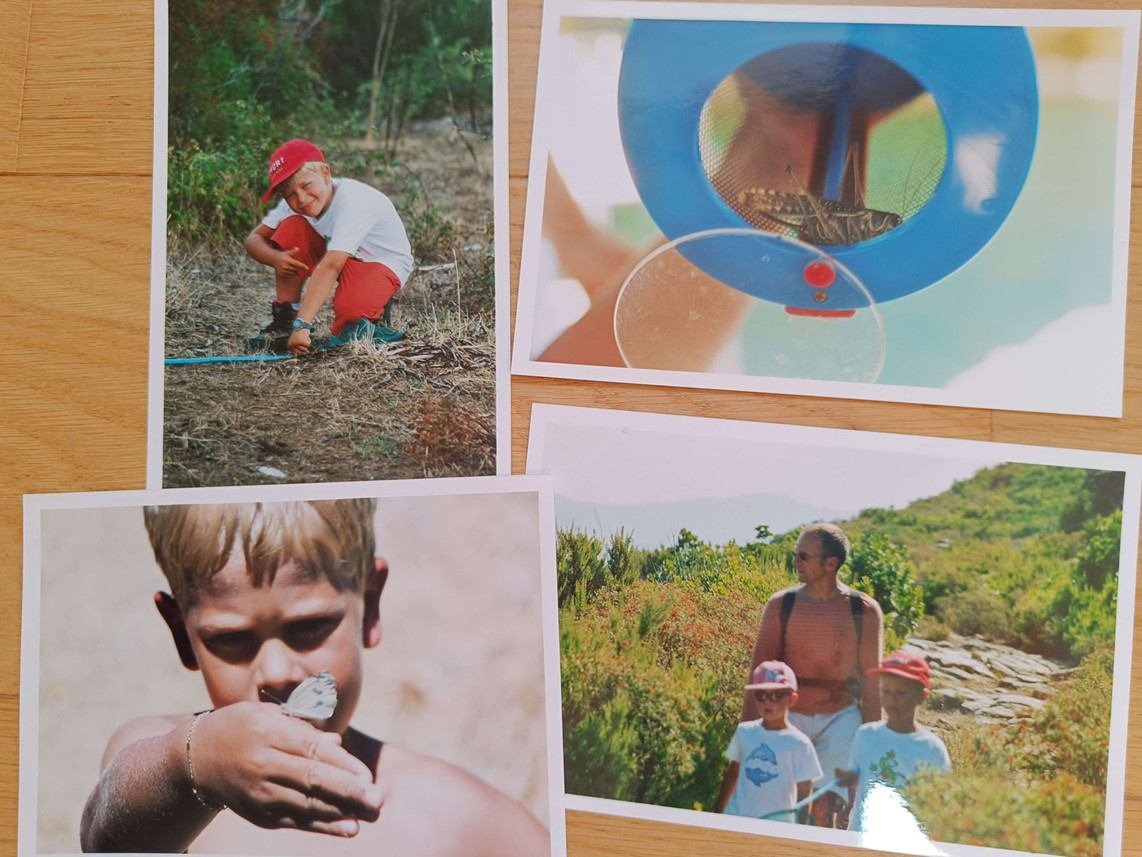
I had a lot of Greater Stag Beetles in my garden as a kid, and that clearly left a strong mark that is one of the main reasons I love beetles and created Kabuto Park. They are just so cool! Here is one I met a few days ago and me as a kid catching bugs.
Hummingbird Hawk-Moths have a special place in my heart too. How can something so weird yet so cute actually exist for real? They are also supposed to bring good luck, and I have a little story about that. Blibloop and I lived in the forest for the last few years, and moved last winter to a small town. There are definitely less bugs here and I didn’t know if we would see any Hummingbird Moths during the summer. Then on the release day of Kabuto Park, just a few hours before release, Blibloop pointed at the window behind me and said “Look at that!”. There was a Hummingbird Hawk-Moth right there, in our small flower bed. That made me so happy!
RPGamer: What were your intentions when you set out to develop Kabuto Park?
Doot: My goal was to make another cute little game!
As with my previous games, the top priority was to keep it small. I really believe that making small games is much healthier than making bigger ones, but it’s really easy to slip and make your game too big during development if you don’t set that as the main objective.
Another goal was to make a game different enough from Minami Lane to try to reduce the impostor syndrome that the big success of that game brought. Kabuto Park worked very well too, so I guess I didn’t really manage to tackle that! It will be a challenge for the next game to keep my expectations low too, but I think it’s really important to me.
RPGamer: Will you be adding more bugs to the game in the future?
Doot: I’m not sure? I already added two new ones (including an extra rare legendary) after release, but I’m currently taking a step back from the game to rest and think about the future. On Minami Lane, everyone around us suggested that we’d continue work on the game, make DLCs or more content, but we decided not to because that’s not what felt the most interesting to us. I think it might be the same this time. I absolutely love that game, but wouldn’t I be happier working on something new? Making many small games is much better for my mental health than sticking to one, so I think I’ll just do that!
RPGamer: One of the most striking elements of Kabuto Park is its art direction. What was the decision making process behind making the game’s world look like a painting?
Doot: Oh, that’s so nice of you to say that, thank you!
Well, that might be a weird answer, but the art direction is mostly due to my very limited skills! I’m new to drawing and have almost no fundamentals; I think that’s where the “naive” art-style comes from. I’m bad with colors, so I use a fixed limited color palette found online to make sure it looks good. Then I want to be able to iterate fast so I don’t use line art but just big color shapes so it’s easier to scale, rotate, or change colors without it looking ugly.
One of the biggest inspirations is Hyogonosuke [illustrator on the Pokémon Trading Card Game, Natsu-Mon, and more], so I tried to study how he did shapes, lighting, and colors and come up with my own style based on that. I’m happy you like it!
RPGamer: What feeling do you hope players feel while playing your game?
Doot: Childlike wonder and excitement along with summer vacation vibes!
As you can see, the focus is more on an overall vibe and fantasy. That’s why I kept the game as simple and intuitive as I could. No way to lose the game, no situations that you can’t overcome in many different ways, no time pressure and a lot of ways to make everything easier if it’s still too complex for you.
I want players to play the game and tell their friends, “Look at my cool bugs! I love them so much!”. I hope some of you did! 🪲💖
RPGamer would like to extend our deepest thanks to Doot for answering our questions, as well as to Sarah Blackwell and Stride PR for facilitating the interview. Kabuto Park is available now for PC, Mac, and Linux via Steam and Itch.io.
RPGamer has been covering RPGs since 1998, with the current version of the site launched in 2018. Due to the wholesale change in our back-end and systems our current site only contains content created since 2018, as well as selected older reviewers. However, all of our older content can still be found at archive.rpgamer.com.






Recent Comments