The Outer Worlds 2 Review
Great Power; No Responsibility
As a standalone sequel to The Outer Worlds, The Outer Worlds 2 promises a new, bigger solar system with more planets, more divergent gameplay, more weapons, and deeper RPG systems. To boot, it also features an entirely new cast of characters, looking to widen its scope to boldly go even further into the reaches of space. The Outer Worlds 2 succeeds in offering players a wide variety of choices both in its character progression and combat, and makes some bold attempts at deviating story branches, especially early on. However, it sadly falls flat in almost every conceivable dimension, with an otherwise mediocre experience frequently and consistently hindered by bugs, glitches, and immersion-destroying sequence breaks, resulting in a game that does not feel sufficiently prepared for launch.
Taking place in the Arcadia star system, The Outer Worlds 2 sees a player-created character navigating a factional conflict over the solar system’s planets, resources, and trade routes. As an agent of the Earth Directorate – an organization created to mediate between Earth and its interstellar colonies – players are tasked with investigating the appearance of dangerous and destructive spatial rifts, which have cut off communication with Earth. In Arcadia, the totalitarian Protectorate government maintains a monopoly over the production of superluminal travel technology, which prompts the hyper-capitalist megacorporation Auntie’s Choice to invade, setting off a massive war.
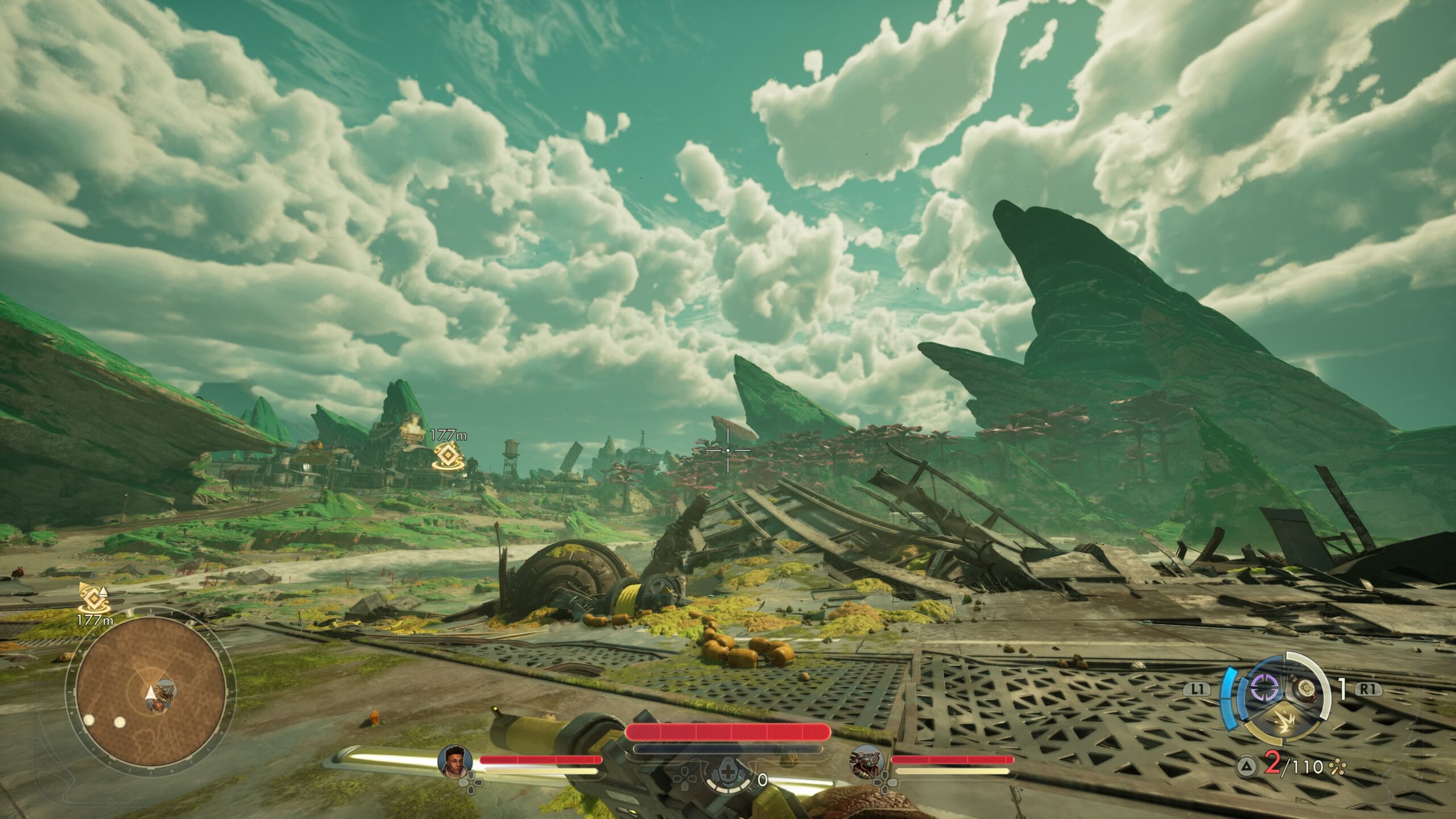
The scale of destruction caused by Auntie’s Choice’s resource extraction is massive.
Much of the early game, especially on the first planet, focuses on the conflict between the Protectorate and Auntie’s Choice, and it is not a particularly interesting conflict. Both factions are cheap, surface-level pastiches of totalitarianism and corporatism, respectively. The critique and satire are banal at best, especially when pitted against each other, which leaves a boring, terrible first impression. The Outer Worlds 2 has a strange mishmash of humorous overtones while having a darker tonal core; sing-song radio broadcasts celebrating workplace dismemberment accidents juxtapose relentless, gruesome summary executions and brainwashing torture. Not only does the humor fall flat on its own, but the tonal clash with the game’s darker narrative focus is egregious enough to stretch the suspension of disbelief well beyond the breaking point.
That said, The Outer Worlds 2 does better with elements relating to other factions and players’ dialogue choices resulting in narrative divergence. The Order, a technocratic-religious society focused on mathematics, is markedly more interesting, as is the Golden Dawn cult, whose members are obsessed with the rifts and have a fanatic, violent death drive towards them. Aza, one of the recruitable party members who has an insane, psychopathic bloodlust, stands out as more compelling and believable in a game where too many of the ostensibly more rational characters simply act as overly dogmatic mouthpieces for their respective factions. Beyond characters and factions, some genuinely cool choices impact the plot in major ways early on, although the relentless presence of glitches and bugs in the review build massively undercuts this positive.
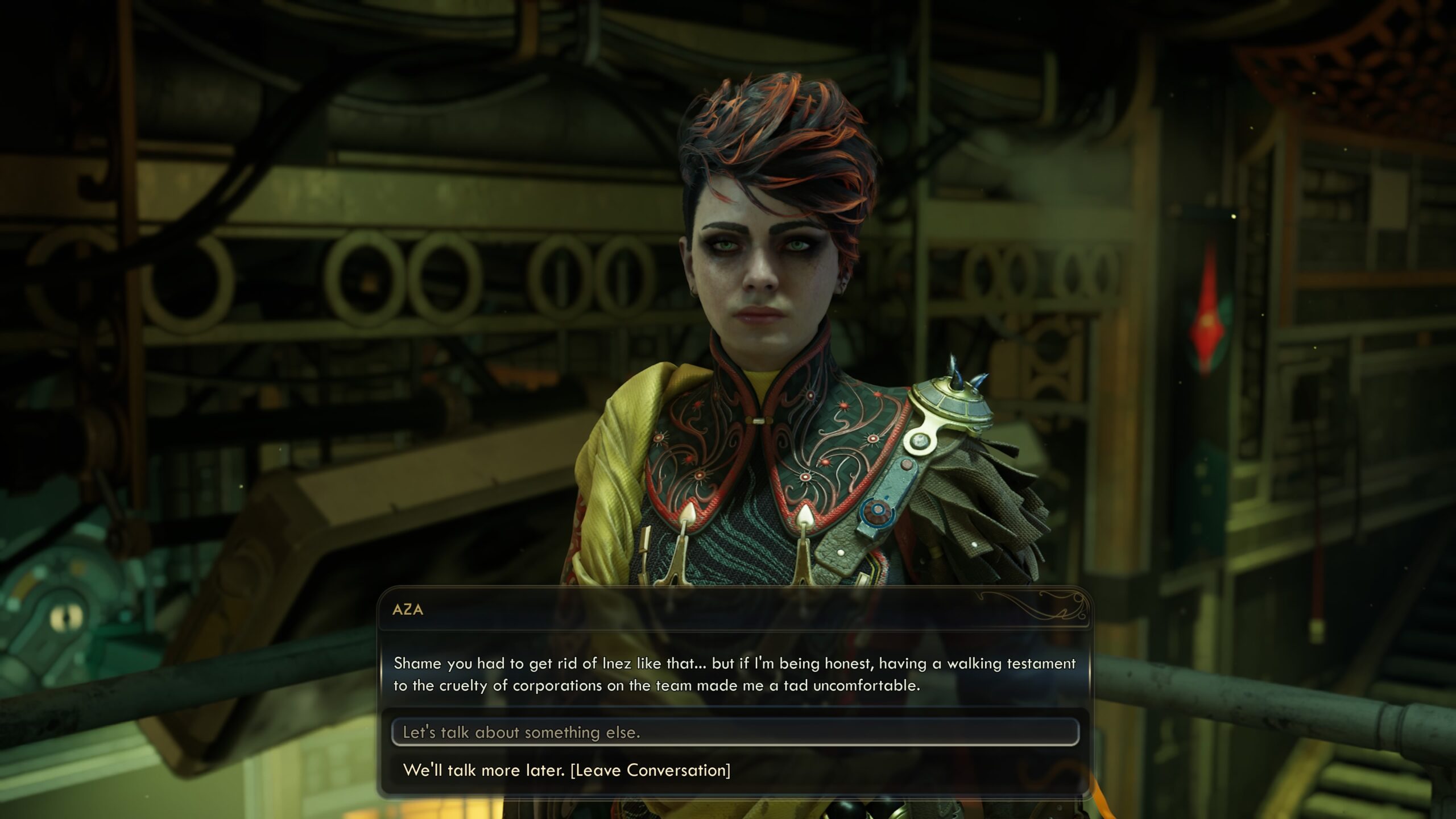
Aza laments the departure of a character she never had the chance to meet.
In the most egregious instance of technical issues, one of the first available party members, Inez, has her initial recruitment quest bugged, and it can become impossible to complete. During this quest, it is possible to select a dialogue choice that leads her to leave, yet, despite this being a choice, every party member afterwards for the rest of the game remarked on her dismissal from the crew, even though they hadn’t met her at all. Entire companion questlines, Aza’s in particular, can become wholly incompletable, and it is even possible to become hardlocked in a room halfway through the game. The Outer Worlds 2 is riddled with bugs, glitches, and sequence breaks too numerous to list that absolutely destroy its interactive elements and brutally hamper the story’s few redeeming qualities.
Fortunately, The Outer Worlds 2 is more enjoyable in combat than outside of it. The action combat revolves around using either guns or melee weapons to attack enemies in the field. Players are given twelve different stats they can level, which impact performance in combat and allow the development of perks. Movement and gunplay are smooth and satisfying, and melee weapons are generally fine to use, if somewhat simple. Early on, the incorporation of RPG elements and elemental differentiation between weapon types – plasma for fire, corrosive for armor depletion, shock for electric – feels deftly incorporated, and there are neat and interesting ways to attack enemy body parts and weak spots that encourage players to be deliberate in their approach.
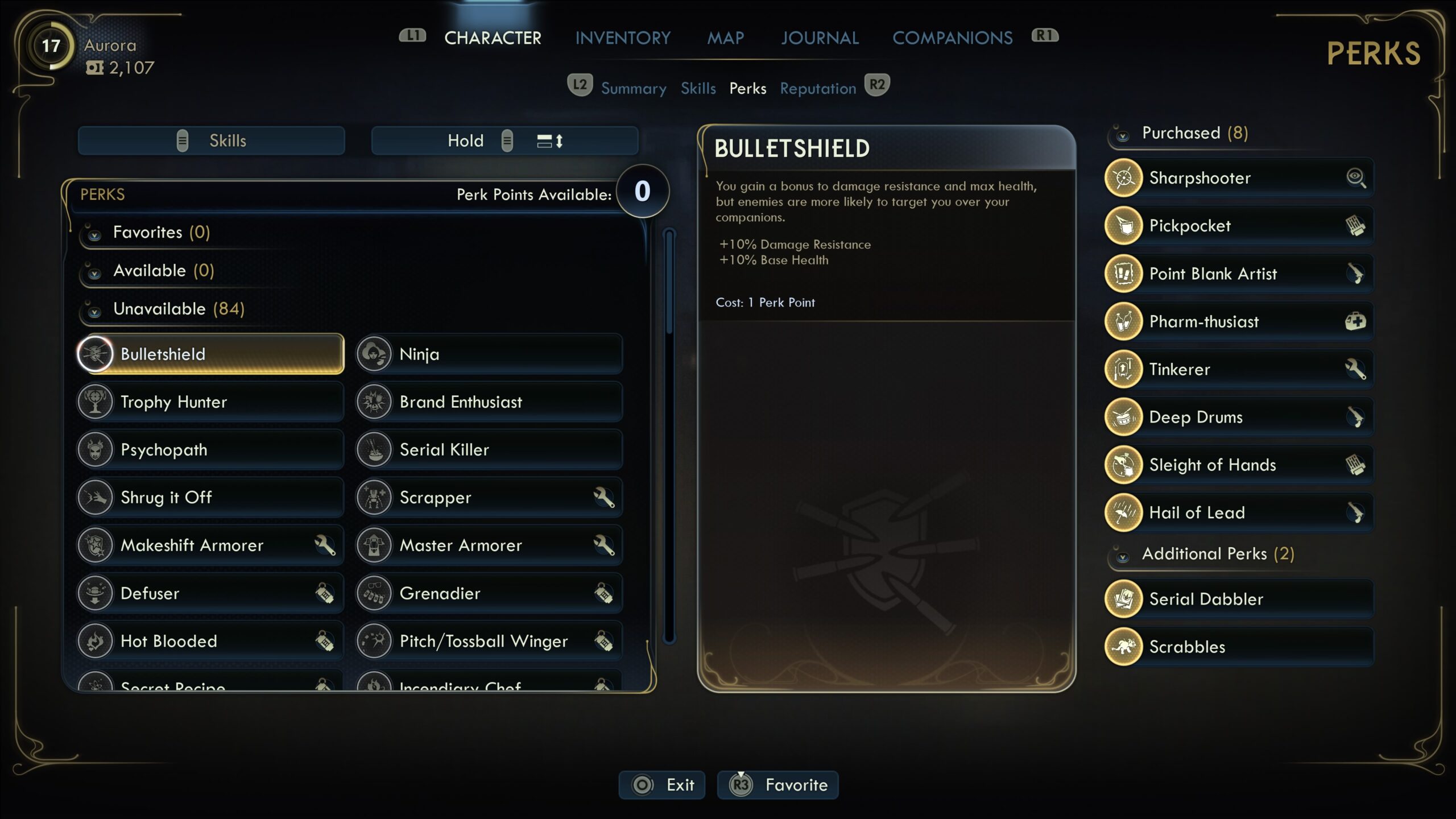
Perks offer an interesting development path and an incentive for growing your character.
Unfortunately, the incorporation of the equipment and extension of stats into combat and gameplay becomes quite unbalanced later in the game; some stats are quite useless compared to others, and the mod system for armor feels superfluous and bloated. Stats like Observation or Explosives either see very little use or are too expensive to warrant focusing on, whereas focuses on stats like Sneak and Speech grant a one-size-fits-all approach to most of the challenges in the game. By the end of the game, even some of the most powerful automechanical enemies can be killed in a single sneak attack due to some ridiculous percentage-based increases conferred by leveling. Other stats like Lockpick eventually feel underwhelming, too, as many doors and rooms, more often than not, have repetitive or redundant rewards, especially when exploring outside of the main story.
Visually, The Outer Worlds 2 is largely fine, with a few flashes of brilliance here and there in its world and architectural design. There is a lot of considerable attention to detail in the environments, and the first two planets are interesting, colorful, and presented well. In particular, the planet Dorado is quite gorgeous, especially at night, and its vibrant, glowing crystals amidst the grand, golden, and ruined architecture on the planet stand out as a particular highlight. Sadly, the other planets aren’t quite as interesting, and the visual fidelity of facial capture and expressions just isn’t good, which detracts from a game that focuses so heavily on dialogue.
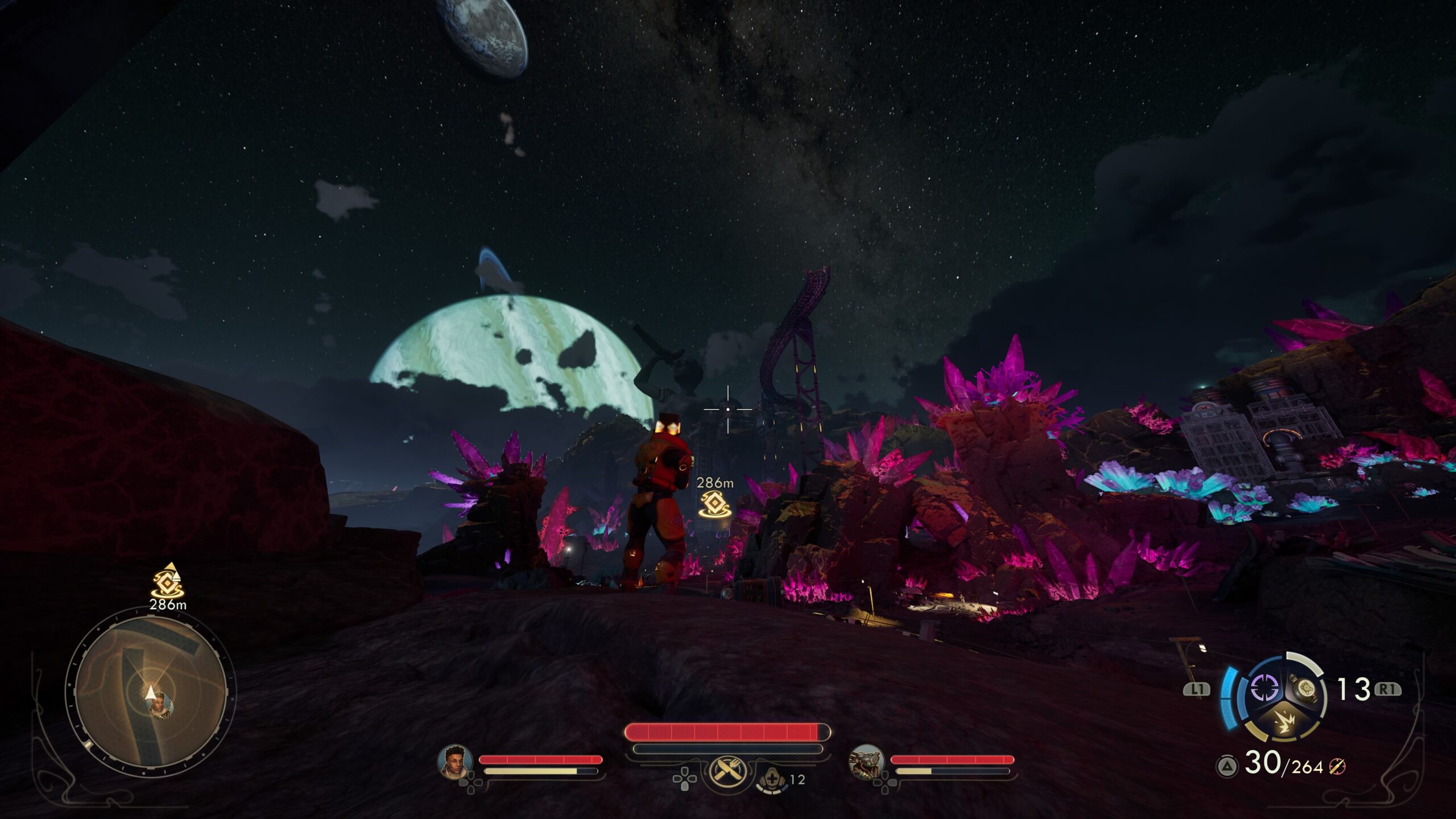
Dorado at night is a visual high point.
On the sound front, the overall soundtrack does the job it needs to do, but is mostly unremarkable. Aside from the location-based ambient tracks, there are some neat overtures on the main menu and other areas, and the in-game radios for the various factions provide some compositionally interesting music and insight into their cultures. Even if the humor and lyrical content of the songs largely fall flat, the instrumentation demonstrates a strong effort. Voice acting in the game varies in quality, but performances are mostly good, although glitches and bugs once again rear their ugly head here, too, as the dialogue regularly cuts out or becomes entirely silent, which significantly hampers immersion through the entire experience.
Despite all of its environmental detail, scope, and promise of a wider, more exciting space-faring adventure, The Outer Worlds 2 is a disappointment. While it offers divergence and choice, its paper-thin satire, tonal mishmash, and balancing oddities see the experience crumble under the weight. In addition, the review build’s far too many immersion-destroying bugs, blocked questlines, and other sequence breaks ensure that the game’s issues outweigh its redeeming qualities.
Disclosure: This review is based on a free copy of the game provided by the publisher.

Some initially interesting plot divergence
Some great presentation elements
Rampant bugs, glitches, and sequence breaks
Broken, incompletable questlines
Gameplay balance falls apart in the second half
Exhaustingly trite satire and tonal mess
Last two worlds are less visually interesting




Recent Comments