The Hundred Line -Last Defense Academy- Review
An Exquisite Combination of Adventure and Tactical RPG
The Hundred Line -Last Defense Academy- is one of a growing number of titles that aim to get the most of its narrative elements by adding further interactivity and freedom to the traditional adventure game formula. Coming from the minds of the renowned creators Kazutaka Kodaka (Danganronpa series and Master Detective Archives: Rain Code) and Kotaro Uchikoshi (Zero Escape and AI: The Somnium Files), the team at Too Kyo Games and Media.Vision has set out to accomplish this through a tactical battle system and heavier RPG elements. The result is a highly successful combination that keeps the player engaged thanks to a well-balanced battle system that beautifully intertwines with a mind-blowing narrative.
The Hundred Line -Last Defense Academy- follows Takumi Sumino, a high school student who lives in Tokyo Residential Complex, a futuristic underground version of Tokyo. The young man’s mundane life comes to an abrupt end when mysterious creatures known simply as the invaders attack his hometown, instilling chaos and killing any inhabitant that crosses their path. Fortunately, Takumi makes the acquaintance of Sirei, a mascot-like android who grants him the power of hemoanima, which is apparently the sole mean to fight back against the enemies destroying his city. After proving his worth, Takumi is enlisted alongside other teenagers in the Special Defense Unit serving at the Last Defense Academy. Under the supervision of Sirei, this unit is tasked with defending the academy against the invaders for a hundred-day period. The success of this mission is said to determine humanity’s survival, with many details kept secret under the guise of classified information.

The saviors of humanity just wake up.
The Hundred Line‘s story is an exquisite blend of mystery, sci-fi, and slice of life in war time. The game starts with many unanswered questions that linger in the mind of the main cast as well as the player’s. It provides answers at a satisfying pace, but those solved mysteries usually end up raising more questions and keeping players thirsty for answers. The sci-fi elements strengthen the mysteries and lead to unpredictable answers that pleasantly destroy most theories players may come with. The slice of life is entertaining thanks to the funny interactions between the endearing characters. From Takemaru, the delinquent who looks more the part rather than acting it out, to Darumi, the emo girl who yearns for killing games, and Shouma, the very incarnation of low self-esteem, the cast oozes an eccentricity that makes for hilarious dialogs and situations. However, under these appearances are characters with fascinating backstories and untapped potential. These unexpected reveals are as rewarding as unveiling key mysteries of the main narrative.
The story of The Hundred Line is more about teenagers involved in a war they know little about rather than super powered teenagers fighting to save humanity. While these two perspectives aren’t incompatible, the brilliance of the storytelling resides in its nuance and implications. The player can witness the doubts clouding the morale of humanity’s proclaimed saviors and how these valid doubts may jeopardise their success. Despite the crazy nature of its events, the story makes a curiously realistic approach that further humanizes these characters, who may pass at first for invincible superheroes who are assured to win in the end. In fact, thanks to a cutting-edge technology, the members of the Special Defense Unit can come back from the dead under certain circumstances, which is well implemented in the battle mechanics. However, the game quickly shatters this false sense of security and makes it clear that failure and even death are fates that won’t be alien to Takumi and his companions. This incentivises the player to worry about the members of the Special Defense Unit and wonder what awaits them at the end of their perilous hundred-day-long mission.

Hopefully, one of the game’s numerous routes has what Darumi is looking for.
The Hundred Line features a branching storyline, with over ten routes to play through, leading to a total of one hundred endings to unlock. However, the ability to alter the ending isn’t enabled until the player clears the common route at least once. During the four playthroughs cleared for this review, each route had a satisfying ending despite certain mysteries mentioned during the common route remaining unsolved. These fulfilling endings are the fruits of clever writing that offers new perspectives or introduces new elements, which significantly alter the initial setting to establish a new continuity that validly stands on its own. This is accomplished without trampling on the original canon or defying the initial characterisation. Takumi always manages to justify the choices made by the player without betraying his ideals or acting out of character thanks to his previous experiences in the common route. The alternate plots cover a wide variety of genres including horror, romance, and comedy. While the prospect of accidentally acquiring bad endings may be repulsive due to the fondness for certain characters, pursuing every ending available is a rewarding endeavor thanks to the extra information revealed, subtly hidden foreshadowing, and exclusive CGs.
While most of the one hundred in-game days spent at the Last Defense Academy see the player reading through visual novel dialog, the game gives a certain freedom to players in the form of free time. During free time, players can take part in various activities such as hanging out with other students, training in virtual battles, upgrading skills, exploring outside the academy, and more. Spending time with other members of the Special Defense Unit allows the player to learn more about them as well as raises Takumi’s academic stats, which determine what skills can be learned or upgraded. Training in virtual battles yields BP (battle points) that are primarily used to learn or upgrade characters’ skills. Exploring outside the academy gives players the opportunity to find materials that may be used to craft battle-purpose tools and make gifts to further strengthen relationships with other students. All free time activities complement each other nicely and help, in one way or another, players prepare for upcoming battles while giving them the feeling they are participating in the war effort instead of being mere spectator of the Last Defense Academy’s predicament.

The main curriculum at the Last Defense Academy involves fighting hordes of relentless enemies.
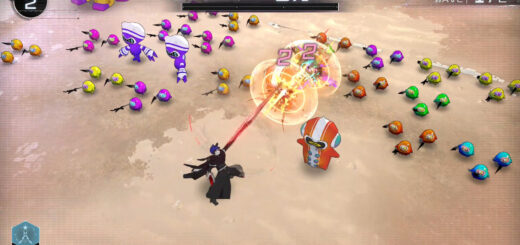
Battles unfold in a turn-based fashion, with the player able to issue commands to any of their characters as long as enough AP (action points) are available. Performing skills, taking a defensive stance, or dashing requires one AP. The player gains a set amount of AP each turn and can choose to end their turn even if there are still some AP left, which allows them to carry over the remaining AP to the next turn. Players can spend all their AP issuing command to the same character; however, after a character takes an action, they are affected by the Fatigue status ailment, which limits their movement until the next turn. Fatigue can be cured by taking a defensive stance or using certain skills or items. Thus, players can’t abuse their strongest characters without a few drawbacks. This contributes to a balanced battle system, where the player must account for Fatigue and prioritise using different assets to secure victory.
The Hundred Line‘s battle system isn’t subject to random occurrences such as critical hits or missing targets. The skills always deal the damage indicated in their description unless the target coated themself with an armor effect, which reduces the damage sustained by the value shown next to the armor icon. This further emphasises the tactical dimension of the game, and prevents it falling into the whims of randomness.
As the player’s units deal or sustain damage, a voltage gauge increases, with 300% as maximum value. By expending a “100%” stack of this gauge, player characters can take various actions that don’t consume any AP such as increasing their attack, acquiring passive abilities, or increasing AP. This makes the voltage gauge a powerful asset capable of turning the tide of the battle. This is even more true considering the voltage may also be used to unleash special skills, which are powerful skills that cover a large area, but leave the characters who used them unable to act during the next turn. Interestingly, if characters are dangerously low on HP, they can also use these skills by expending their life instead of the voltage gauge. The game rewards the use of such dangerous tactics by tremendously filling the voltage gauge. While the benefits of this tactic are evident, the players must carefully gauge the right time to rely on it, as it comes at the cost of the fallen character(s) being unavailable until the next wave of enemies.

Shouma may not think highly of himself, but he is a dependable ally.
The magnificence of the blend between the story and tactical gameplay doesn’t solely reside in their individual strengths, but also in the way they efficiently interact with each other. During battles, the player must fight waves of enemies with various winning or losing conditions that are dependent on the narrative: preventing the academy’s barrier destruction, rescuing a character on the battlefield, defeating all enemies, resisting a large-scale onslaught for a number of turns, and more. The variety of objectives during story missions help keep gameplay fresh. With their hordes of enemies and gimmicky bosses to defeat, the battles fittingly convey Takumi and his friends’ desperate struggle to protect the Last Defense Academy. The ability for the Special Defense Unit members to be resurrected is also accurately conveyed in gameplay, with the dead player characters coming back to life after each wave. Even the characters’ skills rightfully translate their personality. For example, the overly pacifist but resilient Shouma Ginzaki has only access to skills that focus on absorbing damage and eventually redirecting it to enemies.
The Hundred Line has different visual presentations that are all well-crafted in their own right. The cut scenes, which play out to highlight key moments of the story, boast gorgeous 3D graphics that can easily pass for decently budgeted anime production. While the 3D graphics in combat aren’t as polished as the cut scenes, they are detailed enough to let players admire the flashy class armors of the Special Defense Unit. This is especially true when Takumi and his teammates perform their Special Skills for which the camera zooms in to let the player become a privileged spectator of the stylish and deadly choreography. Exploration through the academy and certain buildings is presented in stunning 2.5D graphics, where players can interact with expressive and detailed 2D sprites of other characters. At last, the countless hand-drawn CGs beautifully capture the importance of key scenes.

One of the smiles Takumi is fighting to protect.
From the calm and soothing tune of the daily life at the academy to the eerie composition that echoes with the latest grim development, and the goofy moments’ upbeat piece between, the music fits the tone and atmosphere of the scenes it is paired with. The voice acting perfectly conveys the palette of emotions seen on screen. The proper use of pauses in characters’ speech serves to show their hesitation, shock, or disbelief during emotionally charged moments. Unfortunately, the number of unvoiced lines is more abundant than dialog that benefits from voice acting. However, this doesn’t compromise the overall experience thanks to an effective presentation that doesn’t miss the opportunity to voice or even animate the most important parts of the story.
The Hundred Line -Last Defense Academy- is a wonderful experience where adventure and tactical RPG have been mixed in ideal proportions to deliver an engaging tale. The sheer number of endings ensures dedicated players will have their fill, while the quality of these endings is assured to satisfy those who have less time to spare and can’t afford to clear multiple routes. The Hundred Line -Last Defense Academy- is an exquisite blend of genres that lets the player loses theirself in its well-crafted immensity where each final destination is worth the travel.
Disclosure: This review is based on a free copy of the game provided by the publisher.


Great story with many twists and turns
Lovable and entertaining cast
Well-balanced battle system
Many endings with satisfying conclusions
A few character 2D sprites don't fit in the background
More voiced lines would be appreciated






Recent Comments