Teenage Mutant Ninja Turtles: Splintered Fate Review
Same Shell, Different Day
It’s a great time to be a fan of the Teenage Mutant Ninja Turtles: there was last year’s movie, a brand-new series set to hit streaming shortly, and a handful of games recently released, including an HD collection of vintage hits, two arcade style beat-‘em-ups and now this port of an action roguelike. Whether you’re new to the series, a grizzled veteran, or introducing your kids to it, the long-lasting franchise has as many iterations as it does art styles, with a little bit of something for everyone. Expanding its ranks of potential fans, Teenage Mutant Ninja Turtles: Splintered Fate is now available on Nintendo Switch after being released on Apple Arcade last year. Boasting an engaging gameplay loop, multiplayer options, and a sharp art style, Splintered Fate provides hours of single and multiplayer fun.
The story is simple enough for newcomers, but peppered with enough fan service for long-time fans of the shows or deeper universe. Splinter, the turtles’ father figure and mentor, has been abducted by iconic series villain Shredder. The boys chase after him, traveling through portals to a bevy of locales while squaring off against the Foot Clan, homicidal robots, and a revolving door of mini and full-sized bosses including a few surprises for series stalwarts. Each brother is well represented in terms of combat style and characterization, with plenty of suitable quips, references, and signature weapons.

Each turtle’s personality is reflected in their fighting style.
It’s clear the development team did its homework to create something to satisfy even die-hard Turtle enthusiasts, while still being accessible to those with only a cursory familiarity with the series. The story isn’t afraid to wink at its audience, with characters aware of the repetition: when players face Leatherhead, the first boss during a second run, he recognizes this is the second go around. The gameplay mechanics are frequently referenced, with the turtles commenting on how odd it is to receive power-ups and artifacts from allies or even enemies, and doubly so with how they keep having to return to square one every time they get a thrashing.
The gameplay loop quickly establishes itself as players choose a turtle — each with their own distinct advantages — and set out across a handful of stages, accumulating scrap, coins, and other tokens to provide power-ups. These range from short-term ability boosts, but also permanent upgrades such as health or stat increases or more effective abilities. When the turtle runs out of health, he is warped back to the lair in the sewers to start another run at it, having retained the power ups and collectibles from previous runs. Each attempt has players restarting their portal hopping, with the level layouts and changing with each run. Mid-level bosses change with each run, and even dedicated end-level bosses have different modifications each time.

Character art is beautifully drawn
To the uninitiated, it might sound daunting and repetitive, but the repetition is the point, with acclimated players quickly slicing through stages. This Groundhog’s Day approach is very much a defining feature for the subgenre, and with a combat heavy game like this one, it works. There is a feeling of progress with each run, and while it may be frustrating to run out of health just before a stage’s boss, the player is validated for the time spent as they can see the turtle grow stronger with each attempt. It’s pleasing to have the turtles grow stronger in ways that aren’t found in the franchise’s other titles. Likewise, the feeling of failure quickly gives way to a hopeful feeling that perhaps this time, coming back with both what has been learned and gained from before, things will be different. Within the narrative, it’s a feeling the player shares with the characters.
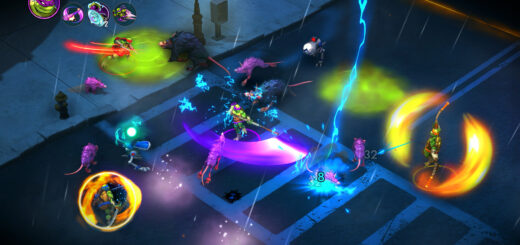
Combat allows players to launch standard attacks as well as two special attacks that require a brief reload time or recharge slowly as standard attacks land. There is depth and customization inherent to the game’s combat abilities, as they are powered up or swapped out. Not only is each turtle’s combat style different, but they can also be tailored to individual player preferences through the intricate layers of stackable power-ups and buffs. Finding and taking advantage of elemental power-ups during a rainy level or obtaining throwing stars mid-level and knowing to save them for a busy room or boss fight significantly alters the playing field and inform which available tactics to use.
Once a room has been cleared, a power-up reward can be selected and players move on to the next, stopping once or twice per stage at a shop where scrap and tokens can be exchanged for health-replenishing pizza or other buffs. Combat is simple to grasp but proves tricky, especially when the onscreen action becomes quite frantic. Players must manage health and avoid incoming attacks with well-timed dashes while plowing through enemy waves. If unsuccessful, the turtle is whisked away back to the lair to try again and again.
Splintered Fate has a pronounced art style that is evocative of many earlier iterations while also maintaining a unique identity. Locations are varied and colorful, with a slight Saturday morning-cartoon aesthetic that is reminiscent of the 1980’s cartoon. The character portraits on display are crisp and fresh, bringing to mind both the classic comic art-style and the 2003 television series, while the in-game graphics seem more akin to the 2012 Nickelodeon-era. Similarly, soundtrack themes sound new but vaguely familiar. Stellar vocal performances for the Turtles and their cohort bring the turtles to life and add a sense of authenticity. The game features voice talents like Dominic Catrambone, who voiced Leonardo in the 2012-series, as well as Yuri Lowenthal and Roger Craig Smith, who only sound as if they have voiced turtles in the past. Similar to the art style, this blend of old and new feels fresh.

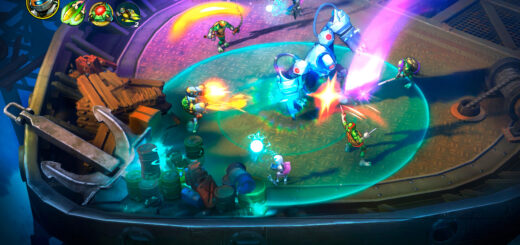
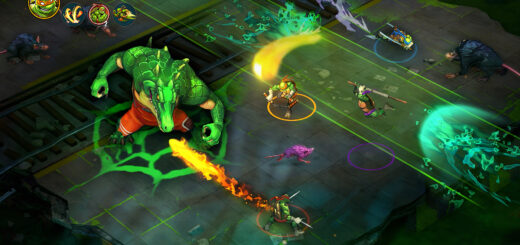
Boss fights are bombastic encounters.
With this freshness in presentation and intentional repetition in gameplay, Splintered Fate is best played in short bursts. Simply repeating the first stage so frequently becomes cumbersome, even with the little differences in each run. There are other issues that diminish the overall experience. It’s onerous to play online due to the lobby structure. It’s not possible to simply pair up with random players with a button press, but rather players generate a unique code when creating a lobby and then share it with others to join. Without online friends to play with, it becomes impossible to play co-op without your comrades physically sitting next to you.
This lobby system is outdated and doesn’t mesh well with the Switch’s limited online connectivity, so despite best efforts, it feels impossible to natively find other players. Similarly, the load times are practically unacceptable. Sometimes a loading screen’s progress bar will slowly fill before feeding directly into another loading screen. Toss in a few crashes, and Splintered Fate doesn’t seem particularly well-suited for the seven-year-old hardware.
Despite these technical flaws, Teenage Mutant Ninja Turtles: Splintered Fate stands out amongst the sea of TMNT games. Sure, it might at times seem like a Turtles-skinned Hades clone, but the roguelike aspect gels quite well with the franchise. The game doesn’t reinvent things, and its appeal may be limited to fans of the series or roguelikes. Yet for those who are drawn to the gameplay loop, there is an addictive experience here. The turtles might be stuck in a time loop, but Splintered Fate’s smooth combat, availability of multiple playstyles, and snappy presentation make sure it’s an entertaining, if somewhat bumpy, ride.
Disclosure: This review is based on a free copy of the game provided by the publisher.

Hades, but Ninja Turtles
Authentic TMNT vibes
Immersive voice acting
Customizing the Turtles is great fun
Hades, but Ninja Turtles
Loading times
Weak online multiplayer




Recent Comments