Super Robot Wars Y Review
Lady Zechs, Where Are My Keys?!
I have been in a twenty-year relationship with a giant robot nerd. Over the course of our relationship, my husband has spent a large amount of time building my giant robot franchise knowledge, from the seventies classics to the current crop of new shows that have plenty to offer. I’ve watched him play multiple Super Robot Wars games, complaining in the background as to why he wasn’t using some of my favourite characters, or why JAM Project’s “Heats” from Shin Getter Robo wasn’t playing on repeat. It was to his surprise that he found me on the couch with a PlayStation 5, a copy of Super Robot Wars Y, and an intense, newfound addiction. That’s right — I became addicted to Super Robot Wars Y, and I’ve learned the joys of smashing the robot toys together in what I believe are plotlines made up by children as a way for all these franchises to come together and create epic crossovers.
Super Robot Wars Y begins with the player selecting between a male or female protagonist who is a member of a stealthy organization known as NINJA, which stands for New Infinity Neuron Japanese Assassin. They are tasked with protecting Echika, a wealthy young girl who, on her fourteenth birthday, learns that she is the official leader of the A. Advent, a mobile city-state. With her new bodyguard and crew in tow, Echika and her comrades must handle potential invasions from nefarious world organizations, kaiju attacks, and more. Along their journey, they meet and recruit fan favourite characters from popular anime franchises and thus begins this bonkers adventure.
Part of the joy that comes with Super Robot Wars Y is being able to see how all the different characters from various franchises interact with one another. With twenty-plus series being represented, some for the first time, there are tons of fun and hilarious story beats throughout the game, such as adults wanting a break from the younger protagonists. Then all hell breaks loose, to the excitement of a pop concert being invaded by enemy forces. Nothing in Y ever feels normal, with every bit of the game’s fifty-plus hour story maintaining its high Saturday morning cartoon energy from start to finish. There is so much energy and vibrancy in this cast, with some of the best interactions coming from Takuma from Getter Robo Arc and Domon Kasshu from Mobile Fighter G Gundam. Even if one is unfamiliar with a franchise on screen, the game does a great job of providing a wealth of information about the stories and characters within it. While this reviewer wasn’t familiar with Reideen the Brave or Combattler V, the game’s battles provide so much storytelling that it will make one want to explore those series after turning the game off.

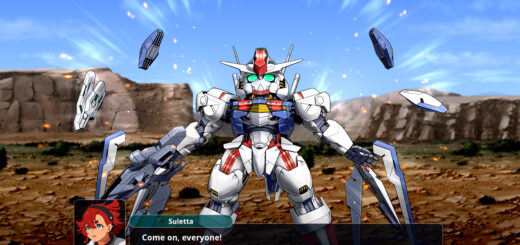
Making her franchise debut… Suletta Mercury!
There are so many stories being told at once throughout the fifty-plus hours it takes to complete a playthrough. It creates a story whiplash, as every franchise and original character gets their own main stories and side stories that must be completed. However, the game blends different franchises, particularly if they already have a connection (such as Mazinger and Getter Robo Arc being created by Go Nagai), together fairly seamlessly. One of the more fun elements is seeing how all the Gundam pilots across franchises react and interact with newcomer Suletta Mercury from Witch from Mercury, especially given her hard-loving Golden Retriever vibes. Many of the franchises have similar themes across the board, such as the horrors of war, the apocalypse, and fighting for those who cannot protect themselves. Even the original characters for Y are all likeable, charming, and play nice with all of the other franchises. Where the story struggles is more based on a player’s preference for a particular franchise, in this case a personal dislike for the storylines focused on Majestic Prince or Macross. One’s mileage will vary, as some characters and plotlines are just more engaging than others.
What is notable to the Super Robot Wars franchise is the fact that a lot of the game’s narrative is told during combat sequences, and Y is no different. While a lot of the story sequences are visually flat-looking with talking heads, the actual stories being told are interesting, with every story combat section having its own twists and turns, from different mustache-twirling villains appearing to new friendly units joining the fray. Part of the game’s overall charm really boils down to the excitement of who is joining the team and the badass introduction they receive.
Battles are tactical affairs wherein the player places a number of units onto the battlefield. During combat, players will be able to move, attack, use spirit commands, and assist links. While moving and attacking are straightforward, spirit commands are skills possessed by each unit, which allow them to power up, heal, move faster, or dodge better. As the game progresses and pilots level up, they acquire more unique spirits, such as the ability to take more turns or supercharge themselves to have all the spirits bestowed upon them. Every unit has a set amount of spirit points, and managing them is crucial to how combat players out.

Don’t mess with Team Getter!
As units take out enemies, they fill an assist gauge and, depending on the number of points in that gauge, they can also summon support help during battle, including healing, extra damage output, or energy refills. A lot happens during combat that players need to be aware of, and while it may be overwhelming at first, once it all clicks, specific mech units begin to feel like wrecking balls, mowing down enemy grunts. Combatants also have morale, and as it increases, so does their damage output or, in the case of specific units, allows them to move into their Super Mode, allowing them to harness specific abilities that cannot be used initially. Once morale has hit its peak, battles become a glorious, chaotic charge, and watching the damage output go up is hugely satisfying.
That being said, there is a lot to manage during combat. Some missions will have players babysitting specific units, especially if the player likes to stick to the same few each battle. Therefore, it’s important to bust out lower-level units to ensure that they level up and can stay alive when forced into action. Battle conditions can change on the fly, and players need to be able to adapt quickly, meaning having a good variety of long-range and close-combat units becomes important. During the enemy phase, players will need to endure onslaughts of foes, either using spirits to avoid taking a hit or trust in a unit’s ability to tank them. There’s a lot of risk and reward in Y‘s battle system, and sometimes bad draws will occur. Still, part of what makes it so engaging is how unpredictable combat can be, and having to weigh one’s options with a lot of thought and consideration.
Unit placement plays heavily into strategy, and one distinct element to the series is that certain moves can only be done while standing still, but often have a much larger range. Units like Heavyarms Custom from Gundum Wing benefit from being stationary, as its range is larger than other units. The other thing to consider is how many enemies a player can hit in an attack, and that’s where Map Attacks shine. There is nothing more satisfying than blowing up multiple enemy units in one attack, but the downside is that Map Attacks require specific placement to even become available to the player. There is so much to consider during combat; rushing in is almost always a recipe for disaster, but playing too methodically has its drawbacks as well.

V-V-V-Victorrrrrrrry!
There is an intermission phase after each mission where players can level up pilots with new skills or upgrade mechs to have more mobility, sight, and even weapon power. Upgrading units to certain points will also grant them additional passive skills. Unfortunately, there are a lot of menus to comb through, and overwhelmingly so. These menus also don’t do a great job for newcomers in terms of understanding what a lot of the game’s jargon is, and having to reference the glossary frequently is not great. Clicking through so many menus to find specific information, be in a unit’s equipped spirits or basic statistics, is a cumbersome experience. It also doesn’t help that buying skills and upgrades is very expensive, meaning the player will need to play through some of the skirmishes that are meant for grinding, unnecessarily adding to an already long runtime. There are a lot of parts and skills that feel superfluous, and trying to weigh their pros and cons due to the game’s jargon is boring to say the least, when all one really wants to do is smash the toys together.
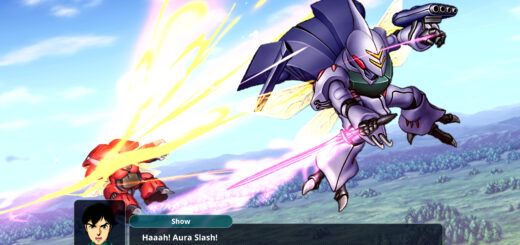
In keeping with the series, Super Robot Wars Y‘s visuals are adequate, though it’s clear the majority of the budget went to animating the attacks performed by the various mecha and super robots. These animations are stunning, rich with detail and colour, and do a great job of showing how absurd certain character attacks can be, such as Domon Kasshu and Rain from G Gundam performing Love Love Tenkyoden and having the dance animated while they yell the importance of both their love and how their hands are burning red. That being said, the still frame moments during the story portions are bland, with very minimal facial expressions, and while there are so many characters to keep track of, certain franchises look the same and uninspired. There are only a handful of different types of maps, such as space, mountain, and forest. There are only small changes to give them a bit of difference, likely in the form of a plot-related building, making them serviceable but uninteresting. In contrast, a lot of the robot spirits are distinct looking, meaning players won’t get confused by who is who.

SHIIIIIIIIIININNNNNG FINNNNNGER!
The game’s soundtrack, however, is amazing. Not only are players treated to each unit’s theme song, but the game’s original music will have players rocking out and having a grand old time. Hearing “White Reflection” from Gundam Wing Endless Waltz while the Wing boys attack never gets old, while the cheeky 1970s-vibe Reideen and Combattler V theme songs are earworms that one will find oneself humming along to, even when least suspecting it. There is a fantastic mixture of theme songs, as well as more somber tunes for the game’s more serious moments, and more upbeat and playful tracks when Y isn’t taking itself too seriously. Listening to the game’s soundtrack during all aspects, from combat to story, is easily one of the game’s major highlights.
While there is absolutely more to gush about, the bottom line is that Super Robot Wars Y is a high-octane ride from start to finish. There’s so much to love here in terms of the game’s robust combat system, the excellent mixture of franchises that are both new and old, and a soundtrack that absolutely slaps. Having never previously played a Super Robot Wars game, I can confidently say that while there are a lot of systems and franchises to understand, once everything clicks, it becomes an addictive experience, making it great for newcomers. While not every franchise feels equal in its inclusion, I have been begging my husband to find ways for us to watch some of the shows I am less familiar with, thanks to their appearance in Y. Despite some flaws, Super Robot Wars Y is a complete joy to play, and it definitely has me wanting to explore more games in this long-running franchise.
Disclosure: This review is based on a free copy of the game provided by the publisher.

Smashing toy robots in battle is addictive
Soundtrack that absolutely slaps
Fabulous for newcomers
REIDEEEEEEEEEEEEEN
Too many menus
Not all plotlines are interesting
Majority of visuals are bland




My thoughts on this exactly. Thank you for the wonderful review. <3