Qliphah in Providence’s Shadow Review
A Shadow of Its Potential
I’ve always enjoyed RPGs that are willing to experiment, which is what first drew me to Qliphah in Providence’s Shadow. Set in a distorted version of Tokyo where strange phenomena spread across the city, the game follows delivery boy Soma Hoshigami and investigator Rena Hizuki as they become caught up in a growing supernatural crisis. Soma’s transformation leaves him caught between human and monster, while Rena is trying to uncover the truth behind the Aberrations and other strange phenomena spreading across the city. There is a good idea at the heart of the game, but the execution is so poor that it never comes close to realizing its potential.
Battles in Qliphah in Providence’s Shadow use a timing-based counter system. Whenever an enemy attacks, a small circle expands toward a larger one, and pressing the matching color button when they overlap counters the attack. If the timing is missed, the dodge action can cancel the attack and give the player a chance to try again. Successfully countering several attacks will eventually down an enemy, leaving it open to heavy damage before the process starts again. Soma Hoshigami and Rena Hizuki also have their own attacks and abilities, all of which come with cooldowns. Swapping between the two characters can help keep abilities available, but it unfortunately fails to make the battles themselves more interesting. Most regular enemies require a full cycle of counters and downs before they can be defeated, usually ending with an ultimate attack. That might be reasonable for tougher enemies, but having to repeat the same process against regular foes makes battles drag on far too long.

Keeping an eye on the timeline.
Difficulty options are available for players looking for a greater challenge, and higher settings also provide more research points, which can unlock additional upgrades. Unfortunately, the increased challenge mostly comes from giving enemies higher levels and more health, turning fights into battles against damage sponges. The same problems remain on every setting, with fights following the same basic pattern. Progression does at least offer more than traditional leveling, as completing battles grants access to passive skills. Most of these amount to relatively small stat increases, although some have a greater effect on character builds by improving one stat at the expense of another. Even then, the impact is difficult to notice in practice, and these abilities rarely change how battles are actually played.
Outside of combat, Qliphah in Providence’s Shadow uses a world map reminiscent of the ones found in Shin Megami Tensei games, with locations represented as selectable points across the city. These locations become investigation candidates depending on the current chapter and mission. Players have little freedom in deciding where to go, as missions clearly indicate which locations to investigate. Reaching one triggers a visual-novel-style cutscene that moves the story forward. It is a simple way of handling exploration; the downside is that the world feels like a menu. There is nothing inherently wrong with this approach, but the repetitive gameplay makes progression feel like a slog.
The story has an interesting premise, but Qliphah in Providence’s Shadow gets into it almost immediately without giving the setup any time to establish itself. Soma Hoshigami is caught in the middle of a conflict and absorbs something from the Aberrations, the monsters threatening the city, which turns him into a mutant. Mutants are effectively considered dead and are treated as such, yet Soma mysteriously retains his humanity. Rena Hizuki, the other main character, is initially cold and aloof toward Soma, and her character leans heavily into familiar anime tropes. The game also tries to inject some humor into the story, but it usually falls flat.
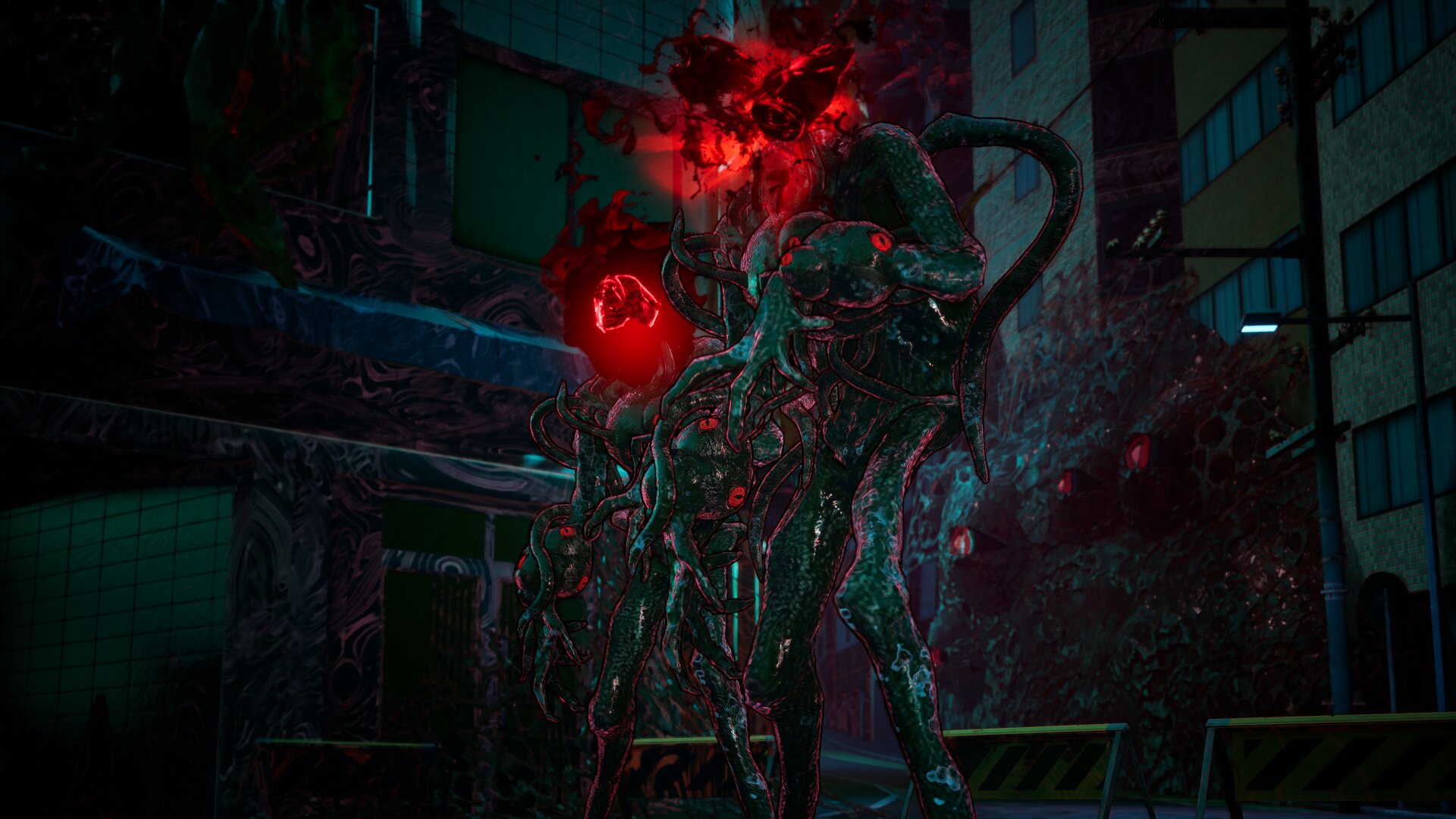
The Aberrations are truly grotesque.
That said, there are clearly some interesting ideas here. The spread of the “Tiny True” drug and a mysterious cult working behind the scenes give the story some decent concepts to explore. The problem is that the writing focuses too much on telling the player what is happening instead of showing it, while plot conveniences and occasional deus ex machina moments make the narrative increasingly difficult to take seriously. Soma and Rena’s relationship also develops over the course of the story, but the progression never feels particularly organic. Like the gameplay, the story has some strong ideas but never does enough with them, which is a shame because the atmosphere is actually quite effective. It feels like a missed opportunity to do something more interesting with the setting.
The visuals are rather basic, sticking to a simple anime-inspired style, albeit with a more distinctive, darker presentation. Character models are serviceable, but the environments are where the presentation suffers. Because of the game’s structure and the lack of any real exploration, battles repeatedly take place in the same handful of areas. As for the cutscenes, the visual novel-style scenes are generally fine, and, in some ways, preferable to the repetitive 3D environments used throughout the game. The soundtrack is also unremarkable, although it is certainly not bad. Regular battles have a decent beat to them, while the music becomes a little more tense during boss fights. Nothing really stands out, though, aside from the opening theme, which is a fairly catchy anime-style track.
Sadly, Qliphah in Providence’s Shadow is a slog from beginning to end. The combat is repetitive from the start, as every fight becomes the same sequence of counters and finishing attacks. The progression system has plenty of upgrades to unlock, but they all leave the same tedious combat intact. The story has some interesting ideas; the writing fails to make them work, and the decent atmosphere is wasted. The basic visuals and repetitive environments are another drag on the experience. Although there are a few good ideas here, the game is simply not much fun to play. RPGamers who want something different may find Qliphah worth a look, but it is ultimately difficult to recommend.
Disclosure: This review is based on a free copy of the game provided by the publisher.


Dark, effective atmosphere
Interesting premise
Extremely repetitive combat
Limited environmental variety
Story relies too heavily on exposition



Recent Comments