LumenTale: Memories of Trey Review
Split in Two Like Talea
Sometimes indie studios dream bigger than the make-believe worlds they create. If players are lucky, the issues with these dreams can be superficial and buffered out with patches; other times, they are inherently baked into the DNA of the title. In Beehive Studios’ creature collector LumenTale: Memories of Trey, it is largely the former, with a few flaws that will be hard to escape. A solid foundation of fun creature designs, a fun story, and a surprisingly customizable battle system are several aspects of the game that work well, though each with their own caveats.
Young Ales is out exploring near his town, being mindful to avoid any Animon due to a fear of them after a few killed his parents, when he comes across someone collapsed in a field. When this stranger, the cyborg Trey, awakens, a reboot sequence is initiated, and he finds he has no memory of what brought him there. Ales’ uncle Kapan, the local scientist, has never seen the cyborg parts that Trey uses and suggest that he becomes an Animon trainer called a Lumen to traverse the world to gain knowledge. After a giant Animon levels the sleepy town they are in, destroying many houses, Ales joins Trey on the journey for answers. They are soon joined by Nada, a young girl who ran away from home to learn more about herself and see the world. Ales and Nada’s wide-eyed innocence and journeys of self-fulfillment help pull Trey out of his shell, making the core journey an enjoyable experience.
Ales and Kapan’s town is in the center of the continent of Talea. Each half of the continent is used to being hostile with the other side. Mythos, in the south, is rooted in tradition and spirituality, while Logos takes a more scientific approach and always seeks new ways to innovate and progress. Trey has an early option to explore either Mythos or Logos first to begin the journey. Every decision affects the story in ways that grow more pronounced towards the end of the title, but both halves of the continent will be explored before the journey ends. Every city has a self-contained story, all of which follow a similar path, and range from middling to very interesting. The basic setup for cities in LumenTale: Memories of Trey is: there’s something off, the local Lumen captain refuses the match, Trey does some digging and uncovers what feels off, a big boss fight ensues, followed by a match against the captain and three other Lumen. At the very least, each story is presented thematically different, but that underlying formula is easy to figure out, making most of the enjoyment come from how the story tinkers with the similar premise each time.

Each of the cities of Talea have their own unique aesthetic.
Kapan gives Trey a choice from five starter Animon and a Holoken to summon them to start his journey. With plenty of random encounters and other ways to level, the difficulty is not very high in LumenTale: Memories of Trey, so it’s easy enough to just pick a team of varied favourites to succeed with. There are 158 Animon in total, including regional variants and evolved forms, and a list of thirteen types that they belong to, that all have their own resistances and weaknesses to one another. Each Animon has a quirk from a base set unique to their species; for example, perfect accuracy but non-existent evasion that affects how they play. When this is combined with a large skill pool, potential hidden traits based on secret factors, and customizable base stats upon levelling up, no two Animon feel the same.
Swapping between Animon is as simple as going into the main menu. In the main menu there is a box that any unused Animon can be swapped out of. There is also a physical representation of this space called the Anispace, where training can be completed and using furniture bought, built, or found as treasure can be used to spruce the space up. This interior decorator can be fun, but doesn’t affect gameplay and resides entirely in an optional spot.
The ease of swapping out Animon is balanced by the annoyance of trying to figure out what special conditions need to be met for a lot of the Animon to evolve. With the game only providing cryptic hints for some of them, which are found through multiple in-combat scans of the Animon. In fairness, there are some that evolve by gaining levels alone, but the crazy requirements are frequent enough to be frustrating.
Traversing the overworld map, going from city to city, has Trey entering Areas. In these Areas, there are Animon roaming around, with available species possibilities shown on the map, and a few spots inaccessible without the use of a Holoken power. Holoken powers involve overcoming simple obstacles like using geo type to destroy boulders, or grass to swing across from a ledge to another. Only six Animon can be active at a time, and using Holoken powers requires an Animon in the party, which leads to frequent swapping. Cities are expansive set designs that feel empty as they just contain shops, story locations, and the occasional side quest prompt, with every house causing long load times. None of the easily found side quests added much beyond busy work to the story, and rewards were small enough that it felt easy to skip.

Burn baby burn, Fulgaze inferno!
Animon are seen onscreen and can be interacted with the physical form of the Holoken that acts like a yo-yo that can either catch or damage wild Animon. Catching starts a timed button press mini game for a higher chance to catch the Animon, or else it gets angry and chases Trey. Some Animon are just naturally aggressive, so players can use the other Holoken feature, where it zips out and damages the enemy before combat, or defeats them wholesale allowing for quick resource gathering and levelling, as experience is always shared with the active party. Resources are versatile and can use consumable recipes to create items that offer a variety of buffs, equipment to catch Animon, or consumable to heal the party, while camping at fountains. Fountains are landmarks found in every Area and can also fully heal while interacting with them.
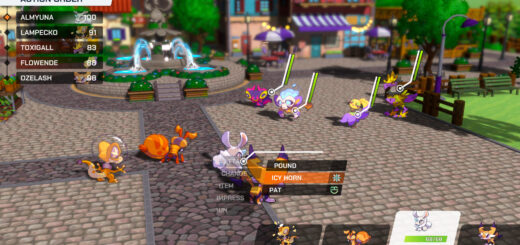
Combat in LumenTale: Memories of Trey is up to four-versus-four with up to six Animon on a team, including opposing Lumen. The quickest Animon move first, with weaknesses and resistances uncovered either through trial and error or by taking a turn to scan Animon. Then it becomes a match game of hitting as many weaknesses as possible, which leads to a free turn when done four times. Getting this extra turn makes even the most routine random encounters feel enjoyable. Turns begin with eight stamina points (SP) at default, and attacks can take anywhere from one to five points depending on the ability used, if a trait is utilized, quirks, or even the weather. Traits are inherent to every Animon and if used the ability will cost one more SP and have additional perks like causing an instant critical hit or healing other party members with a successful attack. Honestly, these traits and synchronicity can be easily forgotten and aren’t overly necessary for success, except for underlevelled Animon to try and succeed against stronger foes. If all SP are used when an Animon’s turn comes up, they can only pass their turn, so keeping that in mind adds a layer of strategy in combat. Boss fights are against giant Animon that not only move twice in a turn, but they only need to hit weaknesses twice to get a free turn. This can allow them to steamroll unsuspecting players, causing battles to heavily lean into discovering and exploiting weaknesses.

Collectible card artwork is truly gorgeous, however, there’s no practical point to collecting them.
LumenTale: Memories of Trey has a few serious flaws that undermine the entire experience. Loading times, whether it’s getting into a fight, transitioning from a house to the city street, or simply entering a cave can take anywhere from ten seconds to over a minute for the transition to complete. Other aspects, such as quick travel, are not mentioned in the tutorial manual, but instead have to be stumbled across by players, or waste a lot of time backtracking to complete quests. The combination of these two issues makes exploration feel like a chore, when there are fun puzzles to complete and new Animon to meet. These issues can be fixed with patches, but as they stand, they are recognizable detriments.
The Animon are all distinct, with a lot of use of colour, idle animations, and designs that are quite striking and adorable. They grow more distinct when the surprise evolutions are uncovered, and it can be fun to find them all. Similarly, there’s a collectible card system that shows some truly exciting artwork, but serves no practical in-game purpose. Basic areas have easy-to-follow maps, but there are special named locations that have puzzles and mazes in them that do not have a map to follow, which only adds to the feeling that exploration is not ideal. The soundtrack is average, as it focuses on simple repeated arrangements that make nothing stand out. The sound effects born from an Animon’s chatter-like calls are fun to hear and cut through the soundtrack.
LumenTale: Memories of Trey is a tale of two games. When everything is clicking, the combat, Animon designs, and story all feel really nice and leave a positive mark on the genre. Though the long load times make exploration feel like a chore, and hiding some features as well as evolution methods makes it get in its own way and take longer than needed. It can truly feel exciting to weave through Animon, shooting out the Holoken to catch or damage while solving puzzles, and learning about Trey’s past, but in the meantime, that quality title is buried underneath some flawed execution.
Disclosure: This review is based on a free copy of the game provided by the publisher.


Collectible card artwork is stunning
Plenty of varied Animon designs
Animon customization makes combat enjoyable
Loading times are a drain
Some key features feel hidden for no real reason





Recent Comments